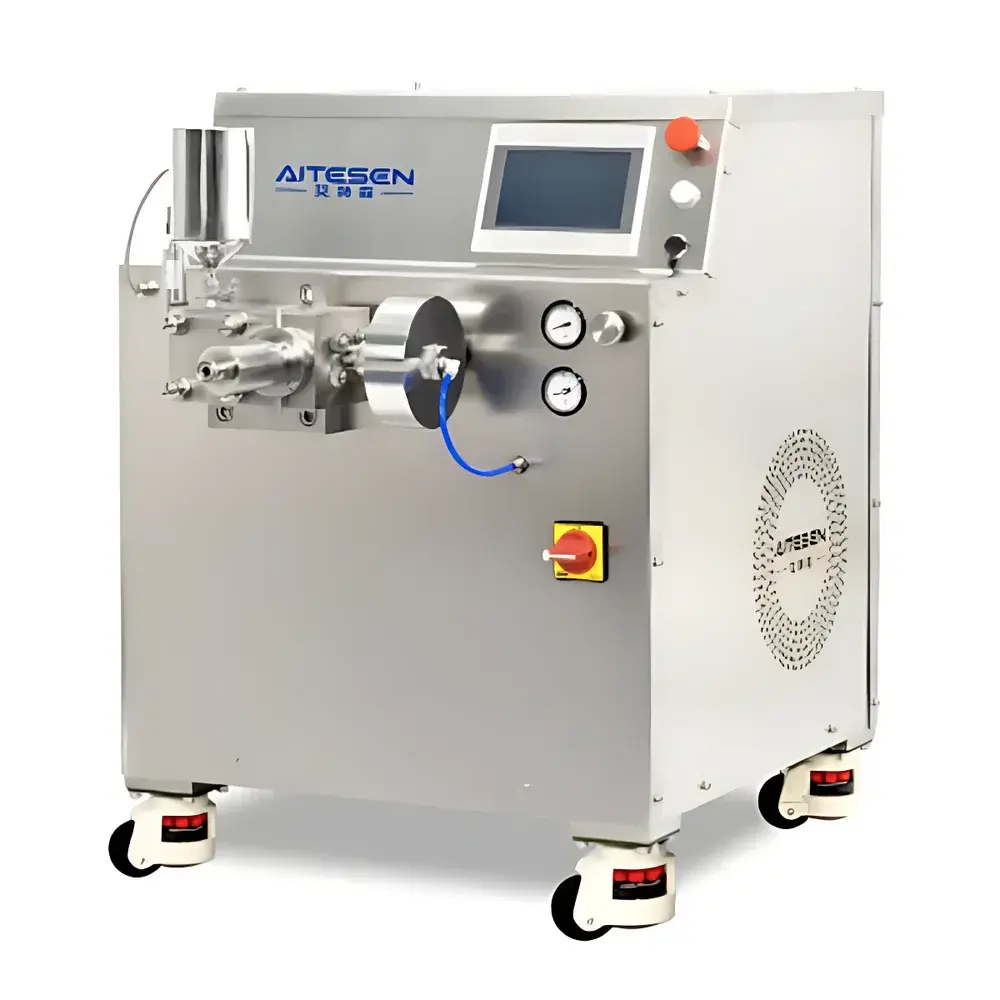
Aitesen HPH-L3 High-Pressure Homogenizer
| Brand | Aitesen |
|---|---|
| Origin | Jiangsu, China |
| Manufacturer Type | Authorized Distributor |
| Product Category | Domestic |
| Model | HPH-L3 |
| Max. Inlet Particle Size | 500 µm |
| Flow Rate | 10–40 L/h |
| Max. Operating Pressure | 1800 bar |
| Minimum Sample Volume | 30 mL |
| Noise Level | 65 dB(A) |
| Power Rating | 5.5 kW |
| Cleaning & Sterilization | Yes |
| Dimensions (L×W×H) | 658 × 868 × 920 mm |
| Weight | 280 kg |
Overview
The Aitesen HPH-L3 is a bench-to-pilot scale high-pressure homogenizer engineered for reproducible, scalable cell disruption and nanoemulsion formation under strictly controlled process conditions. It operates on the principle of turbulent shear, cavitation, and impact forces generated when a pressurized fluid stream is forced through a precisely engineered homogenizing valve—typically a fixed-geometry interaction chamber with adjustable pressure control. This physical mechanism enables efficient lysis of robust microbial cells (e.g., E. coli, yeast, and filamentous fungi), uniform size reduction of lipid vesicles (liposomes, LNPs), and stabilization of submicron dispersions including fat emulsions, suspensions, and nanomaterial colloids. Designed to meet the operational rigor of biopharmaceutical development and GMP-aligned manufacturing environments, the HPH-L3 delivers consistent particle size distribution (PSD) profiles with minimal thermal load and batch-to-batch variability.
Key Features
- Robust modular pump head constructed from SAF2507 super duplex stainless steel—resistant to erosion, corrosion, and high-cycle fatigue under sustained 1800 bar operation.
- Patented homogenizing valve system with fine-tuned pressure regulation via manual or pneumatic actuation; includes real-time digital pressure monitoring and programmable safety cut-off thresholds.
- Intuitive touch-screen HMI interface supporting multi-step protocol storage, pressure ramping profiles, and time-stamped event logging.
- Integrated data acquisition module enabling export of pressure, temperature (optional), flow rate, and runtime parameters in CSV format for audit-ready documentation.
- Modular expandability: compatible with optional PLC-based automation, variable-frequency drive (VFD) flow control, jacketed temperature management (±2 °C), multi-stage homogenization heads, closed-loop recirculation, and pre-filtration modules.
- Compliant with European Machinery Directive 2006/42/EC (successor to 98/37/EC), CE-marked, and designed to support validation activities per ISO 9001 and ISO 13485 frameworks.
Sample Compatibility & Compliance
The HPH-L3 accommodates viscous and particulate-laden feed streams up to 500 µm nominal particle size, making it suitable for crude lysates, fermentation broths, and pre-filtered lipid formulations. Its wetted path materials—SAF2507 valve seats, ceramic-coated plungers, and EPDM/FKM-sealed manifolds—are compatible with aqueous buffers, organic co-solvents (e.g., ethanol, isopropanol), and low-pH media commonly used in nucleic acid delivery workflows. The system supports CIP/SIP protocols and meets baseline requirements for GLP and early-phase GMP execution. While not inherently 21 CFR Part 11 compliant out-of-the-box, its data export architecture facilitates integration with validated electronic lab notebook (ELN) or MES platforms that provide audit trail, electronic signature, and role-based access control capabilities.
Software & Data Management
The embedded control firmware records all critical process parameters—including setpoint pressure, actual pressure deviation, total homogenization cycles, cumulative runtime, and alarm events—with millisecond-level timestamp resolution. All logs are stored internally and exportable via USB or Ethernet interface. Optional OPC UA or Modbus TCP connectivity allows seamless integration into facility-wide SCADA systems. For regulatory submissions, raw data files may be archived alongside metadata (operator ID, batch ID, calibration status) to satisfy traceability requirements under ICH Q5, Q7, and USP guidelines.
Applications
- Biopharmaceutical processing: bacterial and yeast cell lysis for recombinant protein recovery; preparation of mRNA-LNP formulations for vaccine development.
- Parenteral dosage forms: production of sterile fat emulsions (e.g., ClinOleic®-type), liposomal doxorubicin analogs, and nanocrystalline suspensions meeting USP light scattering specifications.
- Functional food & nutraceuticals: homogenization of plant-derived nanoemulsions, encapsulated probiotics, and bioactive polyphenol dispersions.
- Advanced materials: exfoliation of graphene oxide, dispersion of carbon nanotubes, and stabilization of cellulose nanocrystals for composite matrix applications.
- Process development support: paired with extrusion, tangential flow filtration (TFF), and lyophilization modules to form integrated pilot-scale LNP or liposome manufacturing lines.
FAQ
What is the minimum viable sample volume for method development studies?
The system requires a minimum of 30 mL for stable pressure build-up and representative processing; smaller volumes may be accommodated using a recirculation loop with dead-volume minimization accessories.
Can the HPH-L3 be qualified for use in GMP manufacturing environments?
Yes—when configured with documented IQ/OQ protocols, calibrated pressure transducers (traceable to NIST standards), and integrated with compliant data handling infrastructure, it supports Phase II/III clinical material production.
Is temperature control available as a factory-installed option?
Yes—jacketed homogenizer heads with Peltier or glycol-circulated cooling are available; temperature monitoring at the valve exit is supported via Pt100 sensor input.
How does the HPH-L3 compare to microfluidics-based homogenizers for LNP formulation?
Unlike fixed-orifice microfluidic devices, the HPH-L3 offers higher throughput, mechanical robustness for viscous feeds, and superior scalability from 10 mL to >20 L batches without re-optimization.
Does the system support automated cleaning-in-place (CIP) cycles?
Standard configuration includes chemical-resistant wetted parts and accessible disassembly points; full CIP integration requires optional programmable logic controller (PLC) and solenoid-valve manifold assembly.