
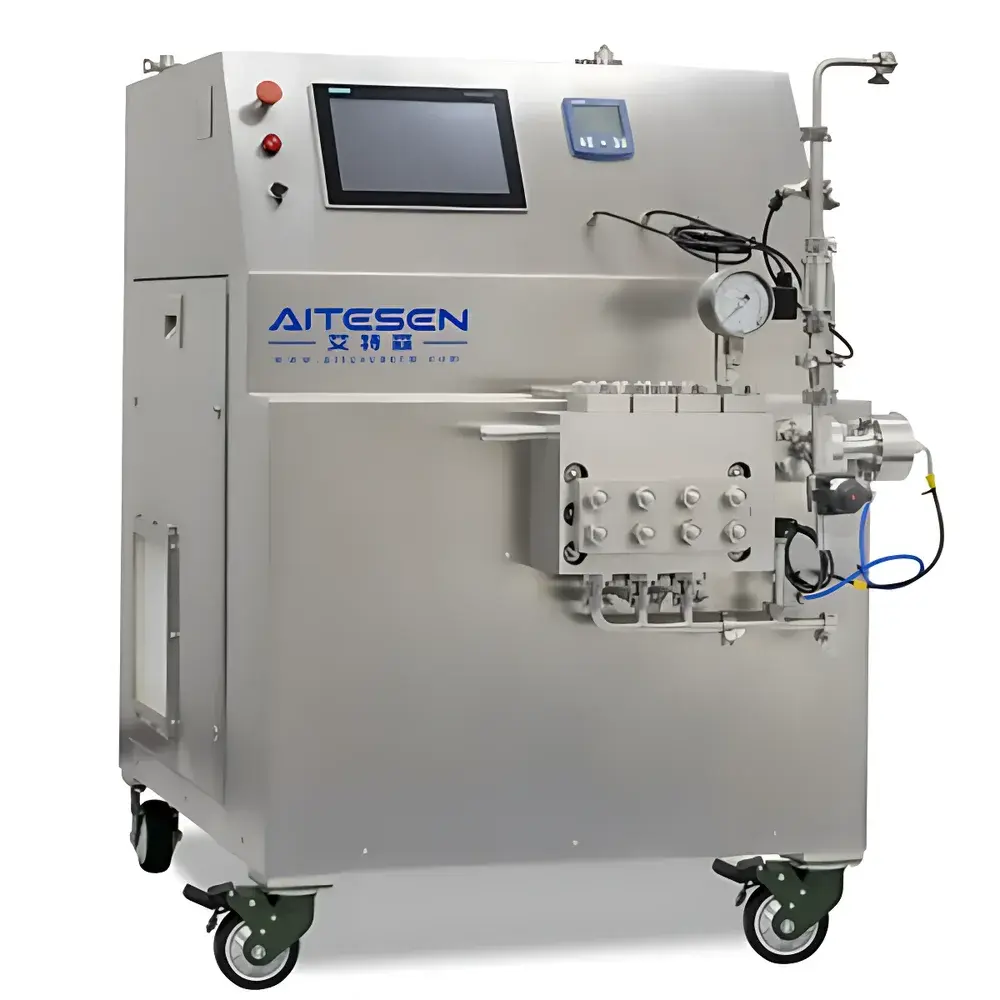
Aitesen HPH-P1 High-Pressure Homogenizer for Cell Disruption and Nanomaterial Processing
| Brand | Aitesen |
|---|---|
| Origin | Jiangsu, China |
| Model | HPH-P1 |
| Construction | Split-head pump design |
| Wetted Materials | SAF2507 super duplex stainless steel |
| Homogenization Valve | High-efficiency safety valve with precision pressure control |
| Drive System | Stable high-torque motor assembly |
| Control Interface | Touchscreen panel with real-time pressure monitoring and data logging |
| Pressure Regulation | Manual and pneumatic dual-mode adjustment |
| Safety Features | Programmable pressure limit with audible/visual alarm |
| Optional Modules | Variable-frequency flow control, auto-pressurization system, PLC-based automation, jacketed temperature control, multi-stage homogenization, closed-loop recirculation, pre-conditioning unit |
| Flow Rate Range | 80–2000 L/h |
| Maximum Operating Pressure | 1500 bar (standard), 1000 bar (high-flow variants) |
| Compliance | Designed to support GLP/GMP-aligned workflows |
Overview
The Aitesen HPH-P1 is a laboratory- and pilot-scale high-pressure homogenizer engineered for reproducible mechanical cell disruption, nanoparticle size reduction, and formulation stabilization across biopharmaceutical, nutraceutical, and advanced materials applications. It operates on the principle of controlled fluid shear, cavitation, and impact forces generated when a pressurized suspension is forced through a precisely engineered homogenization valve at pressures up to 1500 bar. This hydrodynamic mechanism enables efficient lysis of robust microbial cells—including Escherichia coli, Saccharomyces cerevisiae, and filamentous fungi—while preserving labile intracellular components such as enzymes, plasmids, and inclusion bodies. Unlike ultrasonic or bead-beating methods, the HPH-P1 delivers scalable, continuous, and thermally managed processing with minimal batch-to-batch variability—making it a critical unit operation in upstream bioprocessing and nanomedicine manufacturing.
Key Features
- Split-head pump architecture for simplified maintenance and reduced downtime during seal or valve replacement
- SAF2507 super duplex stainless steel wetted surfaces ensuring exceptional corrosion resistance against aggressive biological buffers, organic solvents, and acidic/basic formulations
- Patented multi-stage homogenization valve design enabling precise control over particle size distribution (PSD) and polydispersity index (PDI)
- Integrated touchscreen HMI with real-time pressure waveform visualization, event-triggered data capture, and CSV export capability for audit-ready records
- Dual-mode pressure regulation: tactile handwheel for fine-tuning and pneumatic actuation for rapid ramp-up or hold protocols
- Configurable safety envelope including programmable upper pressure limits, emergency depressurization circuitry, and interlocked access doors compliant with IEC 61508 SIL2 requirements
Sample Compatibility & Compliance
The HPH-P1 accommodates viscous, particulate-laden, and temperature-sensitive feed streams—including bacterial lysates, lipid suspensions, polymer melts, and ceramic slurries—without clogging or thermal degradation. Its modular construction supports optional jacketed homogenization chambers and inline heat exchangers for active temperature management (±0.5 °C control). The system is routinely deployed in environments governed by FDA 21 CFR Part 11, EU Annex 11, and WHO TRS 961 guidelines. Data integrity is maintained via time-stamped, user-identified log files with immutable audit trails. When integrated with validated SOPs, the HPH-P1 meets requirements for GMP-compliant production of liposomal doxorubicin, mRNA-LNP vaccines, sterile fat emulsions, and nanostructured excipients per USP , , and .
Software & Data Management
The embedded control firmware supports configurable process recipes, parameter locking per user role, and automated calibration verification logs. All pressure, flow, and temperature data are timestamped and stored locally with optional Ethernet/IP or Modbus TCP connectivity for integration into MES or SCADA platforms. Exported datasets include full-cycle pressure profiles, cumulative energy input (kJ/L), and valve wear diagnostics—facilitating predictive maintenance scheduling and regulatory submission packages. Audit trail functionality complies with ALCOA+ principles, capturing operator ID, timestamp, action type, and pre-/post-change values for every critical parameter modification.
Applications
- Biopharmaceutical: Gram-negative and gram-positive bacterial lysis, inclusion body solubilization, viral vector purification support, and LNP encapsulation of siRNA/mRNA
- Drug Delivery: Production of sub-100 nm liposomes, sterically stabilized micelles, nanoemulsions for parenteral nutrition, and crystalline nanosuspensions per ICH Q5A
- Food & Nutraceutical: Cold homogenization of probiotic suspensions, nanoencapsulation of curcumin or resveratrol, and stabilization of functional dairy emulsions
- Advanced Materials: Exfoliation of graphene oxide, dispersion of carbon nanotubes in polymer matrices, and size-controlled synthesis of cellulose nanocrystals
- Quality Control: Particle size reduction prior to filtration sterilization, endotoxin mitigation via shear-induced membrane fragmentation, and batch homogeneity validation
FAQ
What is the maximum allowable viscosity for feed material?
The HPH-P1 handles viscosities up to 5,000 mPa·s at inlet temperatures ≤40 °C when equipped with the optional pre-heating module and low-shear feed pump.
Can the system be validated for GMP manufacturing?
Yes—full IQ/OQ documentation packages, DQ templates, and traceable calibration certificates for pressure transducers and flow meters are available upon request.
Is remote monitoring supported?
Standard Ethernet interface enables secure remote access via TLS-encrypted web server; optional OPC UA gateway available for enterprise-level integration.
What maintenance intervals are recommended for the homogenization valve?
Valve service life averages 200–400 operating hours depending on abrasive load; real-time wear diagnostics are provided via pressure decay analysis in the control software.
Does the system comply with explosion-proof requirements for solvent-based processing?
ATEX Zone 2 / Class I Div 2 configurations are available with intrinsically safe instrumentation and purged enclosures—subject to detailed hazard assessment and custom engineering review.
Related Products





