
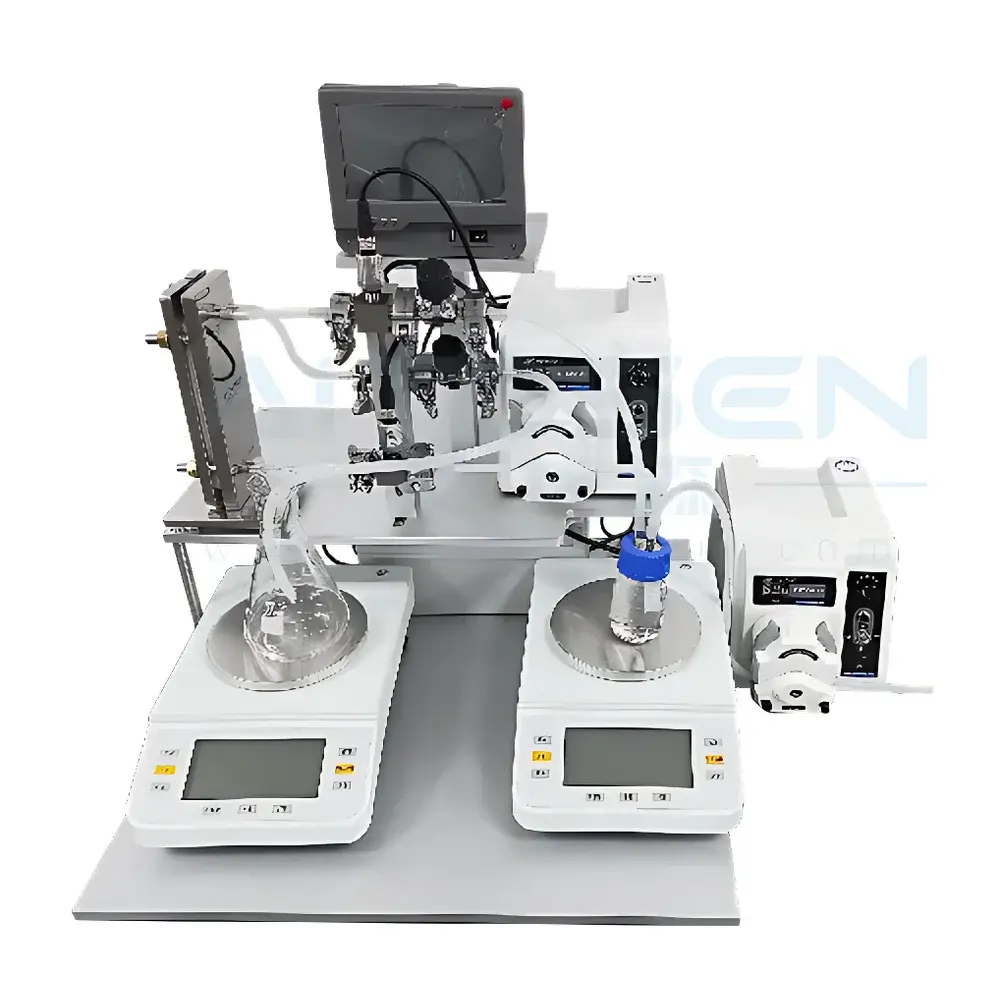
Aitesen LDS-L1 Laboratory-Scale Tangential Flow Filtration (TFF) System
| Brand | Aitesen |
|---|---|
| Origin | Jiangsu, China |
| Manufacturer Type | Authorized Distributor |
| Country of Origin | China |
| Model | LDS-L1 |
| Price Range | USD 14,000 – 28,000 |
| Minimum Sample Volume | 30 mL |
| Pressure Range | −1 to 5 bar |
| Flow Rate Range | 1–2200 mL/min |
| Weight Capacity | 0–4100 g |
| Displayed Parameters | Pf (Feed Pressure), Pr (Retentate Pressure), Pp (Permeate Pressure), TMP (Transmembrane Pressure), ΔP (Pressure Drop) |
| Operation Mode | Manual |
| Compatible Vessels | Glass or Stainless Steel Containers |
| Membrane Formats | PES or Cellulose-Based Cassettes & Hollow Fiber Modules |
| MWCO Options | 5–1000 kDa |
| Effective Filtration Area | 0.01–0.1 m² |
| Compliance | Designed for GLP-compliant lab-scale process development and tech transfer |
Overview
The Aitesen LDS-L1 is a manually operated, laboratory-scale tangential flow filtration (TFF) system engineered for precision process development in biopharmaceutical and advanced therapeutic modalities. It operates on the principle of cross-flow membrane separation, where feed solution is recirculated parallel to the membrane surface under controlled pressure—minimizing concentration polarization and fouling while enabling reproducible concentration, diafiltration, buffer exchange, endotoxin removal, and purification of sensitive biomolecules. Unlike dead-end filtration, TFF maintains consistent flux over time by continuously sweeping the membrane surface, making it indispensable for processing shear-sensitive nanocarriers such as liposomes and lipid nanoparticles (LNPs). The LDS-L1 supports early-stage formulation screening, scalability assessment, and parameter optimization prior to pilot- or GMP-scale implementation.
Key Features
- Manually adjustable peristaltic pump with calibrated flow control (1–2200 mL/min), ensuring stable recirculation without pulsation-induced membrane stress
- Integrated digital pressure monitoring across three critical points: feed (Pf), retentate (Pr), and permeate (Pp), enabling real-time calculation and display of transmembrane pressure (TMP) and pressure drop (ΔP)
- High-resolution weight-based volume tracking (0–4100 g, ±1 g resolution) via load cell integration, supporting precise endpoint determination for concentration and diafiltration steps
- Modular membrane compatibility—including standard PES and regenerated cellulose cassettes (0.01–0.1 m² active area) and hollow fiber modules—with molecular weight cut-off (MWCO) options spanning 5 kDa to 1000 kDa
- Chemically resistant wetted path constructed from USP Class VI-certified tubing and fittings; compatible with glass and 316L stainless steel reservoirs for solvent- and pH-compatible operation
- Compact benchtop footprint (W × D × H: 450 × 400 × 320 mm) with ergonomic layout for glovebox or biosafety cabinet integration
Sample Compatibility & Compliance
The LDS-L1 is validated for use with biologics including monoclonal antibodies (mAbs), recombinant proteins, viral vectors, mRNA-LNPs, siRNA-LNPs, polymer-based nanoparticles, and liposomal formulations (e.g., doxorubicin HCl liposomes, irinotecan liposomes). Its design accommodates low-volume (≥30 mL) samples typical of preclinical and Phase I material batches. All contact materials comply with ISO 10993-5 (cytotoxicity) and USP extractables testing guidelines. While the system itself does not carry CE or FDA 510(k) certification, its architecture aligns with principles outlined in ICH Q5A(R2), USP , and ASTM F838-20 for sterile filtration validation support. Data logging meets basic ALCOA+ criteria when paired with external compliant recording devices.
Software & Data Management
The LDS-L1 features an embedded LCD interface for real-time visualization of Pf, Pr, Pp, TMP, ΔP, and cumulative weight change. It supports optional analog output (4–20 mA) for connection to third-party data acquisition systems (e.g., LabVIEW, DeltaV, or custom SCADA platforms). Though no proprietary software is bundled, raw sensor outputs are timestamped and exportable via RS-232 or USB-C for post-processing in Excel or Python-based analysis pipelines. For regulated environments, users may integrate the system into electronic lab notebooks (ELNs) or LIMS with audit-trail-enabled hardware interfaces—ensuring traceability of critical process parameters during tech transfer documentation.
Applications
- Concentration and diafiltration of liposomal drug products under controlled shear and temperature conditions
- Buffer exchange and endotoxin reduction in plasmid DNA, mRNA, and LNP formulations prior to fill-finish
- Clarification and recovery of microbial or mammalian cell culture harvests—including whole-cell retention and debris removal
- Downstream polishing of monoclonal antibodies and fusion proteins following Protein A chromatography
- Process characterization studies supporting Quality-by-Design (QbD) frameworks per ICH Q8(R2)
- Feasibility testing of novel membrane chemistries (e.g., polyethersulfone, PVDF, or ceramic composites) under defined hydrodynamic conditions
FAQ
What is the minimum recommended sample volume for reliable operation?
The LDS-L1 is validated for volumes ≥30 mL. Lower volumes increase sensitivity to evaporation, air entrapment, and measurement drift—particularly during extended diafiltration cycles.
Can the system be upgraded to automated control?
Yes. Aitesen offers OEM-integrated PLC-based automation packages (LDS-L1-Auto) with programmable logic controllers, PID-controlled pumps, and Ethernet/IP connectivity—designed for seamless integration into GMP-aligned workflows.
Is the LDS-L1 suitable for organic solvent-based formulations?
With appropriate membrane and tubing selection (e.g., fluoropolymer-lined cassettes and Viton®-rated peristaltic tubing), the system supports ethanol-, isopropanol-, and DMSO-containing buffers up to 30% v/v.
How is cleaning-in-place (CIP) performed on this system?
Standard CIP protocols involve sequential circulation of 0.1 M NaOH (for protein removal), 20% ethanol (for lipid residue), and purified water—validated using conductivity and TOC endpoints per ISPE Baseline Guide Vol. 4.
Does Aitesen provide membrane compatibility guidance for specific drug modalities?
Yes. Application engineers supply MWCO selection matrices, flux decay curves, and recovery yield benchmarks for liposomes, LNPs, and viral vectors—based on internal DOE studies and client-reported performance data.




