
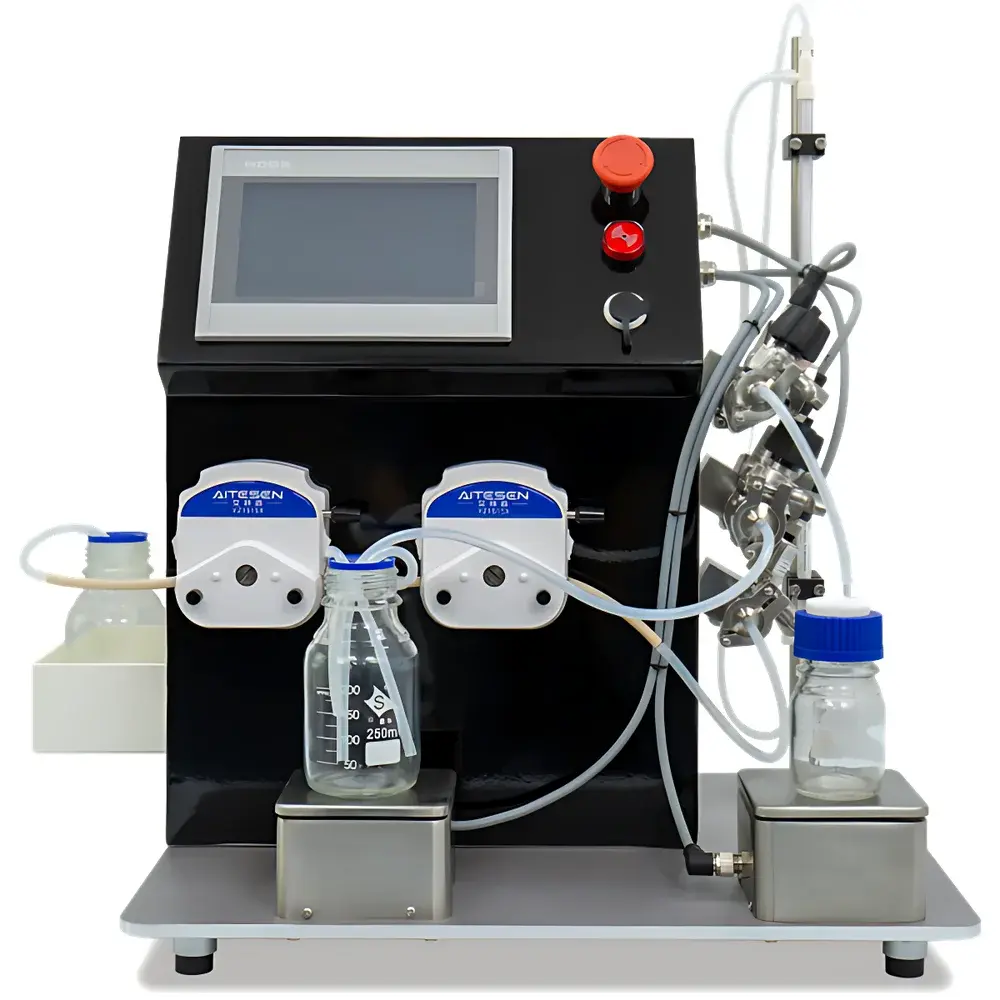
Aitesen LDS-L1 Tangential Flow Filtration (TFF) Ultrafiltration System
| Brand | Aitesen |
|---|---|
| Origin | Jiangsu, China |
| Manufacturer Type | Authorized Distributor |
| Product Category | Domestic |
| Model | LDS-L1 |
| Pricing | Upon Request |
| Minimum Sample Volume | ≤30 mL |
| Pressure Range | −1 to 5 bar |
| Max. Permeate Flow Rate | ≥2200 mL/min |
| Weight Capacity | 0–4100 g |
| Weighing Accuracy | ±0.5% |
| Real-time Monitored Parameters | Pf (Feed Pressure), Pr (Retentate Pressure), Pp (Permeate Pressure), TMP (Transmembrane Pressure), ΔP (Pressure Drop) |
| Compatible Membrane Formats | PES & Cellulose-based Cassettes and Hollow Fiber Modules |
| MWCO Range | 5–1000 kDa |
| Effective Filtration Area | 0.01–0.1 m² |
| Compliance | FDA 21 CFR Part 11 Audit Trail Ready, Designed for GLP/GMP-adjacent R&D Environments |
Overview
The Aitesen LDS-L1 Tangential Flow Filtration (TFF) Ultrafiltration System is an engineered platform for process development and small-scale validation of membrane-based separation in biopharmaceutical and nanomedicine applications. It operates on the fundamental principle of cross-flow filtration—where feed solution flows parallel to the membrane surface under controlled pressure, minimizing concentration polarization and fouling while enabling high-flux, reproducible separation. Unlike dead-end filtration, TFF maintains stable permeate flux over extended operation by continuously sweeping the membrane surface with recirculating retentate. This architecture supports precise control of transmembrane pressure (TMP), shear rate, and residence time—critical variables in optimizing recovery, yield, and product integrity for sensitive biomolecules and colloidal nanoparticles.
Key Features
- Automated, PLC-integrated control system with intuitive touchscreen HMI for full parameter programming—including ramped pressure profiles, timed hold steps, and endpoint-triggered transitions (e.g., volume reduction, buffer exchange completion).
- Real-time monitoring of five hydraulic parameters: feed pressure (Pf), retentate pressure (Pr), permeate pressure (Pp), calculated TMP, and pressure drop (ΔP)—all synchronized with gravimetric mass data from integrated high-precision load cells (±0.5% accuracy, 0–4100 g range).
- Dual-pump configuration supporting independent control of recirculation flow (≥2200 mL/min) and permeate withdrawal, enabling robust scalability assessment from lab-scale (≥30 mL minimum feed volume) to pilot-scale process mapping.
- Modular membrane interface compatible with standard low-protein-binding cassettes (PES, regenerated cellulose) and hollow fiber modules across MWCOs from 5 kDa to 1000 kDa and effective areas from 0.01 m² to 0.1 m².
- FDA 21 CFR Part 11-compliant software with electronic signatures, audit trail logging, user role management, and secure data export (CSV, PDF) for regulatory documentation and internal SOP alignment.
Sample Compatibility & Compliance
The LDS-L1 is validated for processing thermolabile and shear-sensitive biologics—including mRNA-LNP formulations, siRNA complexes, polymer nanoparticles, liposomal chemotherapeutics (e.g., doxorubicin HCl, irinotecan HCl, daunorubicin liposomes), plasmid DNA, monoclonal antibodies, and recombinant proteins. Its wetted path components are constructed from USP Class VI-certified materials (316L stainless steel, pharmaceutical-grade elastomers, and non-leaching polymers), ensuring extractables/leachables compliance per ICH Q5A and Q5D guidelines. The system meets design-for-manufacturing criteria aligned with ISO 13485 and ASTM F838-20 for filter integrity testing readiness. While classified as a research-use-only (RUO) instrument, its operational traceability and documentation structure support early-phase GMP process characterization studies and tech transfer to contract manufacturing organizations (CMOs).
Software & Data Management
The embedded Aitesen TFF Control Suite provides deterministic sequence execution, real-time curve visualization (TMP vs. time, mass vs. permeate volume), and automated endpoint detection based on user-defined thresholds (e.g., target concentration factor, final buffer exchange ratio). All session data—including setpoints, alarms, operator actions, and timestamped sensor outputs—are stored in an encrypted local database with immutable audit trails. Export functions generate ALCOA+ compliant reports suitable for inclusion in IND-enabling CMC sections. The software architecture supports integration with LIMS via OPC UA or RESTful API extensions for centralized data governance in regulated lab environments.
Applications
- Buffer exchange and diafiltration of lipid nanoparticle (LNP) suspensions post-formulation
- Concentration and purification of plasmid DNA prior to IVT reactions
- Removal of free drug and residual solvents from liposomal drug products
- Clarification and harvest of mammalian cell culture supernatants containing mAbs
- Size-based fractionation of extracellular vesicles and virus-like particles
- Process parameter screening (flux, rejection, shear sensitivity) to inform single-use TFF system selection for clinical manufacturing
FAQ
What membrane formats are supported by the LDS-L1?
The system accepts commercially available flat-sheet cassettes (PES, RC, PVDF) and hollow fiber modules with standard connectors (e.g., Sartorius, Repligen, Pall). MWCO compatibility spans 5–1000 kDa; effective area range is 0.01–0.1 m².
Can the LDS-L1 be used for sterile processing?
While the system itself is not autoclavable, all fluid-contact parts are compatible with SIP (steam-in-place) at ≤121°C for 30 min and chemical sterilization (e.g., 0.5 M NaOH, 30 min), enabling aseptic operation when coupled with pre-sterilized single-use kits.
Is remote monitoring supported?
Yes—via optional Ethernet/Wi-Fi module, enabling secure remote access to live data streams, alarm notifications, and historical session review through a browser-based dashboard.
How does the system handle viscous or particulate-laden feeds?
The dual-pump architecture allows independent optimization of recirculation shear and permeate flux; adjustable flow-split ratios and programmable pulsing modes mitigate fouling in challenging feeds such as lysates or crude fermentation broths.
Does the software support IQ/OQ documentation packages?
Aitesen provides vendor-qualified IQ/OQ templates aligned with ASTM E2500 and Annex 11 expectations, including test protocols for pump calibration, pressure transducer verification, and audit trail functionality validation.



