
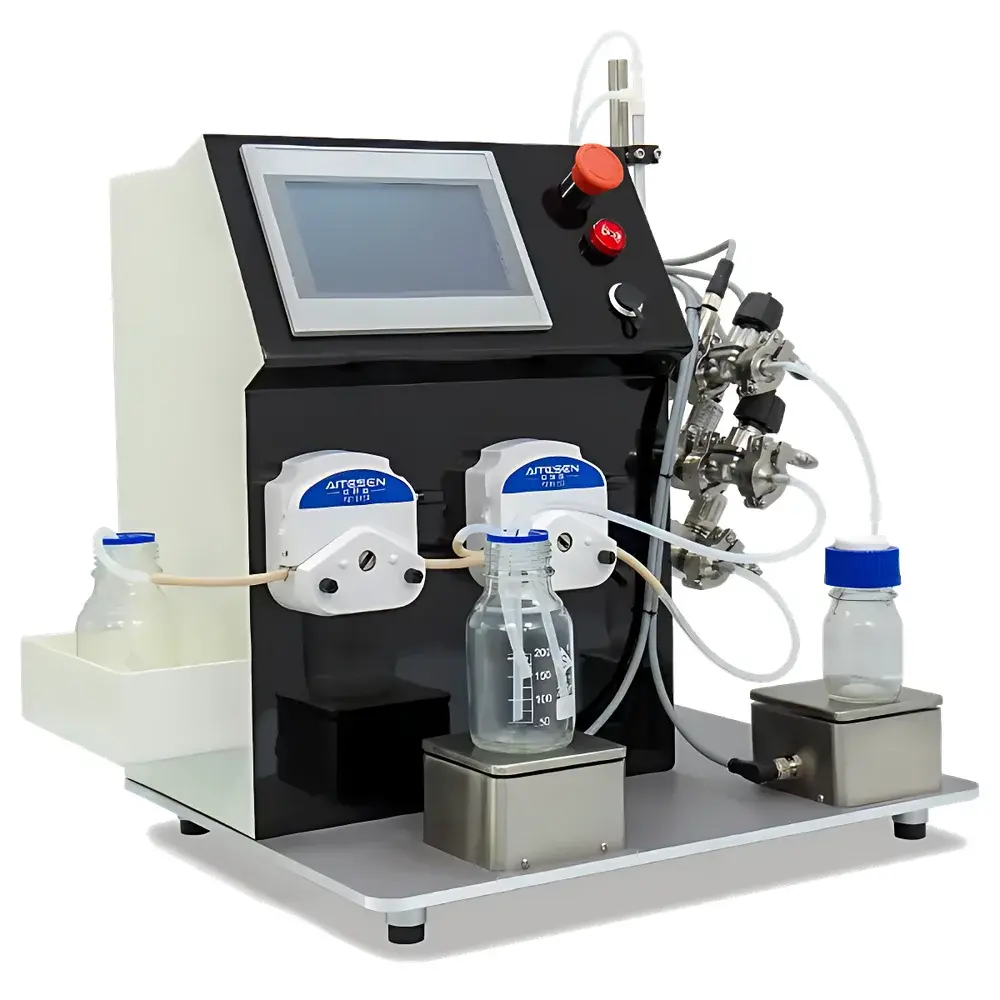
Aitesen LDS-L2 Laboratory-Scale Tangential Flow Filtration (TFF) System for Liposome and Nanomedicine Processing
| Brand | Aitesen |
|---|---|
| Origin | Jiangsu, China |
| Manufacturer Type | Authorized Distributor |
| Product Category | Domestic |
| Model | LDS-L2 |
| Quotation | Upon Request |
| Minimum Sample Volume | ≤30 mL |
| Pressure Range | −1 to 5 bar (with integrated pressure sensors) |
| Maximum Peristaltic Flow Rate | ≥2200 mL/min |
| Weight Measurement Accuracy | ±0.5% (0–4100 g) |
| Controlled Parameters | Pf (Feed Pressure), Pr (Retentate Pressure), Pp (Permeate Pressure), TMP (Transmembrane Pressure), ΔP (Pressure Drop) |
| Operation Mode | Fully Automated PLC-Controlled TFF |
| Compatible Membranes | PES and Cellulose-based Cassettes & Hollow Fiber Modules (MWCO: 5–1000 kDa |
| Effective Area | 0.01–0.1 m²) |
| Software Compliance | FDA 21 CFR Part 11 Audit Trail Enabled |
| User Access Levels | Three-Tier Password Protection (Operator / Process Engineer / Administrator) |
Overview
The Aitesen LDS-L2 is a benchtop-scale tangential flow filtration (TFF) system engineered specifically for process development and analytical-scale purification of sensitive biopharmaceuticals and nanomedicines. It operates on the fundamental principle of cross-flow membrane separation, where feed solution circulates parallel to the membrane surface under controlled hydraulic pressure—minimizing concentration polarization and fouling while enabling high-recovery, reproducible fractionation based on molecular size exclusion. Unlike dead-end filtration, the LDS-L2 maintains stable flux over extended operation by continuously sweeping the membrane surface with recirculating retentate, making it ideal for processing shear-sensitive liposomes, lipid nanoparticles (LNPs), mRNA-LNP complexes, siRNA formulations, polymer nanoparticles, and monoclonal antibodies. Designed for early-stage formulation screening and scalable工艺 parameter mapping, the system bridges the gap between discovery research and GMP-compliant manufacturing by delivering robust, traceable, and transferable process data.
Key Features
- Fully automated PLC-driven control architecture with integrated pressure transducers, load cell-based mass monitoring (±0.5% accuracy), and real-time peristaltic pump speed regulation.
- Intuitive 10.1-inch industrial touchscreen HMI with multi-language support and context-aware navigation for rapid method setup and execution.
- Comprehensive parameter logging—including Pf, Pr, Pp, TMP, ΔP, permeate volume, retentate volume, flow rate, temperature, and time-stamped events—with automatic timestamping at ≤1-second intervals.
- Three-tier user authentication (Operator / Process Engineer / Administrator) enforcing role-based access to calibration, method editing, audit log review, and system configuration functions.
- Predefined and customizable TFF protocols—including constant flux, constant TMP, stepwise diafiltration, and volume-controlled concentration—with programmable alarms for pressure excursions, low/high permeate flow, and weight deviation thresholds.
- Pharma-grade wetted materials compliant with USP Class VI and ISO 10993-5 standards; all fluid-contact components constructed from 316L stainless steel, pharmaceutical-grade silicone tubing, and autoclavable or gamma-sterilizable membrane cassettes.
Sample Compatibility & Compliance
The LDS-L2 accommodates a broad spectrum of biologically active and nanostructured samples, including but not limited to: liposomal doxorubicin HCl, irinotecan HCl, daunorubicin, and combination liposomes; mRNA-LNP vaccines; siRNA-polymersomes; plasmid DNA; recombinant proteins; monoclonal antibodies (mAbs); viral vectors; and clarified microbial fermentation broths. Its design aligns with ICH Q5A(R2), USP <1207>, and ASTM F2887-19 guidelines for sterile filtration validation. All software operations conform to FDA 21 CFR Part 11 requirements for electronic records and signatures, including full audit trail functionality with immutable timestamps, user attribution, and change history for every critical parameter and event. The system supports GLP/GMP-aligned documentation practices through exportable batch records in PDF, CSV, and XML formats—each embedded with digital signatures and checksum verification.
Software & Data Management
The proprietary Aitesen TFF Control Suite provides an integrated platform for method development, execution, and post-run analysis. Real-time visualization includes dynamic trend plots for all monitored parameters, overlay-capable comparative analysis across multiple runs, and auto-generated summary reports highlighting yield, recovery, buffer exchange efficiency, and membrane fouling index. Data integrity is ensured via encrypted local storage (SSD), optional network backup to secure NAS or LIMS endpoints, and configurable retention policies. All exported files contain embedded metadata—including instrument ID, operator ID, method version, environmental conditions, and calibration status—to satisfy regulatory submission requirements under EMA Annex 11 and MHRA GxP Data Integrity Guidance.
Applications
- Buffer exchange and desalting of liposomal and LNP formulations during preclinical development.
- Concentration and purification of plasmid DNA and mRNA prior to encapsulation.
- Removal of free drug, unencapsulated nucleic acids, or residual solvents from nanoparticle suspensions.
- Clarification and harvest of mammalian or insect cell culture supernatants containing therapeutic proteins or viral vectors.
- Process characterization studies supporting Quality-by-Design (QbD) frameworks and Design Space definition per ICH Q8(R2).
- Scale-down modeling for tech transfer to pilot- and production-scale TFF systems (e.g., ÄKTA Flux, Pellicon, or KrosFlo platforms).
FAQ
What membrane types and MWCO ranges are supported?
The LDS-L2 is validated for use with standard PES and regenerated cellulose tangential flow cassettes and hollow fiber modules, covering molecular weight cut-offs from 5 kDa to 1000 kDa and effective filtration areas from 0.01 m² to 0.1 m².
Can the system perform diafiltration automatically?
Yes—the software includes dedicated diafiltration modules that allow users to define target dilution volumes, number of diavolumes, and inflow/outflow logic to maintain constant retentate volume while exchanging buffer composition.
Is remote monitoring or integration with LIMS possible?
The system supports OPC UA and Modbus TCP protocols for third-party integration; optional Ethernet/Wi-Fi connectivity enables secure remote access via browser-based interface or API-driven data ingestion into enterprise LIMS or MES environments.
How is system performance verified and calibrated?
Built-in calibration routines cover pressure sensor zeroing, load cell linearity verification, and flow rate validation using gravimetric measurement against NIST-traceable standards; calibration logs are stored within the audit trail.
Does the LDS-L2 meet regulatory requirements for clinical-stage manufacturing?
While classified as a laboratory-scale development tool, its 21 CFR Part 11 compliance, material certifications, and documented IQ/OQ protocols make it suitable for generating data used in IND-enabling studies and Phase I/II process validation packages.
Related Products



