
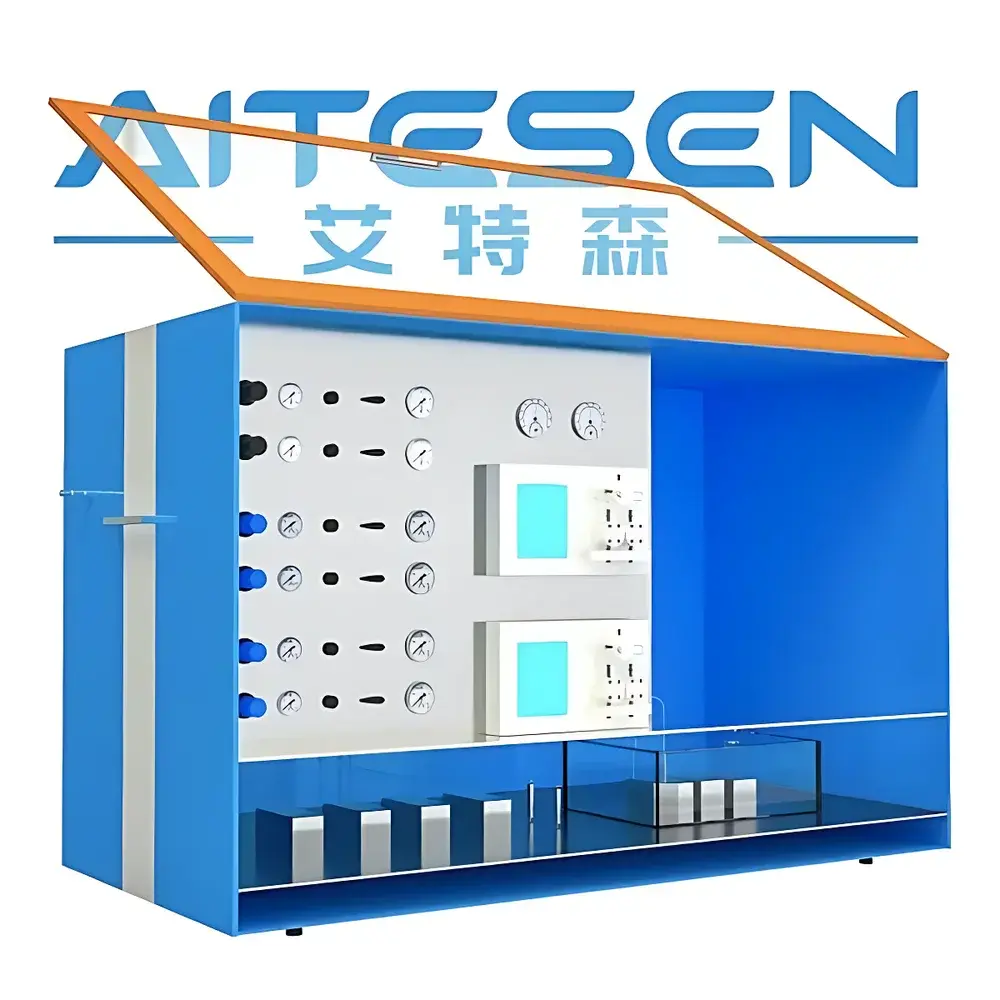
Aitesen MPE-L1 Microfluidic Liposome Emulsification System
| Brand | Aitesen |
|---|---|
| Origin | Jiangsu, China |
| Manufacturer Type | Authorized Distributor |
| Country of Origin | China |
| Model | MPE-L1 |
| Instrument Type | High-Pressure Microfluidic Emulsification System |
| Dimensions (W×D×H) | 280 × 440 × 260 mm |
| Flow Rate Range | 0.1–200 mL/min |
| Pressure Range | 0–25 MPa |
| Temperature Control Range | 4–100 °C |
| Flow Accuracy | ≤ ±1% |
| Flow Repeatability | ≤ 1% |
| Pressure Pulsation | ≤ 0.1 MPa |
| Pressure Accuracy | ≤ 0.1 MPa |
| Minimum Channel Width | 20 µm |
| Particle Size Output | <100 nm |
| Polydispersity Index (PDI) | <0.1 |
Overview
The Aitesen MPE-L1 Microfluidic Liposome Emulsification System is a high-precision, pressure-driven microfluidic platform engineered for continuous, scalable, and reproducible preparation of nanoscale lipid-based colloidal dispersions—including liposomes, solid lipid nanoparticles (SLNs), nanoemulsions, and polymeric micelles. It operates on the principle of controlled hydrodynamic focusing and high-shear microfluidic emulsification, where two or more immiscible phases (e.g., aqueous and organic) are precisely metered, co-laminated, and subjected to defined shear and impact forces within custom-fabricated microchannels. Unlike batch homogenization or sonication methods, the MPE-L1 enables deterministic control over nucleation, droplet breakup, and particle growth kinetics—resulting in narrow size distributions, minimal aggregation, and intrinsic batch-to-batch consistency. Its architecture supports both primary emulsification (formation of initial nanodroplets) and secondary processing (size refinement via high-pressure microchannel impact), making it suitable for process development under Quality by Design (QbD) frameworks aligned with ICH Q5A and Q5C guidelines.
Key Features
- High-precision dual-channel syringe pump system with independent flow control (0.1–200 mL/min), calibrated to ≤±1% accuracy and ≤1% repeatability
- Integrated high-pressure delivery module capable of sustained operation up to 25 MPa, with pressure stability maintained at ≤0.1 MPa pulsation
- Temperature-regulated fluid path (4–100 °C) enabling thermally sensitive formulation handling and phase behavior optimization
- Modular microfluidic chip interface supporting rapid exchange of application-specific chips—each fabricated from chemically inert, biocompatible materials (e.g., glass, silicon, or cyclic olefin copolymer)
- Chip channel geometries customizable down to 20 µm feature width, allowing precise tuning of Reynolds number, residence time, and interfacial shear rate
- Robust mechanical housing (280 × 440 × 260 mm) designed for benchtop integration in ISO Class 5–7 cleanrooms or GMP-compliant QC laboratories
Sample Compatibility & Compliance
The MPE-L1 accommodates a broad range of formulation chemistries—including phospholipid dispersions, polymer solutions (e.g., PLGA, PEG-PLA), surfactant-stabilized oils, and aqueous protein buffers—without cross-contamination risk due to its single-use or rigorously validated reusable chip architecture. All wetted components comply with USP Class VI and ISO 10993-5 biocompatibility standards. The system supports audit-ready documentation workflows compliant with FDA 21 CFR Part 11 when paired with validated electronic lab notebook (ELN) integration. Process parameters—including flow rates, pressure setpoints, temperature logs, and run timestamps—are automatically recorded with cryptographic integrity, satisfying GLP/GMP traceability requirements for regulatory submissions (e.g., IND, ANDA, or MAA dossiers).
Software & Data Management
The embedded control interface provides real-time monitoring and closed-loop regulation of all critical process variables. Exportable CSV and HDF5 data files include synchronized time-series records of flow, pressure, temperature, and system status flags. Optional API integration (REST/HTTP) allows interoperability with LIMS, MES, and PAT platforms for automated process analytics (e.g., multivariate statistical process control, MSPC). Firmware updates are digitally signed and version-locked to ensure configuration consistency across multi-site technology transfer initiatives.
Applications
- Development and manufacturing of mRNA-LNP formulations with controlled encapsulation efficiency and low PDI
- Routine production of sterically stabilized liposomes for drug delivery (e.g., doxorubicin, siRNA)
- Screening of emulsifier-to-oil ratios and solvent quenching kinetics in nanoemulsion design
- Scale-down modeling of industrial microfluidic processes for tech transfer to pilot- or commercial-scale continuous manufacturing lines
- Preparation of reference nanomaterials for DLS, NTA, TEM, and SAXS method validation studies
- Process analytical technology (PAT)-enabled in-line monitoring via integrated UV-Vis or dynamic light scattering (DLS) modules (optional add-on)
FAQ
Is the MPE-L1 compatible with organic solvents such as chloroform or ethanol?
Yes—the fluidic pathway is constructed from chemically resistant materials (e.g., stainless steel 316L, PEEK, fused silica), validated for compatibility with common pharmaceutical solvents per ASTM D471 testing protocols.
Can chip designs be customized for specific formulation requirements?
Absolutely—Aitesen offers collaborative chip co-design services with documented design history files (DHF), including CFD simulation reports and experimental validation datasets for each geometry iteration.
Does the system support automated cleaning-in-place (CIP) protocols?
While the MPE-L1 does not include an integrated CIP manifold, its modular chip and tubing architecture enables rapid disassembly and validated manual cleaning procedures compliant with ISO 14644-1 particle count limits for Class 5 environments.
What regulatory documentation is provided with the instrument?
Each unit ships with a Factory Acceptance Test (FAT) report, IQ/OQ protocol templates, material certifications (RoHS, REACH), and a full traceable calibration certificate issued by an ISO/IEC 17025-accredited laboratory.
How is scalability ensured from lab-scale to clinical manufacturing?
The MPE-L1 employs geometrically similar microchannel architectures and dimensionless number matching (e.g., Capillary number, Weber number), enabling direct scale-up correlation to industrial microfluidic systems without re-optimization of critical quality attributes (CQAs).



