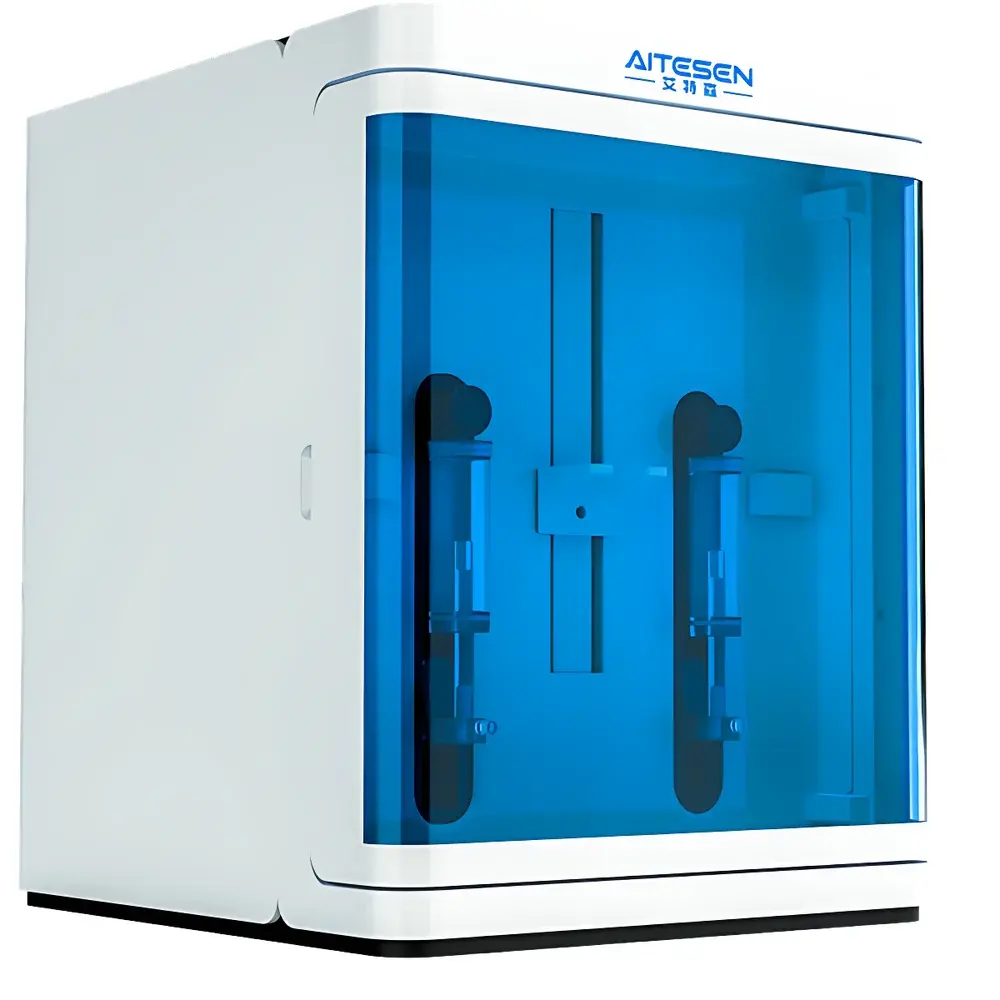
Aitesen MPE-L2 GMP-Compliant Microfluidic Nanomedicine Production System
| Brand | Aitesen |
|---|---|
| Origin | Jiangsu, China |
| Manufacturer Type | Authorized Distributor |
| Product Category | Domestic |
| Model | MPE-L2 |
| Pricing | Available Upon Request |
Overview
The Aitesen MPE-L2 is a benchtop, GMP-aligned microfluidic nanomedicine production system engineered for research-scale development and early-stage process validation of lipid nanoparticle (LNP) formulations. It operates on the principle of hydrodynamic flow focusing and controlled shear-driven nanoprecipitation within precisely fabricated microchannels. Unlike conventional bulk mixing methods—such as vortexing, sonication, or high-shear homogenization—the MPE-L2 enables continuous, laminar-to-turbulent transition control across defined fluidic regimes, ensuring reproducible formation of colloidal nanoparticles with narrow size distribution. Its core architecture integrates dual syringe pumps for precise volumetric delivery of aqueous (Phase A) and organic (Phase B) streams, coupled with a high-pressure conveying module that drives post-mixing stream through a secondary high-shear microfluidic chip. This two-stage design supports sequential operations: primary emulsification (e.g., LNP self-assembly), followed by in-line size refinement via impact and extensional shear. The system is purpose-built for scalable translation—from discovery labs to clinical manufacturing—by embedding Process Analytical Technology (PAT) readiness and alignment with ICH Q5A, Q5C, and FDA’s guidance on nanotechnology-based therapeutics.
Key Features
- Dual independent syringe pump modules with programmable flow rates (0.01–5 mL/min per channel), enabling precise stoichiometric control of A/B phase ratios during nanoparticle assembly
- Modular high-pressure microfluidic chip interface supporting interchangeable chip geometries—including Y-junction, staggered herringbone, and hydrodynamic flow-focusing configurations—for tailored mixing intensity and residence time
- In-process re-injection capability: allows multiple discrete sample introductions without interrupting ongoing fluidic operation, facilitating iterative formulation screening
- Integrated pressure monitoring (0–100 MPa range) and real-time flow feedback control to maintain consistent shear history across runs
- GMP-oriented hardware design: stainless-steel wetted parts, cleanable fluid paths, and optional IQ/OQ documentation support for lab-to-clinic workflow continuity
- Compact footprint (< 60 cm × 45 cm) with CE-marked electrical safety compliance and Class II biological containment compatibility
Sample Compatibility & Compliance
The MPE-L2 is validated for LNP formulation using ionizable lipids (e.g., DLin-MC3-DMA, SM-102), phospholipids (DSPC), cholesterol, and PEG-lipids dissolved in ethanol or isopropanol, combined with nucleic acid payloads (siRNA, mRNA, saRNA) in acidic aqueous buffers. It accommodates viscosity ranges up to 20 cP and particulate loadings ≤ 5 mg/mL. All microfluidic chips are fabricated from biocompatible, solvent-resistant cyclic olefin copolymer (COC) or siliconized glass, with channel dimensions optimized for Reynolds numbers between 10 and 200—ensuring predictable transition from laminar to mild turbulent flow. The system conforms to ISO 13485:2016 design controls framework and supports audit-ready data integrity when paired with compliant software (see Software & Data Management). It meets ASTM E2919-22 requirements for microfluidic device qualification and aligns with USP on characterization of lipid-based nanocarriers.
Software & Data Management
The MPE-L2 operates via Aitesen’s proprietary ControlSuite v3.2 software, running on Windows 10 IoT Enterprise. The interface provides synchronized control of pump speed, pressure setpoints, temperature (via optional external jacketed tubing), and timing sequences for multi-step protocols. All operational parameters—including flow rate, pressure, elapsed time, and user-defined annotations—are logged at 10 Hz resolution into encrypted SQLite databases compliant with 21 CFR Part 11 requirements (electronic signatures, audit trails, role-based access). Raw data export supports CSV, HDF5, and MATLAB-compatible formats. Optional integration with LabVantage LIMS or Empower 3 enables automated metadata tagging and batch record linkage for GLP/GMP environments.
Applications
- Preclinical optimization of mRNA-LNP vaccines under physiologically relevant mixing kinetics
- High-throughput screening of lipid molar ratios and PEG-lipid variants for improved encapsulation efficiency and serum stability
- Process mapping studies correlating chip geometry, flow ratio, and total flow rate with final particle size (D50), polydispersity index (PDI 90%)
- Generation of reference standards for DLS, NTA, and TEM method validation
- Technology transfer support for Phase I/II manufacturing: identical fluidic principles enable direct scale-up to pilot-scale microfluidic platforms (e.g., NanoAssemblr Ignite or Precision Nanosystems NanoAssemblr Benchtop)
FAQ
Is the MPE-L2 suitable for GMP manufacturing?
The MPE-L2 is designed for process development and clinical material generation under GMP-aligned conditions; it is not a fully qualified production line system but supports IQ/OQ execution and provides traceable, auditable process data required for regulatory submissions.
What microfluidic chip types are available?
Standard offerings include Y-junction (for rapid mixing), staggered herringbone (for enhanced diffusion-limited mixing), and focused-flow chips (for narrow PDI control); custom chip design services are available upon technical review.
Can the system handle viscous organic phases such as lipid-in-ethanol solutions?
Yes—pump modules accommodate viscosities up to 20 cP; pre-filtering (0.22 µm) and degassing of organic phases are recommended to prevent clogging.
Does the system support real-time particle size monitoring?
Not natively—but it features standardized optical ports compatible with third-party inline DLS or UV-Vis flow cells (e.g., SpectroClick or Unchained Labs LUMiFlee) for PAT-integrated deployment.
What regulatory documentation is provided?
Factory calibration certificates, electrical safety reports (EN 61010-1), material declarations (RoHS/REACH), and a basic risk management file (ISO 14971) are included; full URS, FMEA, and PQ protocol templates are available under NDA.
Related Products