
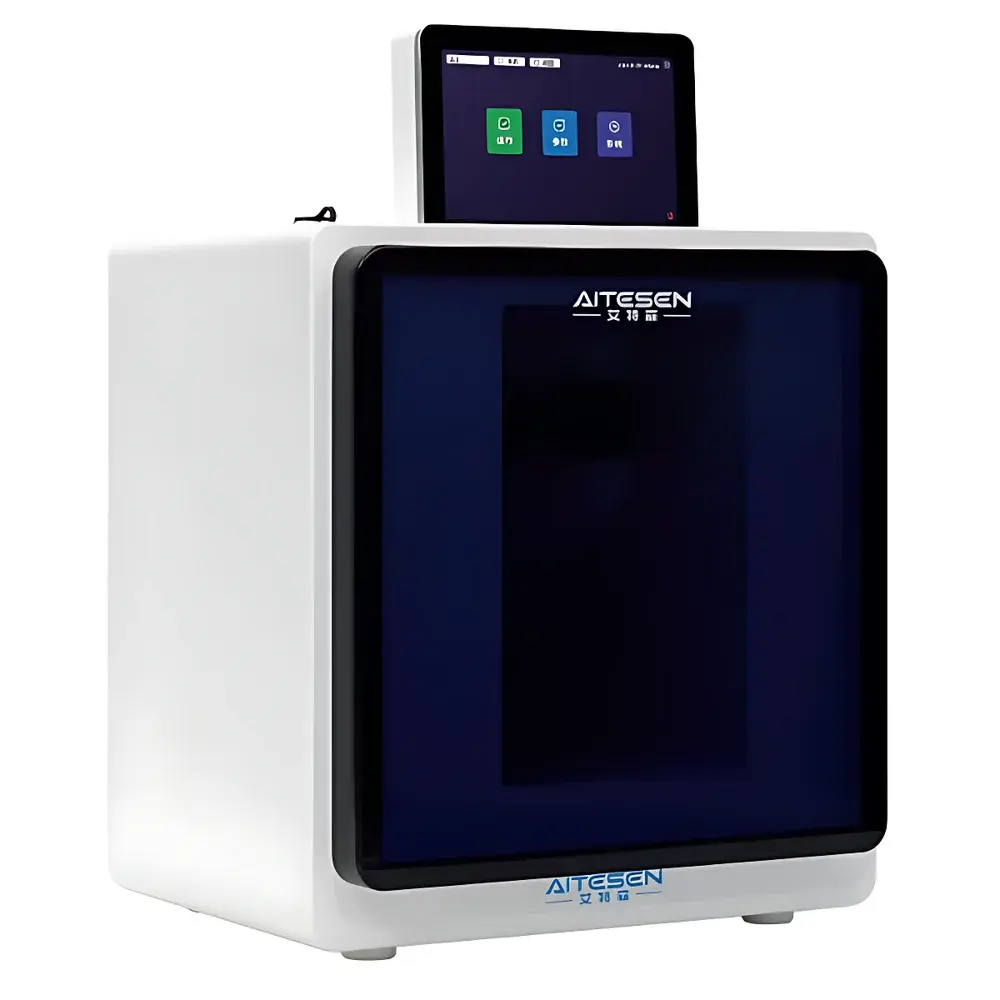
Aitesen MPE-Lab Microfluidic Nanoparticle Preparation System
| Brand | Aitesen |
|---|---|
| Origin | Jiangsu, China |
| Manufacturer Type | Authorized Distributor |
| Product Origin | Domestic (China) |
| Model | MPE-Lab Microfluidic Preparation System |
| Flow Rate Reproducibility Error | ≤1% |
| Minimum Working Volume | ≤200 µL |
| Maximum Single-Run Volume | 40 mL |
| Maximum Total Flow Rate | ≥180 mL/min |
| Supported Carriers | Liposomes, Lipid Nanoparticles (LNPs), Polymeric Microparticles, Micelles |
| Compatible Solvent Systems | Miscible and Immiscible Phases |
| Chip Compatibility | Customizable Microfluidic Chips |
| Control Interface | Integrated Touchscreen |
| Software | MPE Lab Microfluidic Control Suite (Lifetime Free Updates) |
Overview
The Aitesen MPE-Lab Microfluidic Nanoparticle Preparation System is a benchtop-scale, precision-engineered platform designed for the reproducible synthesis of lipid-based and polymeric nanocarriers under strictly controlled hydrodynamic conditions. It operates on the principle of laminar or transitional flow-driven mixing within microstructured channels—leveraging fundamental microfluidic physics to achieve rapid, diffusion-limited interfacial contact between immiscible or partially miscible phases. This enables deterministic control over nucleation, self-assembly, and particle growth kinetics—critical for producing uniform lipid nanoparticles (LNPs), liposomes, polymeric microparticles, and micelles with narrow size distribution. Unlike batch-based emulsification methods (e.g., sonication, high-shear homogenization), the MPE-Lab implements continuous-flow process analytical technology (PAT)-aligned preparation, ensuring real-time parameter traceability and intrinsic scalability from lab-scale formulation development to clinical-grade material generation.
Key Features
- High-reproducibility dual-syringe pump architecture with independent volumetric flow control for phase A and phase B, enabling precise tuning of lipid-to-ethanol or polymer-to-organic solvent ratios.
- Modular microfluidic chip interface supporting interchangeable chip geometries—including T-junction, staggered herringbone, and hydrodynamic focusing configurations—for tailored mixing regimes (laminar, turbulent transition, or controlled droplet breakup).
- Integrated high-pressure post-mixing module (up to 150 MPa nominal pressure rating) for secondary size reduction via impingement and shear-induced fragmentation, achieving final particle diameters down to <100 nm with polydispersity index (PDI) <0.1.
- Touchscreen-based local HMI with intuitive parameter mapping: total flow rate, flow ratio, injection volume, waste purge volume, and dwell time—all logged with timestamped metadata.
- Open-chip architecture compatible with third-party and custom-fabricated silicon, glass, or thermoplastic chips, facilitating method transfer across academic, CMC, and GMP-aligned environments.
Sample Compatibility & Compliance
The MPE-Lab supports formulation development across aqueous-organic, water-in-oil, and double-emulsion systems. It accommodates standard LNP excipients (e.g., DSPC, cholesterol, PEG-lipids, ionizable lipids), biodegradable polymers (PLGA, PLA), and amphiphilic surfactants without modification. All wetted components comply with USP Class VI-certified materials where applicable. While the system itself is not certified to ISO 13485 or FDA 21 CFR Part 11 out-of-the-box, its audit-ready data logging architecture—including user access logs, parameter change history, and electronic signature fields in exported CSV/Excel reports—supports alignment with GLP and early-phase GMP documentation requirements. Method validation protocols (e.g., ICH Q5A, Q5C) can be implemented using built-in repeatability testing functions.
Software & Data Management
The MPE Lab Microfluidic Control Suite provides native support for method creation, execution scheduling, and raw data export. Each run generates a structured metadata file containing pump calibration coefficients, temperature-stamped flow profiles, chip ID, and operator credentials. Export formats include .csv (for statistical analysis in JMP or Python/Pandas), .xlsx (for regulatory submission templates), and .pdf (for internal SOP archiving). Software updates are delivered automatically over secure HTTPS; no cloud storage or remote telemetry is enabled by default—ensuring full data sovereignty per institutional IT policies. Audit trails meet ALCOA+ principles (Attributable, Legible, Contemporaneous, Original, Accurate, Complete, Consistent, Enduring, Available).
Applications
- Preclinical LNP formulation screening for mRNA, siRNA, and pDNA delivery—enabling rapid DoE-driven optimization of encapsulation efficiency, particle stability, and transfection efficacy.
- Controlled liposome synthesis for small-molecule drug loading (e.g., doxorubicin, paclitaxel) with defined lamellarity and membrane fluidity profiles.
- Development of stimuli-responsive micelles and polymeric nanoparticles for targeted release kinetics studies.
- Process qualification of microfluidic unit operations prior to transfer to pilot-scale continuous manufacturing platforms (e.g., NanoAssemblr® Ignite or Precision NanoSystems Genesis).
- Teaching and training in pharmaceutical nanotechnology, emphasizing first-principles understanding of colloidal stability, interfacial thermodynamics, and scale-up predictability.
FAQ
What microfluidic chip types are supported out-of-the-box?
Standard configurations include T-junction, Y-junction, and vortex-assisted mixing chips fabricated in cyclic olefin copolymer (COC) and fused silica. Custom chip integration follows ISO 80369-7 port geometry specifications.
Can the system be integrated into an automated workflow with external analytics?
Yes—via RS-232 and Ethernet TCP/IP interfaces, the MPE-Lab supports trigger-based synchronization with dynamic light scattering (DLS), nanoparticle tracking analysis (NTA), or inline UV-Vis spectrophotometers for real-time quality monitoring.
Is method transfer to GMP manufacturing feasible?
The MPE-Lab’s deterministic flow control, digital parameter locking, and full audit trail capability provide foundational evidence for tech transfer packages; however, formal validation (IQ/OQ/PQ) must be performed per site-specific SOPs and regulatory jurisdiction.
Does the software support multi-user role-based access control?
Yes—administrator, operator, and reviewer roles are configurable with password protection and session timeout enforcement, compliant with basic 21 CFR Part 11 readiness criteria.
What maintenance is required for long-term operational reliability?
Quarterly syringe pump recalibration using gravimetric verification, annual chip manifold seal inspection, and routine cleaning of fluid paths with ethanol/water followed by nitrogen purging are recommended per the manufacturer’s maintenance schedule.




