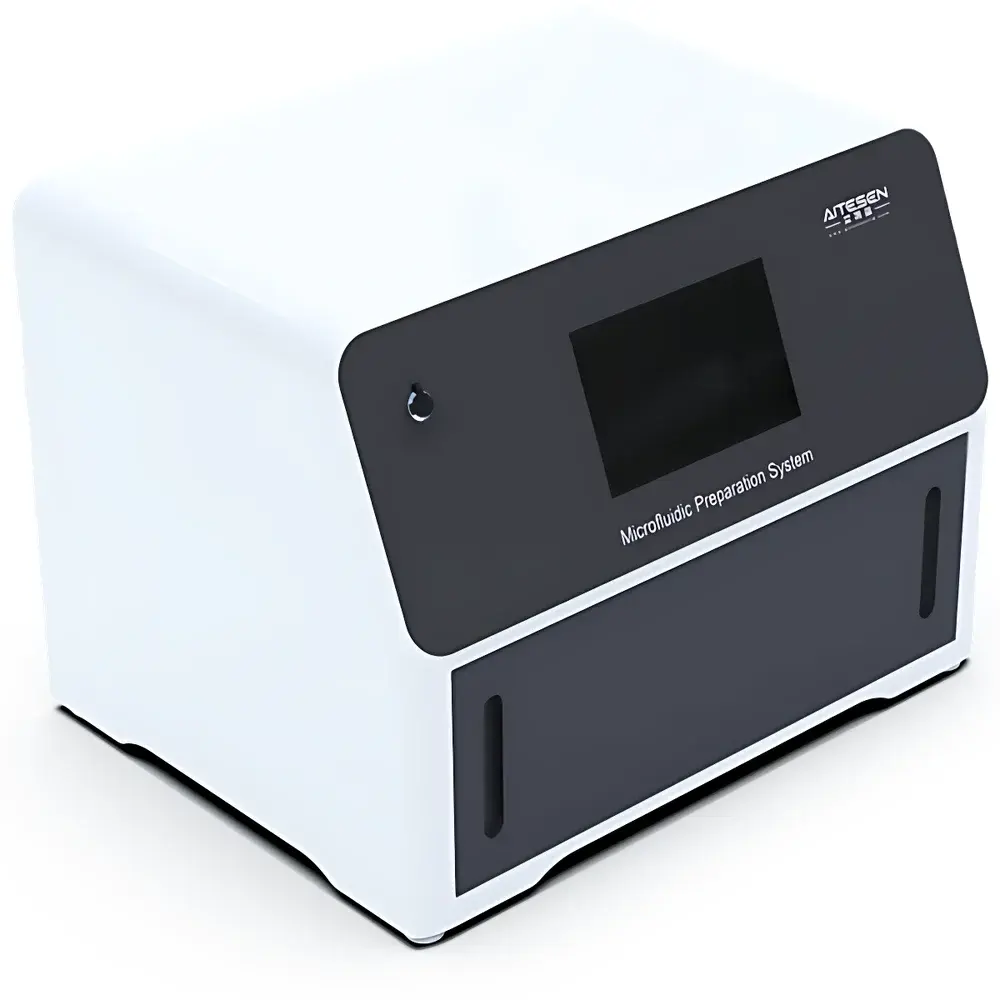
Aitesen MPE-P1 Microfluidic Nanomedicine Production System
| Brand | Aitesen |
|---|---|
| Origin | Jiangsu, China |
| Manufacturer Type | Authorized Distributor |
| Product Category | Domestic |
| Model | MPE-P1 |
| Carrier Type | Lipid Nanoparticle (LNP) |
| Key Features | Integrated touchscreen interface, batch record logging, data export capability, high-concentration & high-flow-rate LNP/liposome processing, particle size control down to <100 nm, PDI < 0.1 |
| Compliance | Designed for GLP-compliant process development and scalable GMP-aligned manufacturing workflows |
Overview
The Aitesen MPE-P1 Microfluidic Nanomedicine Production System is a pilot-scale, continuous-flow microfluidic platform engineered for the robust, reproducible, and scalable preparation of advanced nanocarrier formulations. It operates on the principle of controlled hydrodynamic focusing and shear-driven nanoprecipitation within precision-engineered microchannels—leveraging laminar-to-turbulent transition regimes to achieve rapid, homogeneous mixing of immiscible phases (e.g., lipid ethanol solution and aqueous buffer). This enables precise nucleation kinetics control, critical for forming uniform lipid nanoparticles (LNPs), liposomes, polymeric nanoparticles (e.g., PLGA, PEG-PLGA), nanoemulsions, and inorganic colloids (e.g., gold nanoparticles). Unlike batch-based sonication or thin-film hydration methods, the MPE-P1 implements a fully continuous, closed-system process that aligns with ICH Q5A and USP guidance for nucleic acid delivery systems—supporting early-phase process development through to clinical manufacturing readiness.
Key Features
- Modular microfluidic chip architecture supporting interchangeable configurations for initial emulsification, post-formation incubation, secondary homogenization, and real-time size modulation
- Dual-syringe high-precision metering pumps with flow rate range of 0.01–20 mL/min per channel, programmable via intuitive touchscreen HMI
- Integrated high-pressure delivery module (up to 200 MPa) enabling post-mixing size reduction via impingement jet and controlled shear forces
- On-device batch logging with timestamped parameter capture (flow rates, pressure, temperature, duration) compliant with ALCOA+ data integrity principles
- Exportable CSV/Excel logs compatible with LIMS integration and 21 CFR Part 11–ready audit trail generation (when deployed with validated software environment)
- Stainless-steel fluidic path with CIP/SIP-compatible wetted materials (316L SS, PEEK, fused silica), suitable for sterile processing validation
Sample Compatibility & Compliance
The MPE-P1 accommodates diverse formulation chemistries across biopharmaceutical and small-molecule drug delivery domains. It supports lipid-based systems including ionizable cationic lipids (e.g., DLin-MC3-DMA), phospholipids (DSPC, DOPE), cholesterol, and PEG-lipids; polymer-based matrices such as PLGA, chitosan, and poly(β-amino ester); and surfactant-stabilized oil-in-water emulsions (e.g., MF59-type adjuvants, propofol emulsions). All processes are conducted under ISO 13485–aligned design controls, with documentation packages supporting regulatory submissions under FDA IND/IMPD, EMA CHMP/ICH guidelines, and NMPA Technical Guidelines for Nanomedicines. The system’s deterministic process parameters facilitate direct correlation between lab-scale optimization and commercial-scale tangential flow filtration (TFF) or sterile filtration steps.
Software & Data Management
The embedded control software provides real-time monitoring of all critical process parameters—including differential pressure across chips, temperature at inlet/outlet ports, and cumulative volume dispensed. Batch records include operator ID, calibration status flags, and deviation annotations. Exported datasets conform to ASTM E2500-21 standards for process validation documentation and may be imported into third-party statistical process control (SPC) tools (e.g., JMP, Minitab) for multivariate analysis of critical quality attributes (CQAs) such as particle size distribution (PSD), polydispersity index (PDI), encapsulation efficiency, and zeta potential stability. Optional API integration allows synchronization with enterprise MES platforms for traceability across material lots, equipment usage, and environmental monitoring logs.
Applications
- mRNA and siRNA encapsulation into LNPs for vaccine and gene-silencing therapeutics
- Preparation of sterically stabilized liposomes for anthracycline (doxorubicin) and topoisomerase inhibitor (irinotecan) delivery
- Controlled synthesis of PLGA and PEG-PLGA microparticles for sustained-release peptide formulations
- Manufacture of vaccine adjuvant emulsions meeting WHO prequalification criteria for MF59 analogues
- Rapid prototyping of gold and iron oxide nanoparticles for theranostic applications
- Process mapping studies for Quality by Design (QbD) implementation per ICH Q8(R2)
FAQ
What types of microfluidic chips are supported?
The MPE-P1 accepts custom-designed chips fabricated in glass, silicon, or cyclic olefin copolymer (COC), with channel geometries optimized for specific mixing Reynolds numbers (Re = 10–200), residence time distributions (RTD), and shear stress profiles.
Can the system be validated for GMP production?
Yes—the platform supports IQ/OQ/PQ protocols aligned with Annex 15 and ASTM E2500-21. Full validation documentation packages, including risk assessments (FMEA), calibration certificates, and cleaning verification reports, are available upon request.
Is remote monitoring or cloud-based data backup available?
While the base configuration includes local data storage and USB export, optional Ethernet-enabled firmware upgrades support secure OPC UA communication for integration into centralized SCADA or cloud-based analytics platforms.
What is the typical throughput range per run?
Standard operation yields 10–500 mL batches per hour depending on formulation viscosity, target particle size, and chip configuration—with linear scalability demonstrated from 10 mL/h (R&D) to 2 L/h (pilot) using identical process maps.
Does the system support temperature-controlled operation?
Integrated Peltier-based thermal modules maintain ±0.5°C stability across inlet streams (4–40°C), essential for thermosensitive payloads like mRNA and protein antigens.
Related Products