
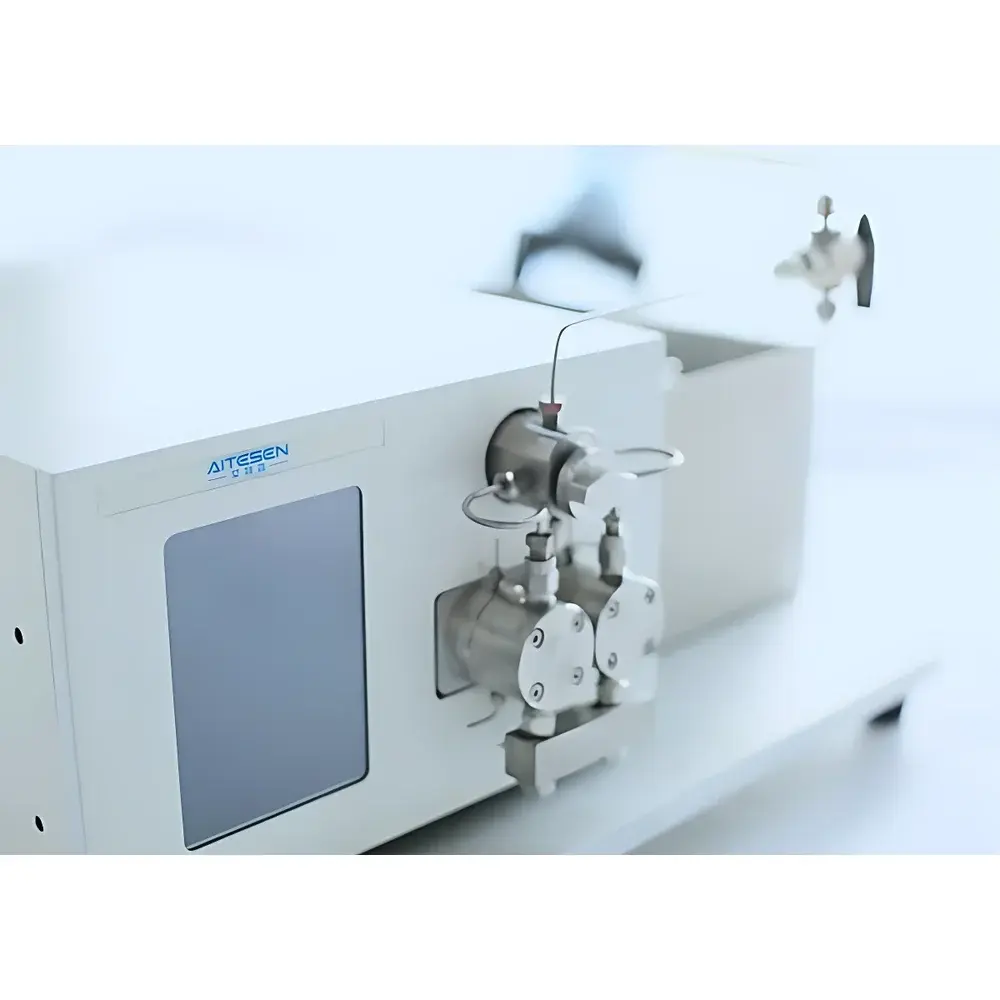
Aitesen OLExS-Pd Continuous Liposome Extruder
| Brand | Aitesen |
|---|---|
| Model | OLExS-Pd |
| Instrument Type | Microfluidic Extrusion System |
| Processing Volume | 100–5000 mL |
| Dimensions (W×D×H) | 280 × 440 × 260 mm |
| Origin | Jiangsu, China |
| Supplier Type | Authorized Distributor |
| Regulatory Classification | Domestic Laboratory-Grade Equipment |
Overview
The Aitesen OLExS-Pd Continuous Liposome Extruder is an engineered microfluidic extrusion system designed for precise, reproducible size reduction and homogenization of lipid-based nanocarriers—including liposomes, lipid nanoparticles (LNPs), and polymer-lipid hybrid vesicles. Unlike batch-mode extrusion or high-shear homogenization methods, the OLExS-Pd employs controlled, continuous-flow extrusion through polycarbonate (PC) track-etched membranes under regulated pressure, enabling deterministic particle sizing via hydrodynamic shear rather than stochastic cavitation or thermal degradation. This principle—rooted in laminar flow-driven membrane filtration—ensures minimal sample loss, low thermal load, and high batch-to-batch consistency, making it especially suitable for temperature-sensitive biologics, mRNA-LNP formulations, and GMP-aligned process development.
Key Features
- Continuous-flow architecture with integrated pressure regulation and real-time flow monitoring, supporting scalable operation from R&D to pilot-scale batches.
- Modular membrane holder compatible with standard PC filters (10 nm to 5.0 µm pore sizes), allowing stepwise extrusion protocols for narrow polydispersity index (PDI) control.
- Compact footprint (280 × 440 × 260 mm) optimized for biosafety cabinets and shared lab environments without compromising mechanical stability or pressure integrity.
- Chemically resistant fluid path constructed from medical-grade stainless steel and PEEK components, validated for compatibility with organic solvents (e.g., ethanol, chloroform), aqueous buffers, and detergent-containing formulations.
- Pressure range calibrated for gentle yet effective extrusion (typically 10–60 bar), adjustable via precision back-pressure regulator to balance particle size reduction against membrane clogging risk.
- No moving parts in the extrusion chamber—eliminating wear-induced contamination and enabling rapid cleaning-in-place (CIP) and sterilization-in-place (SIP) validation per ISO 13485 and FDA Q5A guidelines.
Sample Compatibility & Compliance
The OLExS-Pd accommodates a broad spectrum of nanovesicular systems: unilamellar and multilamellar liposomes (including PEGylated and charged variants), siRNA/mRNA-loaded LNPs, exosome-mimetics, and protein-reconstituted proteoliposomes. It supports both pre-formed vesicle extrusion and post-hydration extrusion workflows. All wetted materials comply with USP Class VI and ISO 10993-5 cytotoxicity standards. The system is designed to meet GLP documentation requirements for preclinical formulation studies and aligns with ICH Q5A(R2) recommendations for characterization of nanomedicine particle size distribution. While not certified for sterile manufacturing, its design facilitates integration into ISO Class 5 cleanroom environments when paired with validated aseptic filtration and nitrogen-purged operation.
Software & Data Management
The OLExS-Pd operates as a stand-alone hardware platform without proprietary software dependency—enabling full manual control and third-party integration via analog 0–10 V pressure feedback output. For audit-trail compliance, users may connect external data loggers compliant with FDA 21 CFR Part 11 (electronic records and signatures) to record pressure, flow rate, temperature (via optional inline PT100 sensor), and total processed volume. Calibration certificates for pressure transducers and flow meters are provided with each unit, traceable to NIST standards. Batch records generated using this system support regulatory submissions under EMA CHMP/Q5A and USP <1787> guidance on liposomal product characterization.
Applications
- Downstream processing of mRNA vaccine candidates requiring uniform LNP size (e.g., targeting 70–100 nm modal diameter with PDI < 0.15).
- Routine quality control of liposomal drug products (e.g., doxorubicin, amphotericin B) per USP <729> light scattering and dynamic light scattering (DLS) validation protocols.
- Formulation screening of novel lipid excipients where membrane compatibility and extrusion efficiency must be evaluated across multiple pore sizes.
- Stability assessment studies involving accelerated aging, freeze-thaw cycling, or long-term storage—where consistent initial sizing minimizes confounding variables.
- Academic research in membrane biophysics, including reconstitution of membrane proteins into defined-size proteoliposomes for cryo-EM grid preparation.
FAQ
What pore sizes of polycarbonate membranes are supported?
Standard configurations support 10 nm, 20 nm, 50 nm, 100 nm, 200 nm, 400 nm, 800 nm, 1.0 µm, and 5.0 µm track-etched PC membranes—each individually validated for flow rate and pressure drop at specified processing volumes.
Can the OLExS-Pd be used with organic solvent-based lipid films?
Yes—the fluid path is fully compatible with ethanol, isopropanol, chloroform/methanol mixtures, and tert-butanol, provided residual solvent content in the final dispersion remains below 5% v/v to prevent membrane swelling.
Is the system compatible with GMP documentation requirements?
While the OLExS-Pd itself is not GMP-certified, its mechanical design, material certifications, and analog data outputs enable full traceability when incorporated into a validated manufacturing process with appropriate SOPs and change control procedures.
How often should the membrane holder be cleaned between runs?
Rinsing with filtered deionized water followed by 70% ethanol is recommended after each use; autoclaving (121°C, 20 min) is permissible for stainless steel and PEEK components but not for assembled membrane cartridges.
Does the system support automated multi-pass extrusion cycles?
No—it is manually operated per pass; however, consistent pressure and flow settings ensure high inter-pass reproducibility, and total pass count is tracked via external logging for protocol adherence.



