
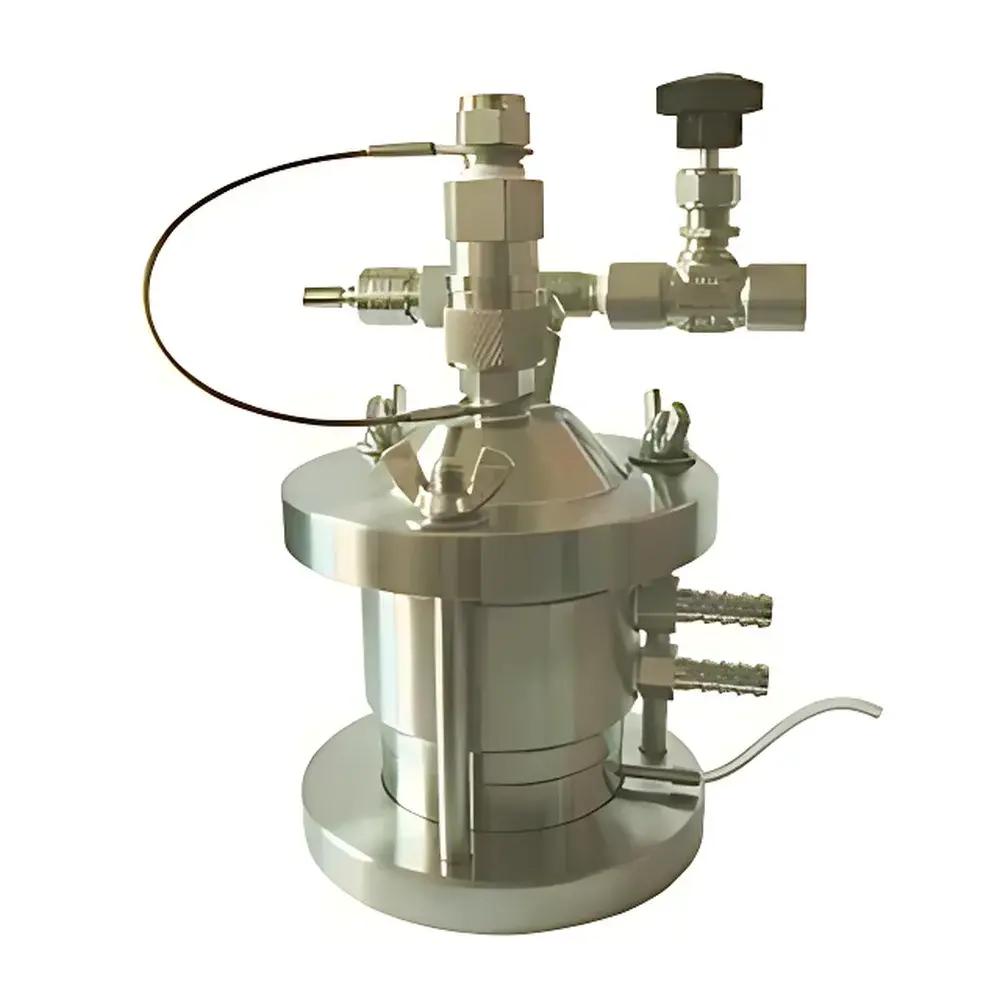
Aitesen TBX001 Tank-Type Pneumatic Liposome Extruder
| Brand | Aitesen |
|---|---|
| Model | TBX001 |
| Instrument Type | High-Pressure Extruder |
| Dimensions (W×D×H) | 80 × 140 × 60 mm |
| Sample Volume Range | 0–10 mL |
| Maximum Operating Pressure | 1000 psi |
| Final Particle Size Range | 50–1000 nm |
| Polydispersity Index (PDI) | <0.1 achievable |
| Operating Temperature Range | 5–75 °C |
| Maximum Lipid Concentration | 200 mg/mL |
| Construction Materials | 316L stainless steel body, polycarbonate (PC) track-etched membranes, FDA-compliant PU/PTFE seals |
| Temperature Control | Jacketed with external recirculating chiller |
| Compliance | Designed for GMP-compliant cleanroom use |
Overview
The Aitesen TBX001 Tank-Type Pneumatic Liposome Extruder is an engineered solution for the precise, reproducible size reduction and homogenization of lipid-based nanocarriers—including liposomes, lipid nanoparticles (LNPs), and albumin-bound nanomicelles. It operates on the principle of forced extrusion through defined-pore polycarbonate membranes under controlled nitrogen gas pressure, enabling deterministic particle sizing via physical sieving rather than stochastic mechanical shear. Unlike high-shear methods such as probe sonication or microfluidic homogenization, extrusion delivers superior batch-to-batch consistency in hydrodynamic diameter and polydispersity—critical parameters for regulatory filing of parenteral nanomedicines. The device integrates a thermostatically jacketed chamber to maintain membrane temperature within the phospholipid phase transition range (typically 50–60 °C), ensuring optimal membrane fluidity and minimizing lipid aggregation or pore clogging during repeated passes.
Key Features
- Stainless steel (316L) construction throughout the extrusion chamber, support plate, and filtration plate—resistant to corrosion, compatible with autoclaving and SIP (steam-in-place) protocols.
- Pneumatic actuation using regulated nitrogen gas (max. 1000 psi) ensures smooth, pulse-free extrusion force—eliminating pressure spikes that compromise membrane integrity or induce lipid oxidation.
- Jacketed thermal management system supports connection to external chillers or heaters, enabling precise temperature control from 5 °C to 75 °C—essential for thermosensitive formulations and phase behavior optimization.
- FDA-compliant sealing system utilizing medical-grade polyurethane (PU) and PTFE components—validated for extractables/leachables per USP and ISO 10993-18.
- Modular design with tool-free assembly/disassembly—facilitates rapid membrane replacement, cleaning validation, and residue-free sterilization between batches.
- Integrated pressure relief valve set at factory-default threshold—prevents over-pressurization and ensures operator safety during routine operation.
- Scalable process: single-pass or multi-cycle extrusion modes supported; final particle size tunable by selecting PC membranes with nominal pore sizes of 50, 80, 100, 200, or 400 nm.
Sample Compatibility & Compliance
The TBX001 is validated for processing a broad spectrum of lipid-based dispersions, including doxorubicin, amphotericin B, paclitaxel, oxaliplatin, and irinotecan liposomal formulations; siRNA- and mRNA-loaded LNPs; albumin-paclitaxel nanoparticles; and other sterically stabilized colloidal systems requiring narrow size distribution. All wetted surfaces comply with ISO 13485:2016 manufacturing standards. The device meets core requirements for GMP environments per Annex 1 (EU) and FDA Guidance for Industry: Liposome Drug Products (2022). Membrane compatibility has been verified for organic solvent residues (e.g., ethanol, chloroform) commonly used in thin-film hydration. No lubricants or adhesives are employed in critical zones—ensuring no interference with analytical characterization (DLS, TEM, SEC-MALS).
Software & Data Management
While the TBX001 is a manually operated, non-electronic instrument, its operational parameters are fully documentable within electronic lab notebooks (ELNs) and quality management systems (QMS). Process parameters—including extrusion pressure (psi), number of cycles, membrane pore size, bath temperature (°C), and sample volume (mL)—are recorded per batch for traceability. When integrated into automated workflows, the device supports audit trail generation aligned with 21 CFR Part 11 requirements via companion SOPs and metadata capture in validated LIMS platforms. Calibration certificates for pressure gauges and temperature sensors are provided upon request, supporting GLP/GMP compliance.
Applications
- Final size refinement of pre-hydrated liposomal suspensions prior to sterile filtration and lyophilization.
- Manufacturing of clinical-grade mRNA-LNPs with PDI <0.1 and mean diameter ≤100 nm.
- Reproducible generation of reference standards for dynamic light scattering (DLS) and nanoparticle tracking analysis (NTA).
- Process development studies correlating extrusion parameters (temperature, pressure, cycle count) with encapsulation efficiency and in vitro release kinetics.
- Quality-by-Design (QbD) implementation for liposome manufacturing, where extrusion serves as a critical process parameter (CPP) influencing critical quality attributes (CQAs).
FAQ
What membrane pore sizes are compatible with the TBX001?
Standard polycarbonate (PC) track-etched membranes with nominal pore diameters of 50, 80, 100, 200, and 400 nm are supported. Custom pore sizes may be accommodated upon request.
Can the TBX001 be used with organic solvents?
Yes—provided membranes and seals are chemically compatible. PC membranes tolerate short-term exposure to ethanol, isopropanol, and chloroform; extended contact with acetone or THF is not recommended.
Is the device suitable for sterile processing?
All components are autoclavable (121 °C, 20 min) or compatible with vaporized hydrogen peroxide (VHP) decontamination. Final assembly must occur in ISO Class 5 or better environments when producing sterile intermediates.
How is temperature uniformity across the extrusion chamber verified?
Temperature mapping studies using calibrated PT100 probes confirm ±0.5 °C stability across the membrane surface when connected to a recirculating chiller operating at ±0.1 °C setpoint accuracy.
Does the TBX001 require calibration?
Pressure gauges and temperature sensors are supplied with NIST-traceable calibration certificates. Routine verification per internal SOP is recommended every 6 months or per batch record requirements.



