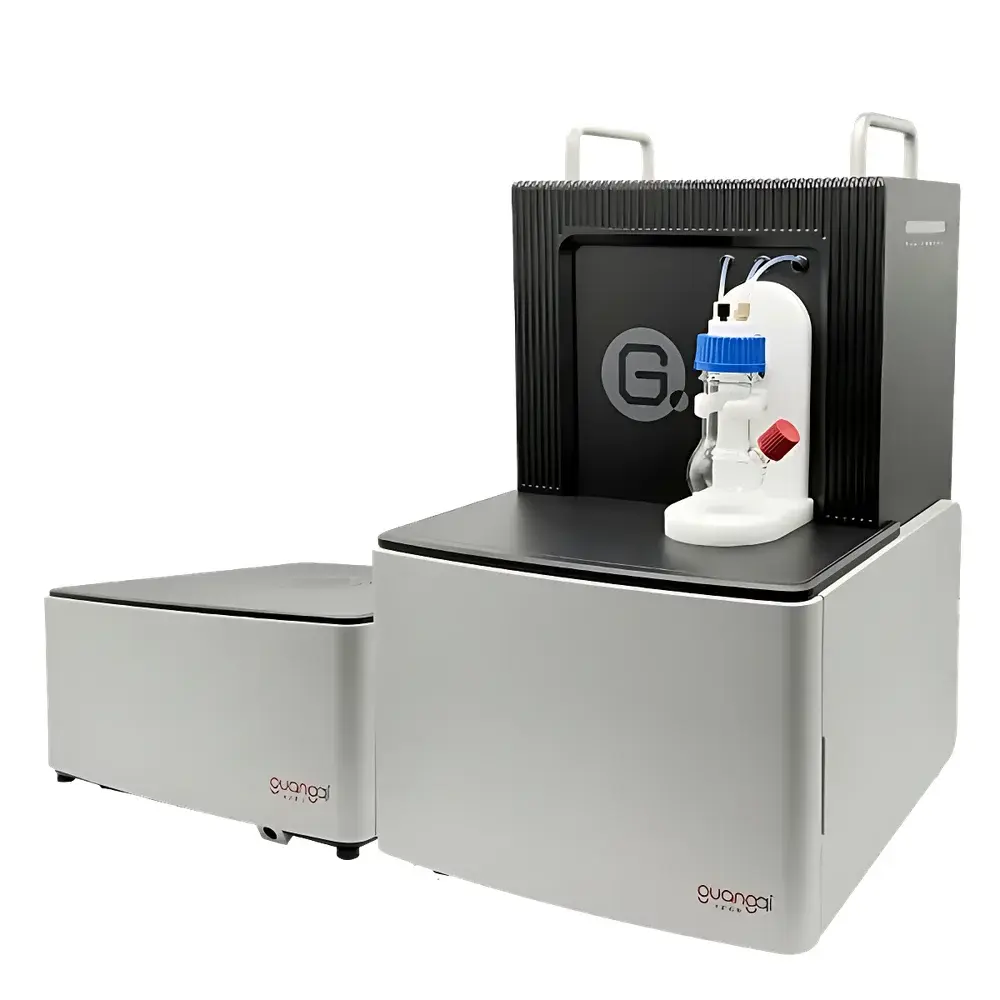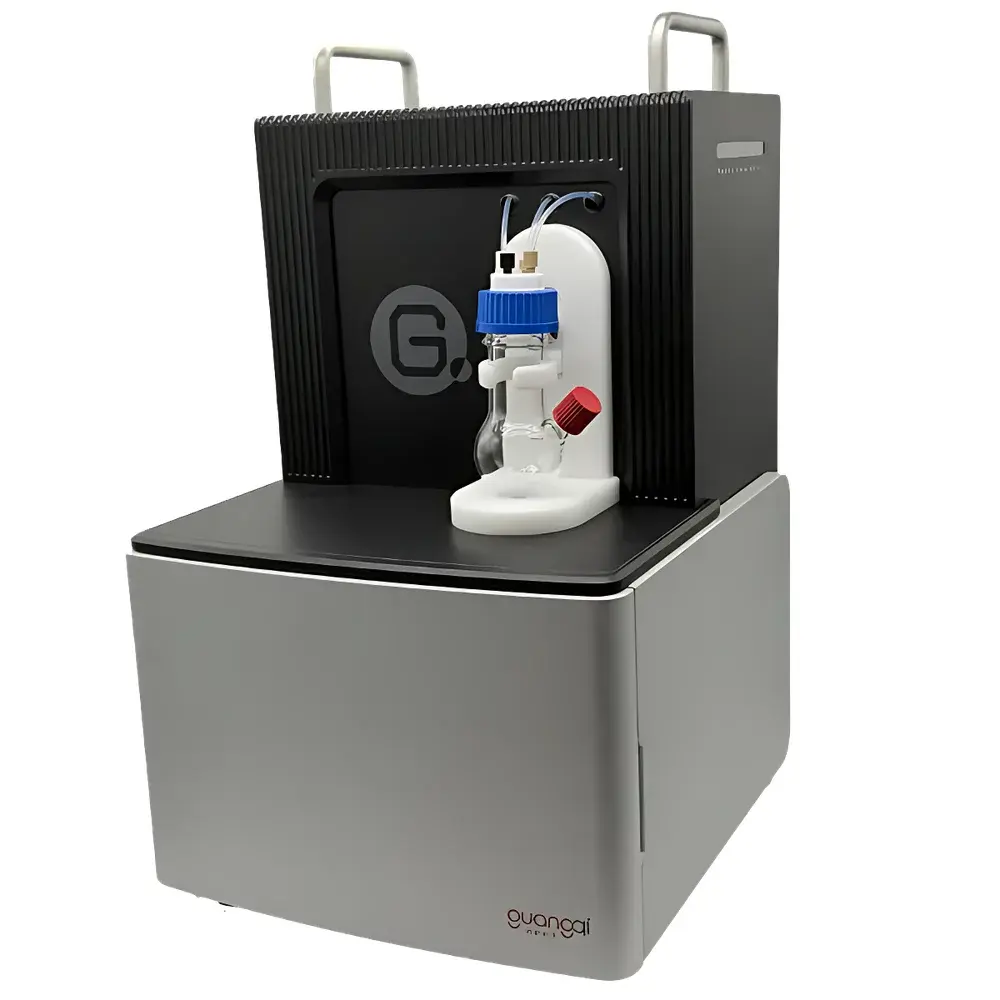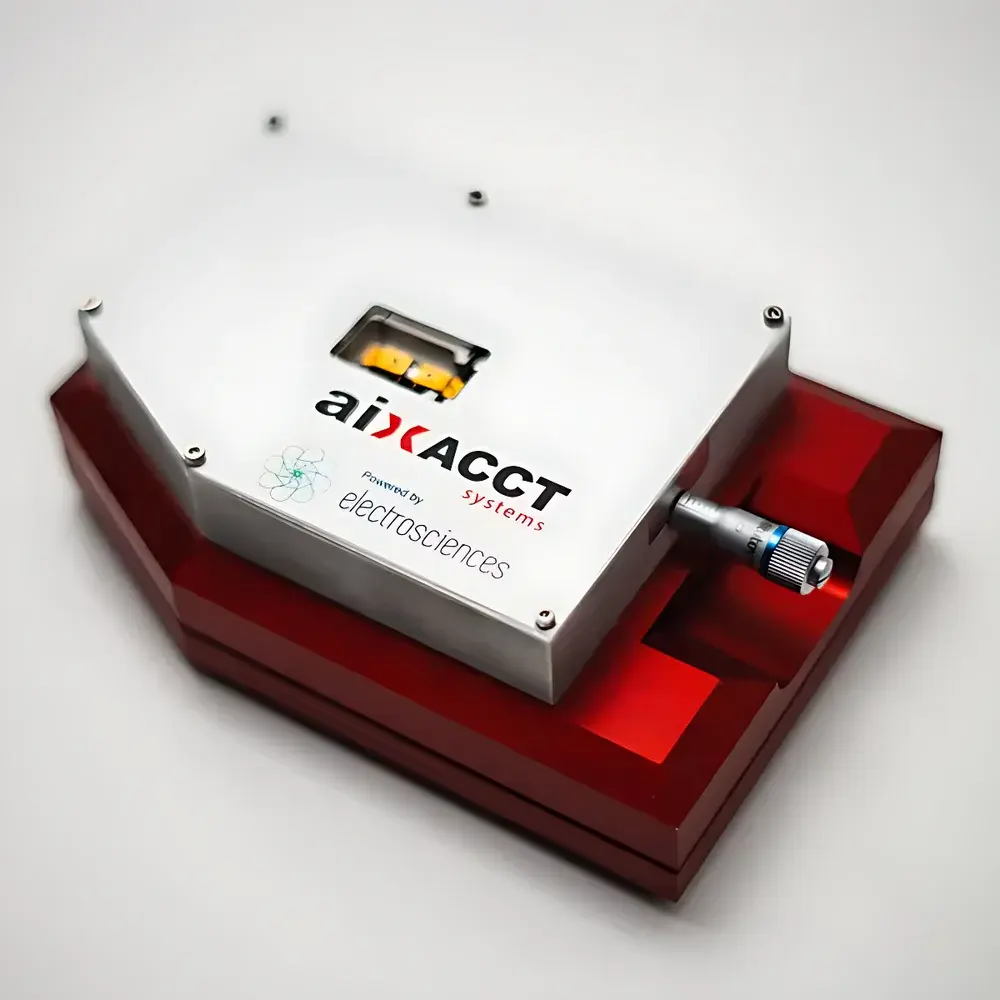
aixACCT ESPY31 Flexible Material d₃₁ and d₃₂ Piezoelectric Coefficient Measurement System
| Brand | aixACCT Systems GmbH |
|---|---|
| Model | ESPY31 |
| Origin | Germany |
| Core Principle | Direct quasi-static force–charge transduction under controlled mechanical loading |
| Measurement Standards | Traceable to PTB (Physikalisch-Technische Bundesanstalt) calibration protocols |
| Key Specifications | d₃₁/d₃₂ range: 0.05–2000 pC/N |
| Force resolution | 0.1 mN (static/dynamic) |
| Current resolution | 100 fA |
| Charge accuracy | sub-pC |
| Repeatability (PVDF) | < 0.03 pC/N (1σ) |
| Reproducibility (PVDF) | < 0.1 pC/N |
| Frequency range | 0.1–500 Hz |
| Static preload | 0.1–5 N |
| Dynamic load | 0–1000 mN |
| Sample dimensions | 4.5 mm × 2 mm, thickness 10 µm–1 mm |
| Environmental operation | −20 °C to +80 °C, 10–85 % RH |
| Compliance | ASTM D790, ISO 6722, IEC 62047-23, USP <1051>, GLP-compliant data audit trail |
Overview
The aixACCT ESPY31 is a dedicated, traceably calibrated measurement system engineered for the quantitative determination of piezoelectric charge coefficients d₃₁ and d₃₂ in soft, flexible functional materials. Unlike conventional resonance-based or impedance-derived methods, the ESPY31 implements a direct quasi-static force–charge transduction principle compliant with IEC 62047-23 and aligned with ASTM D790 (flexural properties) and ISO 6722 (electrical characterization of elastomeric materials). It integrates a high-stiffness, coaxial actuation module with a low-noise, guarded electrometer stage—ensuring mechanical loading is strictly uniaxial and free of parasitic bending or torsional moments. This architecture eliminates cross-axis coupling errors that commonly compromise d₃₁/d₃₂ extraction in thin films, fibers, and dielectric elastomers. The system is built upon the TF Analyzer 2000E/3000 platform, incorporating a PTB-traceable force sensor and a femtoampere-class current amplifier, enabling reliable quantification of charge displacement down to 100 fA with sub-picocoulomb integration accuracy.
Key Features
- Direct d₃₁ and d₃₂ coefficient measurement via controlled uniaxial mechanical excitation and simultaneous charge/current acquisition
- Sub-0.03 pC/N repeatability (1σ) on standard PVDF reference samples, validated per ISO/IEC 17025 internal quality protocols
- Coaxial loading mechanism with active force feedback—eliminates off-axis stress components critical for anisotropic soft materials
- Integrated environmental chamber interface supporting real-time temperature (−20 °C to +80 °C) and relative humidity (10–85 % RH) control at sample position
- Simultaneous electro-mechanical characterization: polarization hysteresis (P–E), capacitance (C), dielectric loss (tan δ), permittivity (εᵣ), and leakage current (I–V)
- Script-driven automation via Python-based LabVIEW-compatible API; supports user-defined test sequences including pre-polarization, dwell, ramp, and multi-cycle fatigue protocols
- High-resolution dynamic actuation: 0.1 mN static/dynamic force resolution, 0.1 Hz–500 Hz frequency sweep capability, and programmable AC voltage bias superposition
Sample Compatibility & Compliance
The ESPY31 is optimized for freestanding, double-sided electrode samples with nominal dimensions of 4.5 mm × 2 mm and thicknesses spanning 10 µm to 1 mm—covering polymer films (e.g., PVDF, P(VDF-TrFE)), nanocomposite membranes, electrospun fibers, hydrogel-based dielectrics, and biohybrid soft actuators. Electrode compatibility includes sputtered Au, evaporated Cr/Au, printed Ag, and conductive PEDOT:PSS layers. All measurements adhere to GLP documentation requirements, with full audit trail logging (user, timestamp, parameter set, raw signal, calibration ID) satisfying FDA 21 CFR Part 11 electronic record integrity criteria. Calibration certificates are issued against PTB reference standards, and system verification follows aixACCT’s internal SOP-PM-042 (Piezoelectric Metrology Verification Protocol).
Software & Data Management
Control and analysis are executed through the proprietary aixACCT TF Analyzer Software Suite v4.8+, which provides ISO 17025-aligned data handling: automatic metadata embedding, digital signature support, version-controlled script libraries, and export to HDF5, CSV, and MATLAB .mat formats. Real-time FFT-based spectral analysis enables harmonic distortion assessment during dynamic testing. The software enforces role-based access control (RBAC), configurable report templates (ASTM/ISO-compliant), and optional integration with LIMS platforms via RESTful API. All raw voltage, current, force, and displacement waveforms are time-synchronized at 100 kS/s and stored with embedded calibration coefficients—ensuring full metrological traceability from measurement to final d-coefficient calculation.
Applications
- Quantitative benchmarking of d₃₁/d₃₂ in next-generation piezoelectric polymers for wearable energy harvesting and tactile sensing
- Reliability assessment of dielectric elastomer actuators (DEAs) under thermal–hygric cycling and multicycle electromechanical fatigue
- Process–structure–property correlation studies in roll-to-roll printed piezoelectric composites
- Validation of poling efficacy and domain stability in ferroelectric polymer thin films
- Material qualification for ISO 13485-certified biomedical transducers and implantable microgenerators
- Interlaboratory comparison studies supporting IEC TC47 WG14 standardization efforts for soft piezoelectrics
FAQ
What metrological standards does the ESPY31 comply with?
The system conforms to IEC 62047-23 (microelectromechanical systems—piezoelectric property measurement), ASTM D790 (flexural testing), and ISO 6722 (electrical characterization of elastomers); calibration is traceable to PTB, and software supports 21 CFR Part 11 audit requirements.
Can the ESPY31 measure d₃₃ or strain coefficients (e.g., g₃₁)?
No—the ESPY31 is specifically configured for d₃₁ and d₃₂ under uniaxial in-plane stress conditions; d₃₃ requires hydrostatic or out-of-plane compression setups not supported by this platform.
Is sample mounting automated or manual?
Mounting is semi-automated using precision kinematic fixtures; alignment is verified optically via integrated stereo microscopy (optional add-on), and electrical contact is established via spring-loaded tungsten carbide probes with <100 mΩ contact resistance.
Does the system support variable-temperature piezoelectric spectroscopy?
Yes—when coupled with the optional TSC-2000 environmental chamber, it enables synchronized d-coefficient mapping across −20 °C to +80 °C at fixed humidity levels, with thermal drift compensation applied in real time.
How is charge leakage compensated during low-frequency d₃₁ measurement?
The system employs guarded integrator topology with active baseline correction and adaptive offset nulling, reducing leakage-induced drift to <0.5 fC/s—validated per IEC 60270 partial discharge methodology adapted for piezoelectric current integration.