
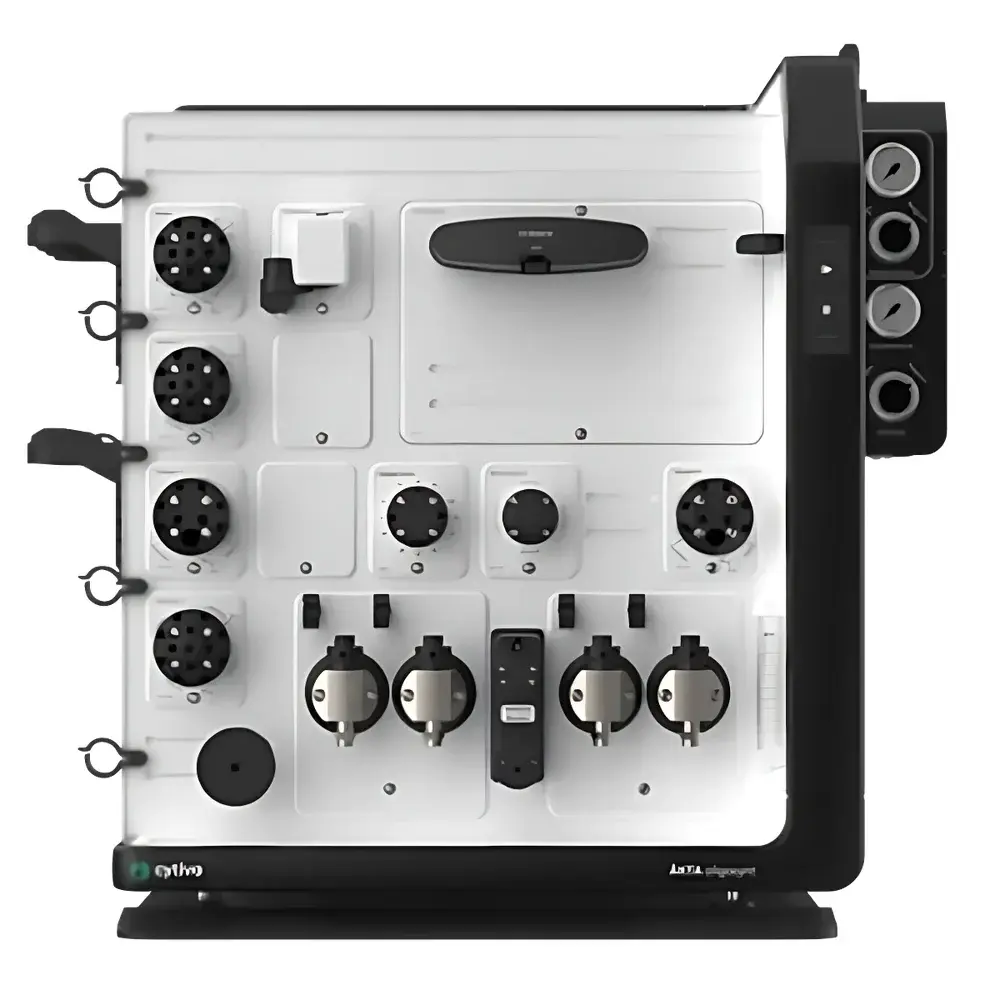
ÄKTA oligosynt™ Oligonucleotide Synthesizer
| Brand | Cytiva |
|---|---|
| Origin | Sweden |
| Model | ÄKTA oligosynt™ |
| Type | Fully Automated Solid-Phase Oligonucleotide Synthesizer |
| Synthesis Scale Range | 40 nmol to 1 µmol |
| Reagent Delivery Precision | ≤2% RSD |
| System Footprint | 600 × 650 × 700 mm (W × D × H) |
| Integrated Sensor Suite | Pressure, Mass Flow, Temperature, UV Absorbance, Conductivity |
| Compliance | Designed for GLP/GMP-aligned process development environments |
Overview
The ÄKTA oligosynt™ Oligonucleotide Synthesizer is a fully automated, benchtop-scale solid-phase synthesizer engineered for precision, reproducibility, and scalability in oligonucleotide process development. Built on Cytiva’s proven ÄKTA platform architecture, it implements phosphoramidite chemistry under strictly controlled anhydrous and inert conditions—leveraging sequential, computer-regulated delivery of activated nucleoside phosphoramidites, oxidizing, capping, and deblocking reagents. Unlike conventional parallel or low-throughput synthesizers, the ÄKTA oligosynt™ employs a serial flow-through column configuration with real-time in-line monitoring, enabling quantitative assessment of coupling efficiency, detritylation completeness, and reagent consumption per cycle. Its design prioritizes robustness for method transfer: synthesis parameters—including dwell times, solvent flush volumes, activator concentration gradients, and stepwise pressure profiles—are digitally defined, version-controlled, and directly exportable to larger-scale Cytiva systems such as the ÄKTA avant-based oligonucleotide manufacturing platforms.
Key Features
- Modular fluidic architecture with chemically resistant PFA and MP35N wetted materials, compatible with acetonitrile, dichloromethane, pyridine, and iodine-based oxidizers
- Integrated high-sensitivity pressure transducers (0–10 bar range) and thermal mass flow controllers (±0.5% full scale accuracy) for precise reagent metering and column backpressure management
- On-board UV-Vis spectrophotometer (190–800 nm) for real-time trityl cation release quantification during detritylation—enabling cycle-by-cycle coupling yield calculation
- Conductivity sensor for wash solvent purity verification and residual amine detection post-capping
- Touch-enabled, web-based HMI with drag-and-drop method editor, audit-trail-enabled parameter logging, and role-based user access control
- Support for external peripherals via standardized TTL and analog I/O ports—including integration with nitrogen purge cabinets, environmental chambers, or automated cleavage/deprotection modules
Sample Compatibility & Compliance
The ÄKTA oligosynt™ accommodates standard 1000–2000 Å pore-size controlled-pore glass (CPG) supports, universal solid-phase carriers (e.g., polystyrene, oxalyl-CPG), and specialty linkers for modified nucleotides (e.g., LNA, 2′-O-methyl, phosphorothioate, fluorescent dyes, biotin). It supports synthesis of DNA, RNA, and chimeric sequences up to 200 nt with <99.3% average stepwise coupling efficiency (verified per ASTM E2915-22). The system’s firmware and electronic logbook comply with ALCOA+ data integrity principles and are configurable to meet 21 CFR Part 11 requirements—including electronic signatures, immutable audit trails, and secure user authentication. All hardware components adhere to IEC 61000-6-3 (EMC) and IEC 61010-1 (safety) standards; CE marking is valid for laboratory use within the EEA.
Software & Data Management
UNICORN 8.2 software (included) provides end-to-end workflow orchestration—from sequence import (FASTA, CSV, or manual entry) and method generation to real-time chromatogram overlay, yield prediction modeling, and raw data export in HDF5 format. Method files are stored in encrypted SQLite databases with SHA-256 hash validation. Batch reports include timestamped sensor traces, reagent lot traceability, cycle-specific UV peak integrals, and deviation alerts triggered by pre-set thresholds (e.g., >5% drop in trityl signal amplitude). Data exports support direct ingestion into LIMS platforms via RESTful API or SFTP push, and raw sensor streams are timestamp-synchronized to microsecond resolution for multivariate process analysis.
Applications
- Rapid screening of phosphoramidite coupling reagents and activators under varied temperature and residence time conditions
- Development and qualification of novel solid supports and linker chemistries for improved deprotection kinetics
- Process characterization studies supporting QbD (Quality by Design) submissions to regulatory agencies
- Small-batch synthesis of clinical-grade antisense oligonucleotides (ASOs) and siRNA guide strands for pre-IND toxicology studies
- Training platform for GMP-compliant oligonucleotide manufacturing operations—mirroring control logic and alarm hierarchies of production-scale systems
- In-process monitoring of side reactions (e.g., cyanoethyl adduct formation, depurination) via spectral deconvolution of UV traces
FAQ
What synthesis scales does the ÄKTA oligosynt™ support?
It operates across a validated linear scale range from 40 nmol to 1 µmol per synthesis column, with consistent coupling efficiency and minimal inter-scale variability.
Can methods developed on this system be transferred to manufacturing-scale synthesizers?
Yes—method files are natively compatible with Cytiva’s ÄKTA process systems; scaling is achieved via geometric similarity principles and flow-rate normalization, preserving residence time distributions and mixing Reynolds numbers.
Is the system compliant with FDA 21 CFR Part 11?
When configured with UNICORN 8.2 in “Regulatory Mode”, it meets all technical and procedural requirements for electronic records and signatures, including audit trail review functionality and password complexity enforcement.
Does it support RNA synthesis with 2′-protecting groups?
Yes—fully compatible with tert-butyldimethylsilyl (TBDMS) and bis(2-acetoxyethoxy)methyl (ACE) RNA phosphoramidites, including integrated acid-labile protecting group removal protocols.
What maintenance intervals are recommended for fluidic components?
PFA tubing and column frits require replacement every 200 synthesis cycles; valves and pumps undergo automated calibration checks every 50 runs, with full service recommended annually by Cytiva-certified field engineers.
Related Products



