
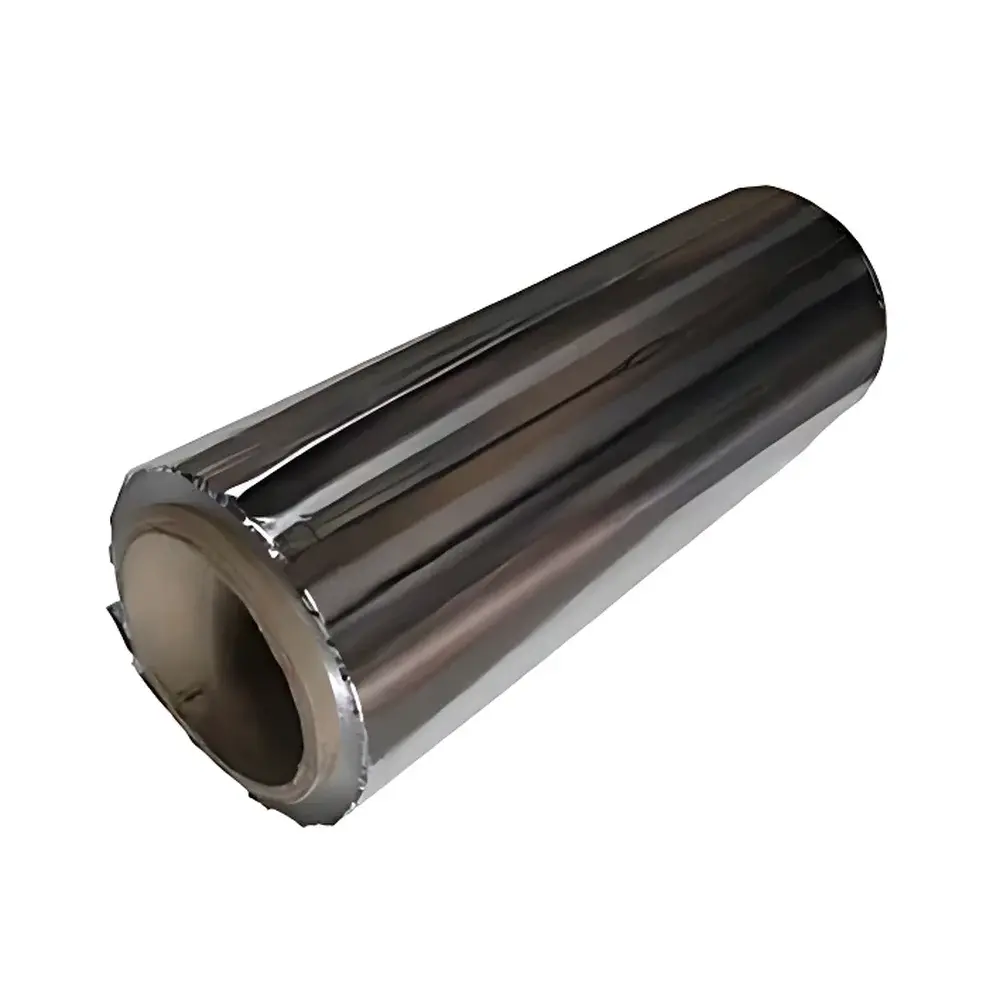
Al Foil for Quartz Crystal Microbalance (QCM) Applications – Hefei Kejing High-Purity Aluminum Substrate
| Brand | Hefei Kejing |
|---|---|
| Dimensions | 500 mm × 295 mm × 15 µm |
| Purity | 99.9% (3N) |
| Density | 2.70 g·cm⁻³ |
| Packaging | Vacuum-sealed in Class 100 cleanroom bags, stored and shipped from Class 1000 cleanroom environment |
Overview
This high-purity aluminum foil is specifically engineered as a substrate material for quartz crystal microbalance (QCM) sensor fabrication, thin-film deposition studies, and electrochemical interface characterization. Unlike generic industrial foils, this grade is manufactured under controlled cleanroom conditions to minimize surface contamination, native oxide variability, and mechanical defects—critical parameters that directly influence QCM frequency stability, mass sensitivity, and Sauerbrey equation applicability. The 15 µm thickness provides optimal mechanical handling robustness while maintaining sufficient flexibility for uniform electrode transfer or sputtering target mounting. Its consistent 3N purity ensures minimal trace-metal interference during in situ electrochemical QCM (EQCM) measurements, particularly in corrosive or reducing electrolytes where impurity-driven side reactions compromise signal fidelity.
Key Features
- Ultra-low surface defect density: No visible oxidation, pinholes, edge curling, or macroscopic waviness—verified via optical inspection under 50× magnification in ISO Class 5 (Class 100) laminar flow hoods
- Precision-calibrated thickness tolerance: ±0.5 µm across full sheet area, enabling reproducible acoustic impedance matching with AT-cut quartz crystals (fundamental frequency 5–10 MHz)
- Controlled native oxide layer: Native Al₂O₃ thickness stabilized at ≤3 nm via inert-gas passivation post-rolling, minimizing uncontrolled interfacial capacitance drift during long-term EQCM monitoring
- Cleanroom-integrated packaging: Double-bagged in static-dissipative, low-outgassing polyethylene; vacuum sealed with residual pressure <10 Pa to prevent moisture adsorption and hydroxide formation during storage
- Traceable lot documentation: Each batch includes certificate of analysis (CoA) listing ICP-MS quantification of Fe, Cu, Si, Mg, and Na impurities (<10 ppm each), aligned with ASTM E1479-22 for reference materials used in electrochemical sensors
Sample Compatibility & Compliance
This Al foil is compatible with standard QCM electrode patterning techniques—including photolithography, laser ablation, and shadow-mask evaporation—as well as physical vapor deposition (PVD) processes such as thermal evaporation and magnetron sputtering. Its surface energy (45–48 mN·m⁻¹, measured by sessile drop with diiodomethane/water) supports uniform wetting of conductive inks and polymer electrolytes. For regulated environments, the manufacturing and packaging workflow complies with ISO 14644-1 Class 5 (Federal Standard 209E Class 100) cleanroom protocols. While not an active instrument, its use in GLP/GMP-aligned laboratories supports audit readiness when documented within instrument qualification files (IQ/OQ/PQ) for QCM-based release testing per USP Analytical Instrument Qualification.
Software & Data Management
As a consumable substrate—not an instrument—this foil does not include embedded firmware or software interfaces. However, it is fully interoperable with industry-standard QCM data acquisition platforms including QCM-I (Biolin Scientific), Q-Sense E4 (Q-Sense AB), and custom LabVIEW- or Python-based DAQ systems. When integrated into validated EQCM workflows, foil lot numbers must be recorded in electronic lab notebooks (ELNs) with metadata linking to raw frequency shift (Δf) and dissipation (ΔD) datasets. Traceability aligns with FDA 21 CFR Part 11 requirements when paired with audit-trail-enabled ELN systems (e.g., Benchling, LabArchives) and timestamped calibration logs for associated oscillator electronics.
Applications
- Preparation of working electrodes for in situ electrochemical QCM studies of aluminum anodization, Li-ion battery SEI formation, and corrosion inhibition mechanisms
- Sputtering target backing or sacrificial layer in multilayer QCM sensor stacks requiring thermal expansion coefficient matching (α ≈ 23.1 × 10⁻⁶ K⁻¹)
- Reference substrate for calibrating mass sensitivity (C-factor) of QCM resonators operating in liquid phase (e.g., aqueous Na₂SO₄, PBS, or organic electrolytes)
- Control material in interlaboratory comparison studies assessing QCM reproducibility under ISO/IEC 17043 proficiency testing schemes
- Substrate for graphene or MXene transfer where minimal metal ion leaching prevents catalytic degradation of 2D materials during annealing
FAQ
Is this foil suitable for high-vacuum thermal evaporation?
Yes—outgassing rate is <5 × 10⁻⁹ Torr·L·s⁻¹·cm⁻² at 25 °C (measured per ASTM E1557), and it withstands bake-out temperatures up to 150 °C without delamination or blistering.
Can it be sterilized for biological QCM applications?
Ethanol wipe or UV-O₃ treatment (30 min, 185/254 nm) is validated; autoclaving or gamma irradiation is not recommended due to native oxide thickening and grain boundary oxidation.
What is the typical shelf life under recommended storage?
24 months when kept sealed in original packaging at 20–25 °C and <40% RH; requalification via XPS surface scan is advised after 12 months for critical EQCM applications.
Related Products




