
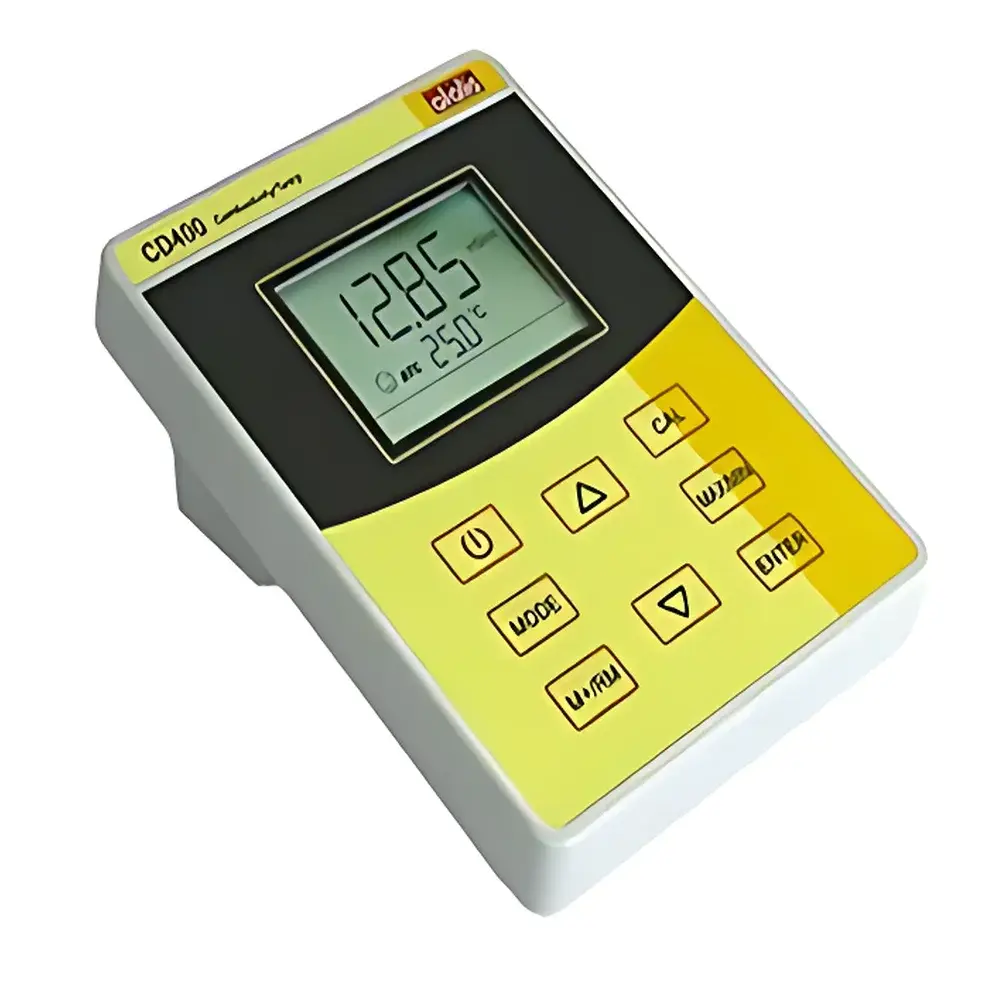
Alalis CD400 Educational Benchtop Conductivity Meter
| Brand | Alalis |
|---|---|
| Origin | Shanghai, China |
| Model | CD400 Educational |
| Form Factor | Benchtop |
| Conductivity Range | 0–200 mS/cm (with sub-ranges: 0–200 μS/cm, 200–2000 μS/cm, 2.00–20.00 mS/cm, 20.0–200.0 mS/cm) |
| TDS Range | 0–100 g/L |
| Resistivity Range | 0–100 MΩ·cm |
| Salinity Range | 0–100 ppt |
| Temperature Range | 0–100 °C |
| Accuracy | ±1.0% FS (conductivity), ±0.5 °C (temperature) |
| Minimum Resolution | 0.1 μS/cm |
| Temperature Compensation | Automatic/manual (0–50 °C) |
| Electrode Constants Supported | K = 0.1, 1.0, 10.0 cm⁻¹ |
| Calibration | 1–3 point auto-calibration with built-in guidance and validation |
| Standard Solution Recognition | CH & USA series (8 total) |
| Data Storage | 50 manual entries with min/max tracking |
| Display | 80 × 58 mm LCD, large-font interface |
| IP Rating | IP54 |
| Compliance | Designed for GLP-compliant educational and industrial QA/QC workflows |
Overview
The Alalis CD400 Educational Benchtop Conductivity Meter is a precision-engineered instrument designed for rigorous academic instruction and applied industrial water quality monitoring. It operates on the fundamental principle of two-electrode or four-electrode conductometric measurement—applying an alternating current across a defined electrode geometry to determine solution conductivity based on Ohm’s law and cell constant calibration. Its extended temperature range (0–100 °C) and broad conductivity span (0–200 mS/cm) make it particularly suitable for applications involving high-temperature process streams—including boiler feedwater, condensate loops, multi-effect distillation systems in pharmaceutical manufacturing, heat exchanger monitoring, and industrial cleaning validation. Unlike portable meters optimized for field spot checks, the CD400 prioritizes repeatability, traceable calibration integrity, and pedagogical transparency—enabling students and technicians to observe real-time effects of temperature compensation, electrode polarization, and cell constant selection on measured values.
Key Features
- Multi-point auto-calibration (1–3 points) with step-by-step on-screen guidance and automatic validation of standard solution acceptance criteria
- Intelligent recognition of eight certified conductivity standards across CH (Chinese national standards) and USA (NIST-traceable) series
- Selectable cell constants (K = 0.1, 1.0, or 10.0 cm⁻¹) to match electrode geometry and sample conductivity range—critical for minimizing polarization error in high- or low-conductivity media
- Endpoint stabilization algorithm that suppresses transient drift and delivers stable, repeatable readings within defined response thresholds
- Large-format 80 × 58 mm LCD with high-contrast, oversized numerals—optimized for classroom demonstration and lab bench readability under variable ambient lighting
- Configurable temperature compensation (0–50 °C), supporting both automatic RTD-based correction and manual input for non-standard probe configurations
- Integrated data logging: 50 manually triggered measurements with timestamped min/max tracking, recallable via front-panel navigation
- Dual temperature units (°C/°F), factory-reset functionality, and IP54-rated enclosure with sealed connector ports for enhanced durability in teaching labs and light industrial environments
Sample Compatibility & Compliance
The CD400 accommodates aqueous solutions across wide ionic strength gradients—from ultrapure water (resistivity up to 100 MΩ·cm) to saturated brines (salinity up to 100 ppt). Its robust analog front-end and guarded electrode interface minimize noise in electrically noisy environments typical of HVAC or steam-generation facilities. While not certified for hazardous area use, its design adheres to IEC 61010-1 safety requirements for laboratory electrical equipment. For regulated environments, the meter supports documentation practices aligned with ISO/IEC 17025 and ASTM D1125 (Standard Test Methods for Electrical Conductivity and Resistivity of Water), enabling traceable calibration records and audit-ready operation logs. Its fixed K=1 electrode (included) meets USP conductivity system suitability criteria for purified water testing when used with validated procedures.
Software & Data Management
No proprietary software or USB connectivity is required for basic operation; all configuration, calibration, and data review occur via intuitive front-panel controls. However, stored measurements (50 entries) retain full metadata—including date/time stamp, conductivity value, temperature reading, selected cell constant, and calibration status—accessible through hierarchical menu navigation. The instrument does not support FDA 21 CFR Part 11 electronic signatures or audit trails natively, but its deterministic behavior, non-volatile memory retention, and manual record export capability facilitate compliance with GLP documentation standards in academic and non-GMP industrial settings. Calibration certificates for included standards and electrode can be retained alongside instrument logbooks for full traceability.
Applications
- University chemistry and environmental engineering laboratories—teaching core concepts of electrolytic conduction, Kohlrausch’s law, and temperature dependence of ionic mobility
- Pharmaceutical water system qualification—monitoring conductivity of purified water (PW) and water for injection (WFI) per pharmacopeial limits during commissioning and routine surveillance
- Power generation facilities—tracking condensate purity and detecting cooling tower leakage into steam cycles
- Food & beverage processing—verifying rinse water conductivity after CIP (clean-in-place) cycles to ensure detergent removal
- Mechanical parts cleaning validation—quantifying residual ionic contamination on surfaces post-ultrasonic or alkaline wash
- Industrial boiler water management—assessing blowdown frequency and feedwater treatment efficacy through continuous conductivity trending
FAQ
Does the CD400 support automatic temperature compensation beyond 50 °C?
No—the ATC circuitry is specified for 0–50 °C. For samples above 50 °C, manual temperature entry is required, and users must apply external compensation factors per ASTM D1125 Annex A2.
Can the included K=1 electrode be used for ultrapure water measurements?
It is not recommended. For resistivity >1 MΩ·cm, a flow-through cell with K=0.1 cm⁻¹ and guarded electrodes is required to mitigate surface leakage and atmospheric CO₂ interference.
Is the CD400 compliant with USP for pharmaceutical water testing?
The instrument itself is not USP-certified, but when operated with a calibrated K=0.1 cell, NIST-traceable standards, and documented procedures, it satisfies the functional requirements outlined in USP Section 3.
How often should the electrode be recalibrated?
Calibration frequency depends on usage intensity and regulatory context. In educational labs, daily verification before first use is advised. In QC environments, calibration before each analytical batch—or at least every 2 hours during continuous operation—is standard practice.
What happens if the rubber seal on the electrode port is damaged?
Loss of IP54 protection increases susceptibility to dust ingress and moisture exposure, potentially affecting long-term stability of internal analog circuitry. Replacement seals are available from Alalis technical support upon request.





