
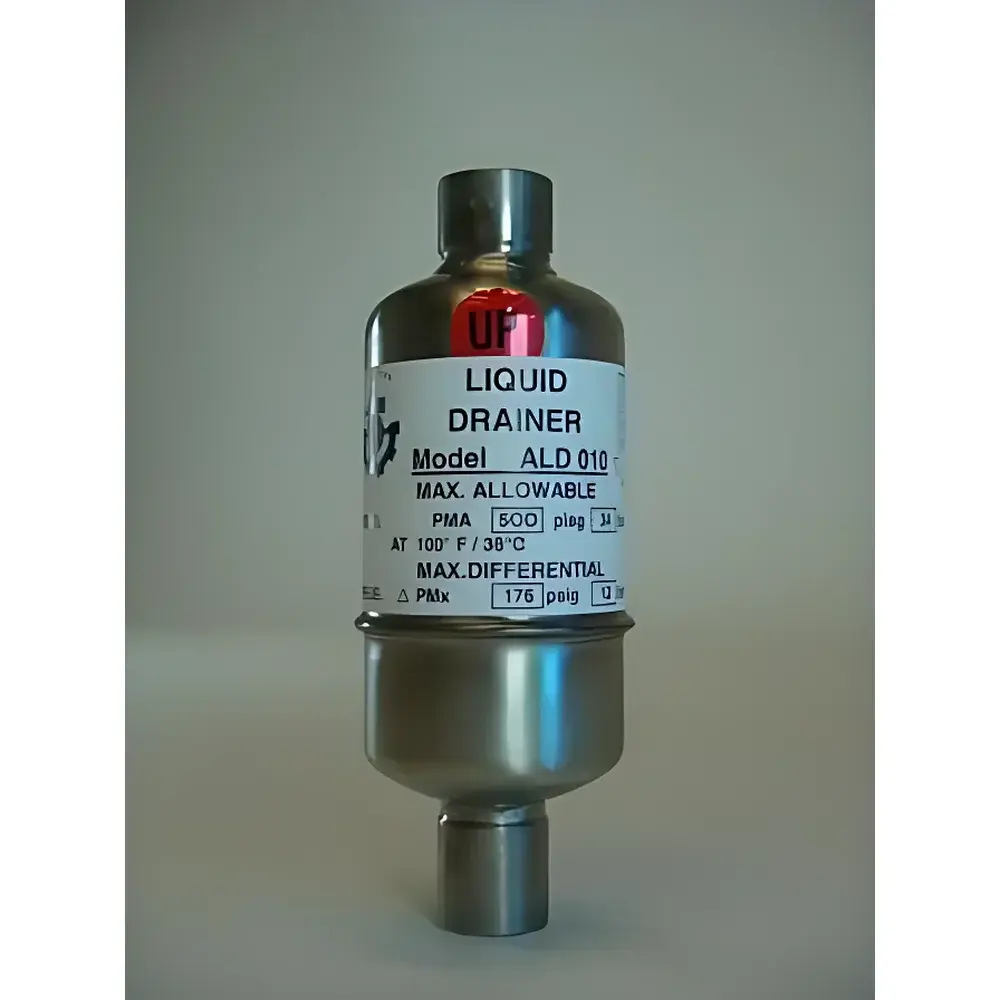
ALD Condensate Drain Unit
| Origin | Netherlands |
|---|---|
| Manufacturer Type | Distributor |
| Origin Category | Imported |
| Model | ALD Condensate Drain Unit |
| Pricing | Upon Request |
Overview
The ALD Condensate Drain Unit is a precision-engineered component designed for integration into industrial gas sampling and conditioning systems—particularly where saturated or humid process gases undergo active cooling. As cooled gas streams pass through sample lines or pre-treatment modules, water vapor condenses, forming liquid droplets that pose significant risks: flow restriction, sensor fouling, corrosion of downstream analyzers (e.g., NDIR, electrochemical, or PID sensors), and measurement drift. The ALD unit addresses this challenge using gravity-assisted phase separation combined with pressure-driven automatic drainage. It operates on the principle of differential density separation in a vertical chamber, where condensed water accumulates at the bottom while dry gas continues upward via a side-port outlet. Unlike passive drip legs or manual drain valves, the ALD system maintains continuous, unattended operation under stable backpressure—ensuring gas integrity and analytical reliability across extended monitoring cycles.
Key Features
- Integrated dual-function design: combines coalescing pre-separation and autonomous condensate ejection in a single compact housing.
- Side-mounted gas inlet/outlet configuration enables inline installation without flow redirection or additional T-fittings.
- Pressure-actuated diaphragm valve mechanism ensures reliable drainage at defined minimum backpressure thresholds—typically ≥0.15 bar(g) above ambient, compatible with most extractive CEMS and portable gas analyzers.
- Chemically resistant wetted materials (316 stainless steel body, FKM elastomers) ensure long-term stability in corrosive environments containing H₂S, SO₂, NOₓ, or acidic condensates.
- No external power supply or control signals required—fully mechanical, intrinsically safe operation suitable for Zone 1/2 hazardous areas.
- Transparent sight port (optional) allows visual verification of condensate level and drainage activity during commissioning and routine maintenance.
Sample Compatibility & Compliance
The ALD Condensate Drain Unit is validated for use with ambient to moderately elevated temperature gas streams (−20 °C to +60 °C) and relative humidity levels up to 100 % RH. It accommodates common industrial gas matrices including flue gas, biogas, landfill gas, compressed air, natural gas (dry basis), and ambient air monitoring streams. The unit complies with structural requirements outlined in EN 15267-3 (performance testing of automated measuring systems) and supports traceable calibration workflows per ISO/IEC 17025. When deployed within an overall gas analysis system, it contributes to meeting data integrity criteria specified in EPA Method 9, EN 14181 (QAL2/QAL3), and EU Directive 2010/75/EU (IED)—particularly regarding sample representativeness and moisture interference mitigation.
Software & Data Management
As a purely mechanical, non-electronic subsystem, the ALD Condensate Drain Unit does not incorporate firmware, embedded software, or digital interfaces. Its operational status is inferred indirectly through upstream pressure transducers or differential pressure monitoring across the unit (e.g., using a DP cell installed before and after the ALD). In fully integrated CEMS architectures, PLC or DCS logic may correlate drainage frequency with ambient dew point trends or chiller duty cycles—enabling predictive maintenance alerts. While the ALD itself generates no data logs, its consistent performance underpins audit-ready data chains compliant with FDA 21 CFR Part 11 (when part of a validated emissions monitoring system) and supports GLP/GMP-aligned environmental reporting frameworks requiring documented sample conditioning integrity.
Applications
- Continuous Emissions Monitoring Systems (CEMS) for thermal power plants, cement kilns, and waste incinerators.
- Biogas upgrading and quality control stations requiring dew point stabilization prior to CH₄/C₂H₆ analysis.
- Indoor air quality (IAQ) networks deploying multi-gas sensors in high-humidity HVAC ducts.
- Calibration gas delivery systems where moisture-sensitive reference standards must remain uncontaminated.
- Mobile emission testing units (e.g., PEMS) operating under variable ambient conditions and transient load profiles.
- Research-grade atmospheric chemistry sampling trains involving cryogenic trapping or adsorption-based preconcentration.
FAQ
What minimum system backpressure is required for automatic drainage?
A sustained differential pressure of ≥0.15 bar(g) between inlet and outlet is necessary to actuate the internal diaphragm valve. Lower pressures may result in incomplete or intermittent drainage.
Can the ALD unit be installed vertically only, or is horizontal mounting acceptable?
Vertical orientation is mandatory to ensure proper gravitational phase separation and condensate pooling at the base chamber. Horizontal installation compromises separation efficiency and may cause gas bypass or liquid carryover.
Is routine maintenance required, and how often should the unit be inspected?
Visual inspection every 3–6 months is recommended; cleaning of the internal baffle and valve seat is advised annually or following exposure to particulate-laden or oily gas streams.
Does the ALD unit include filtration capability for particulates or aerosols?
No—the ALD is not a filter. It separates bulk liquid condensate only. For sub-micron aerosols or solid particulates, a dedicated sintered metal or ceramic pre-filter (e.g., 5 µm rating) must be installed upstream.
Is third-party certification available for hazardous area use?
Yes—ATEX and IECEx certifications (Category 2G, Ex db IIB T4 Gb) are available upon request for units equipped with certified enclosure variants and material traceability documentation.
Related Products







