
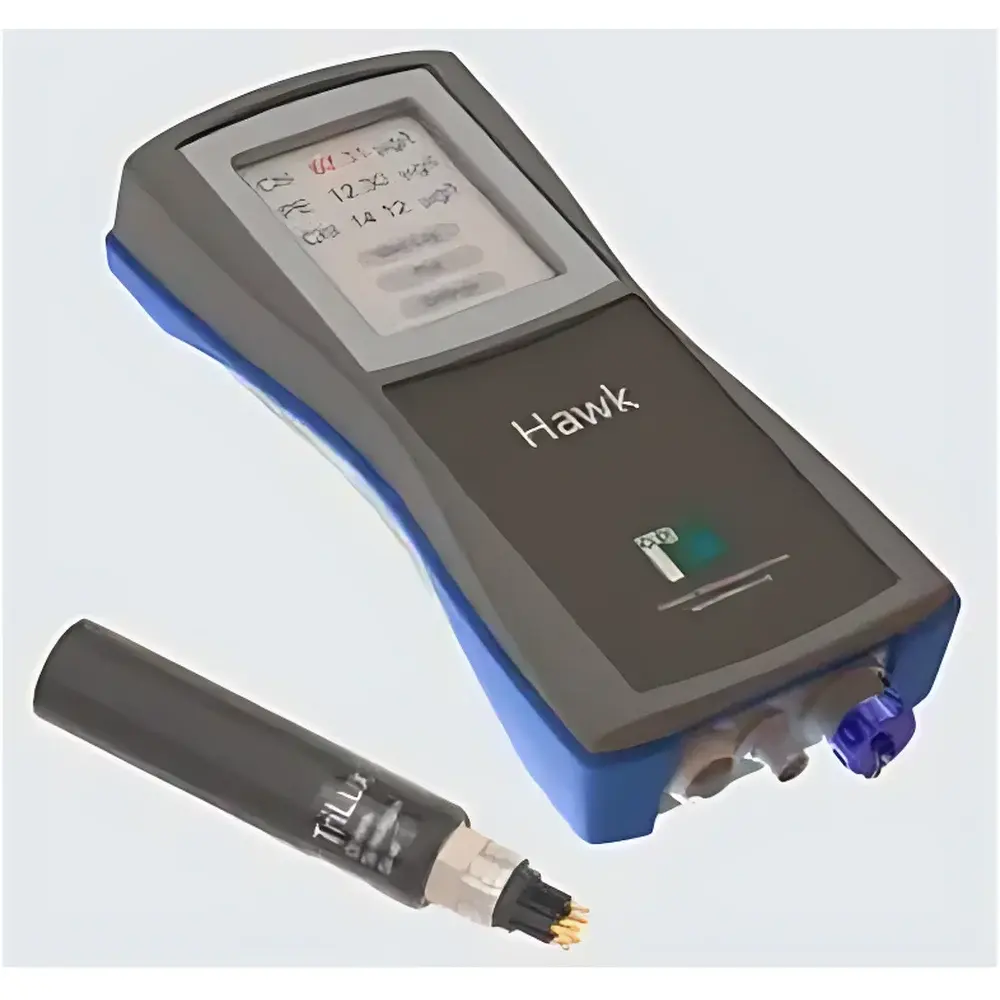
ALGAE-Wader and ALGAE-Wader Pro Algal Biomass Analyzer
| Brand | CTG |
|---|---|
| Origin | UK |
| Instrument Type | Portable/Handheld Water Quality Analyzer |
| Detection Parameter | Algal Pigments (Chlorophyll-a, Phycocyanin, Phycoerythrin) and Turbidity |
| Sensor Technology | Submersible Fluorescence Probe (TriLux Series) |
| Data Logger | Hawk Handheld Terminal (IP68-rated, Touchscreen, 2 GB Internal Storage) |
| Power Options | Rechargeable or Disposable Batteries |
| Compliance | Designed for Field-Deployable Environmental Monitoring per ISO 10260, ASTM D3921, and EPA Method 445.0 (Chlorophyll-a by Fluorometric Determination) |
Overview
The ALGAE-Wader and ALGAE-Wader Pro are field-deployable algal biomass analyzers engineered for in-situ, real-time quantification of phytoplankton pigments in natural and engineered water systems. These instruments operate on the principle of selective excitation and emission fluorescence detection—leveraging three-wavelength optical interrogation (TriLux probe architecture) to resolve chlorophyll-a (Chl-a), phycocyanin (PC), and phycoerythrin (PE) independently, while concurrently measuring turbidity as a co-located optical parameter. Unlike broad-spectrum absorbance methods, this fluorescence-based approach delivers high specificity for functional algal groups—including cyanobacteria (via PC), cryptophytes (via PE), and general eukaryotic phytoplankton (via Chl-a)—with minimal interference from colored dissolved organic matter (CDOM) or suspended solids. The system is calibrated against reference pigment extracts and validated per EPA Method 445.0 and ISO 10260 for fluorometric Chl-a determination, ensuring traceability to internationally accepted protocols.
Key Features
- TriLux multi-parameter submersible probe with factory-calibrated, temperature-compensated fluorescence channels for Chl-a, PC, PE, and turbidity
- Hawk handheld terminal featuring an IP68-rated rugged enclosure, capacitive touchscreen interface, and embedded GPS for georeferenced data tagging
- Real-time visualization of pigment concentrations in both numeric and time-series graphical formats (log-scale and linear options)
- User-configurable sampling intervals (1 s to 24 h), alarm thresholds (ppb-level Chl-a triggers), and dynamic range selection (0.01–500 µg/L Chl-a typical)
- Low-noise photodetector architecture enabling stable signal acquisition under variable ambient light and flow conditions
- 2 GB internal flash memory supporting >1 million timestamped records; export via USB-C or Bluetooth 5.0 to compatible desktop software
- Dual power configuration: lithium-ion rechargeable pack (≥12 h continuous operation) or AA alkaline battery option for extended deployment without charging infrastructure
Sample Compatibility & Compliance
The ALGAE-Wader series is validated for direct immersion in freshwater lakes, reservoirs, rivers, estuaries, drinking water intakes, and wastewater effluents. It meets operational requirements for GLP-aligned environmental monitoring programs and supports audit-ready data integrity through embedded metadata (UTC timestamp, GPS coordinates, probe serial ID, calibration epoch). Firmware implements secure logging with immutable record headers, satisfying documentation expectations under ISO/IEC 17025 and US EPA’s QA/QC guidance for field instrumentation. All optical components comply with IEC 60529 (IP68 ingress protection) and RoHS 2011/65/EU material restrictions.
Software & Data Management
Data collected by the Hawk terminal is structured in CSV and SQLite formats, preserving native sensor resolution and metadata hierarchy. Optional desktop software (CTG AquaView Suite v3.2+) enables batch processing, spectral deconvolution validation, statistical trend analysis, and automated report generation compliant with ISO 5667-3 and ASTM D3921. The software supports 21 CFR Part 11-compliant user authentication, electronic signatures, and full audit trail logging—including modification history, calibration event logs, and instrument configuration snapshots.
Applications
- Early-warning detection of cyanobacterial blooms via real-time phycocyanin threshold exceedance
- Long-term spatial mapping of phytoplankton community structure across reservoir stratification profiles
- Regulatory compliance monitoring for surface water bodies under EU WFD Article 5 reporting requirements
- Process control in drinking water treatment plants—tracking raw water algal load prior to coagulation
- Research-grade validation of satellite-derived chlorophyll products (e.g., Sentinel-3 OLCI, Landsat-9 OLI-2)
- Education and citizen science deployments requiring robust, low-maintenance field instrumentation
FAQ
What calibration standards are supported for field verification?
Certified liquid chlorophyll-a and phycocyanin reference standards (NIST-traceable, 10–1000 µg/L) are recommended for periodic two-point verification. In-field zeroing is performed using particle-free deionized water.
Can the TriLux probe be deployed continuously for unattended monitoring?
Yes—the probe is rated for 30-day submerged operation at depths ≤10 m; optional mooring kits and external power adapters are available for permanent station integration.
How does the system handle biofouling during extended deployments?
The TriLux probe incorporates a hydrophobic optical window coating and optional wiper mechanism (ALGAE-Wader Pro only); routine cleaning intervals are defined per ISO 10260 Annex B guidelines.
Is GPS position data automatically embedded in exported datasets?
Yes—each measurement record includes WGS84 latitude, longitude, altitude, and UTC timestamp, synchronized to the Hawk unit’s internal GNSS receiver (GPS + GLONASS support).
Does the system meet regulatory requirements for reporting to national water authorities?
Data output conforms to EFSA, Environment Agency (UK), and USEPA data submission templates; validation reports and uncertainty budgets are provided upon request for accreditation purposes.
Related Products







