
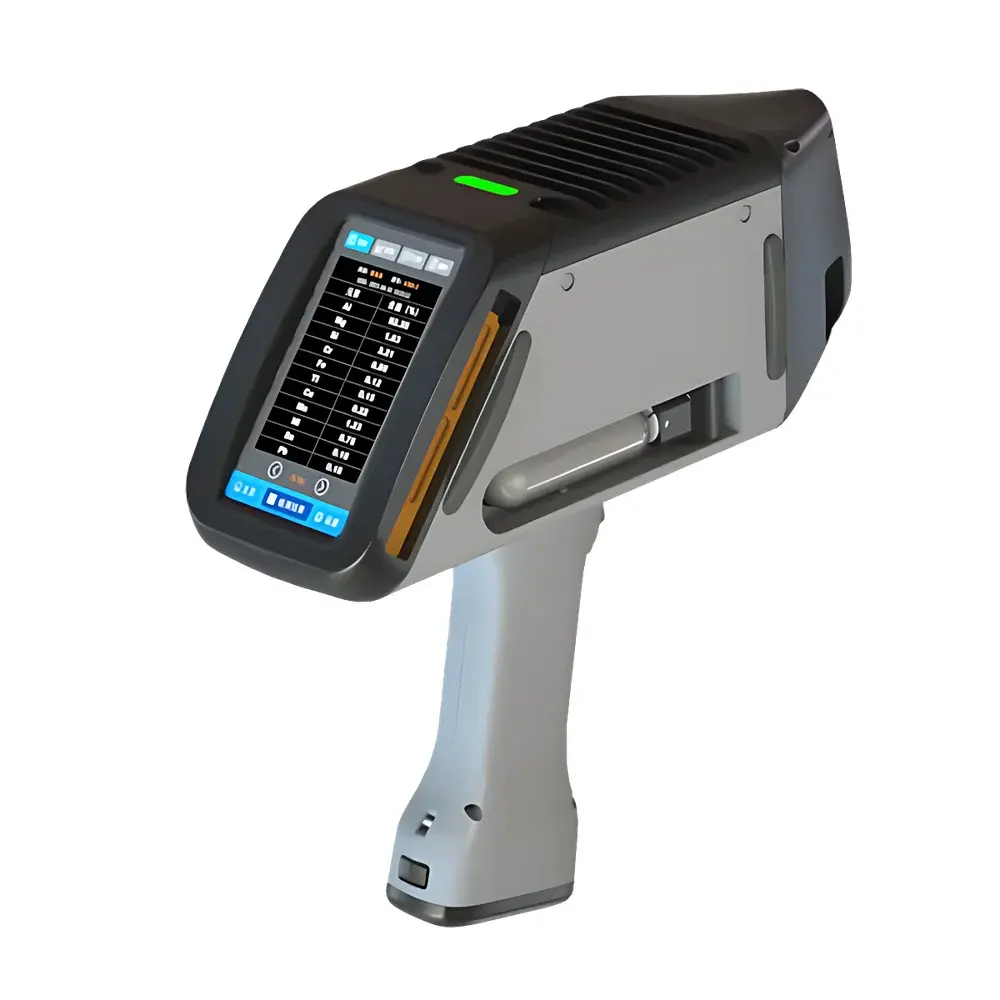
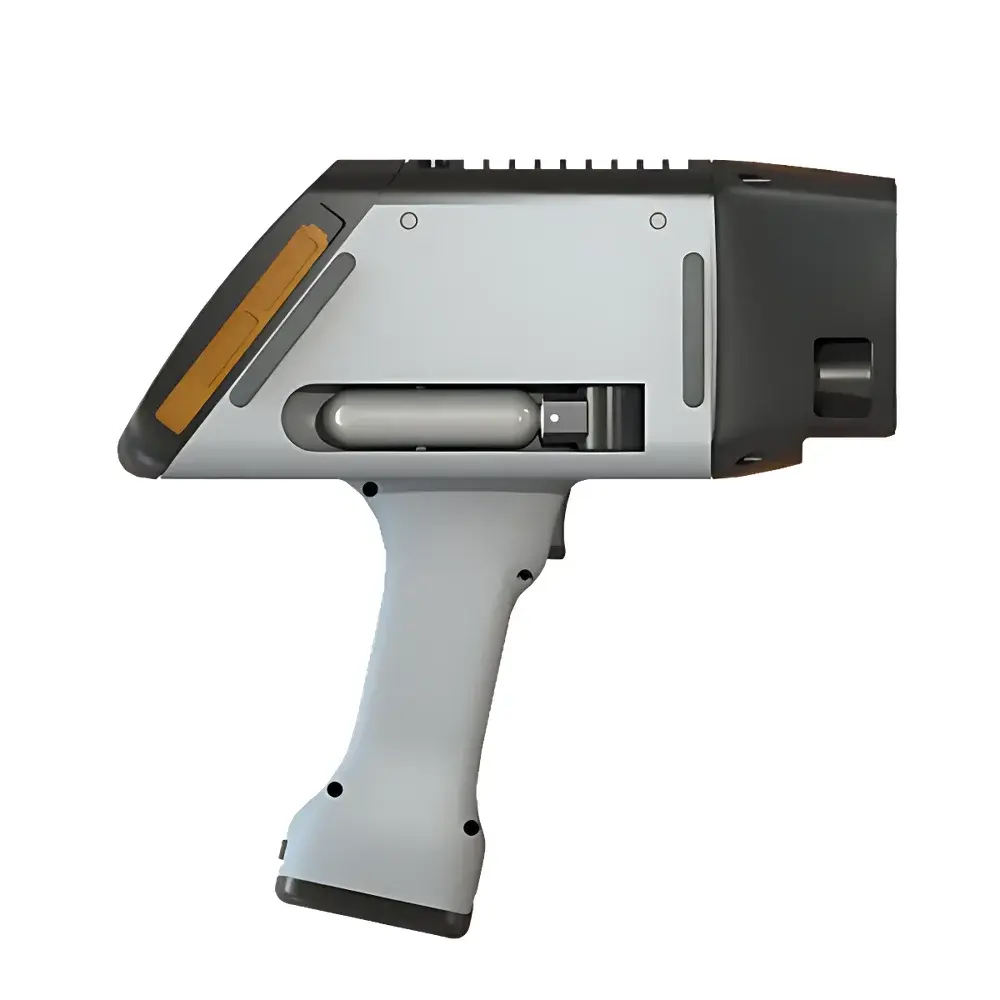
Aliben LMKS Handheld Laser-Induced Breakdown Spectrometer
| Brand | Aliben |
|---|---|
| Origin | Sichuan, China |
| Manufacturer Type | Manufacturer |
| Regional Classification | Domestic (China) |
| Model | LMKS |
| Pricing | Upon Request |
| Instrument Type | Handheld |
| Integration | Fully Integrated Unit |
Overview
The Aliben LMKS Handheld Laser-Induced Breakdown Spectrometer (LIBS) is an engineered field-deployable analytical instrument designed for real-time, in-situ elemental analysis of geological and industrial materials. Based on the fundamental principle of laser-induced breakdown spectroscopy, the LMKS employs a pulsed Nd:YAG laser (typically 1064 nm, nanosecond duration) to ablate a micro-volume of sample surface, generating a transient high-temperature plasma (>10,000 K). As the plasma cools, excited atoms and ions emit characteristic atomic and ionic emission lines across the UV–VIS–NIR spectral range (e.g., 190–900 nm). These emissions are collected via fiber-coupled optics and resolved by a high-resolution Czerny–Turner spectrometer equipped with a scientific-grade CCD or CMOS detector. The resulting spectrum is processed using multivariate calibration models (e.g., partial least squares regression, PLS-R) to deliver quantitative concentrations for major, minor, and trace elements — including light elements inaccessible to conventional X-ray fluorescence (XRF), such as lithium (Li), beryllium (Be), boron (B), carbon (C), nitrogen (N), and oxygen (O).
Key Features
- Multi-element simultaneous detection: Capable of qualitative and semi-quantitative/quantitative analysis of up to 30+ elements in a single laser shot, covering the majority of the periodic table from Li (Z=3) to U (Z=92).
- True handheld ergonomics: Weighing only 2.3 kg (without battery), the LMKS features an integrated ergonomic grip, balanced center-of-mass design, and IP54-rated enclosure for dust and splash resistance — optimized for extended field use.
- Battery-powered operation: Equipped with hot-swappable, high-capacity Li-ion battery packs supporting >6 hours of continuous operation under typical measurement duty cycles (1–5 Hz pulse repetition rate).
- Direct solid sampling: No sample preparation required for rocks, ores, soils, slag, or metallurgical products; analysis occurs in ambient air without vacuum or inert gas purge.
- Light element capability: Unique sensitivity to low-Z elements (Z < 12) enables critical applications in lithium-rich mineral exploration, battery cathode material screening, and geochemical mapping where XRF fails.
Sample Compatibility & Compliance
The LMKS accepts heterogeneous solid samples—including unprepared drill core fragments, outcrop surfaces, crushed ore concentrates, and industrial scrap—without grinding, pressing, or fusion. For liquid or slurry samples, rapid phase conversion is achieved via drop deposition onto inert substrates (e.g., stainless steel or quartz slides) followed by controlled drying. All hardware and firmware comply with IEC 61000-6-3 (EMC emission standards) and IEC 61000-6-2 (immunity). Spectral data acquisition and processing workflows support audit-ready documentation aligned with GLP principles; raw spectra, metadata (laser energy, delay time, gate width), and calibration history are embedded in each result file. While not pre-certified for FDA 21 CFR Part 11, the system architecture permits integration with validated LIMS environments requiring electronic signature and change control.
Software & Data Management
The instrument is operated via the proprietary Aliben LIBS Studio software suite running on an embedded Android-based touchscreen interface. Key capabilities include real-time spectral preview, automated peak identification using NIST Atomic Spectra Database (ASD) libraries, customizable calibration models (user-loaded or factory-provided), and batch reporting in CSV, PDF, and XML formats. All spectral data are stored with timestamp, GPS coordinates (via optional GNSS module), operator ID, and environmental parameters (ambient temperature, humidity). Data export supports secure transfer via USB-C or Wi-Fi 5 (802.11ac) to laboratory networks or cloud-based analytical platforms.
Applications
- Mineral exploration & grade control: Rapid quantification of Fe, Cu, Pb, Zn, Ni, Co, Mn, and REEs in drill chips and trench samples to guide resource estimation and pit optimization.
- Lithium mining operations: On-site discrimination of spodumene, lepidolite, and petalite; real-time Li content mapping at mine face to reduce haulage of low-grade material.
- Secondary battery recycling: Identification and sorting of cathode chemistries (NMC, LFP, LCO) and quantification of Li, Co, Ni, Mn prior to hydrometallurgical processing.
- Environmental geochemistry: Screening for heavy metals (As, Cd, Cr, Pb) in contaminated soils and tailings with sub-ppm detection limits achievable through signal averaging.
- Metallurgical process monitoring: In-line analysis of sinter feed composition and slag basicity control in ferrous and non-ferrous smelting facilities.
FAQ
What is the typical detection limit for lithium in ore samples?
Detection limits for Li vary with matrix and measurement conditions; under optimized settings (50 shots, 3 mJ/pulse, 1.5 µs delay), sub-100 ppm (w/w) is routinely achieved in silicate matrices.
Does the LMKS require helium or argon purge for improved sensitivity?
No — the system operates robustly in ambient air; inert gas purging is optional and only recommended for specific research-grade applications targeting ultra-trace elements.
Can calibration models be transferred between instruments?
Yes — calibration files (.cal) are portable across LMKS units of the same hardware revision; cross-instrument reproducibility is maintained within ±5% RSD for major elements when using standardized reference materials.
Is spectral data compatible with third-party chemometric software?
Yes — raw spectra are exported in industry-standard .SPA or ASCII format, fully compatible with Unscrambler, MATLAB, Python (SciPy/NumPy), and R-based modeling environments.
What safety certifications does the LMKS hold?
The device complies with IEC 60825-1:2014 Class 4 laser safety requirements; integrated interlocks, beam shutter, and Class 4 warning labels meet international regulatory expectations for field-deployed laser systems.






