
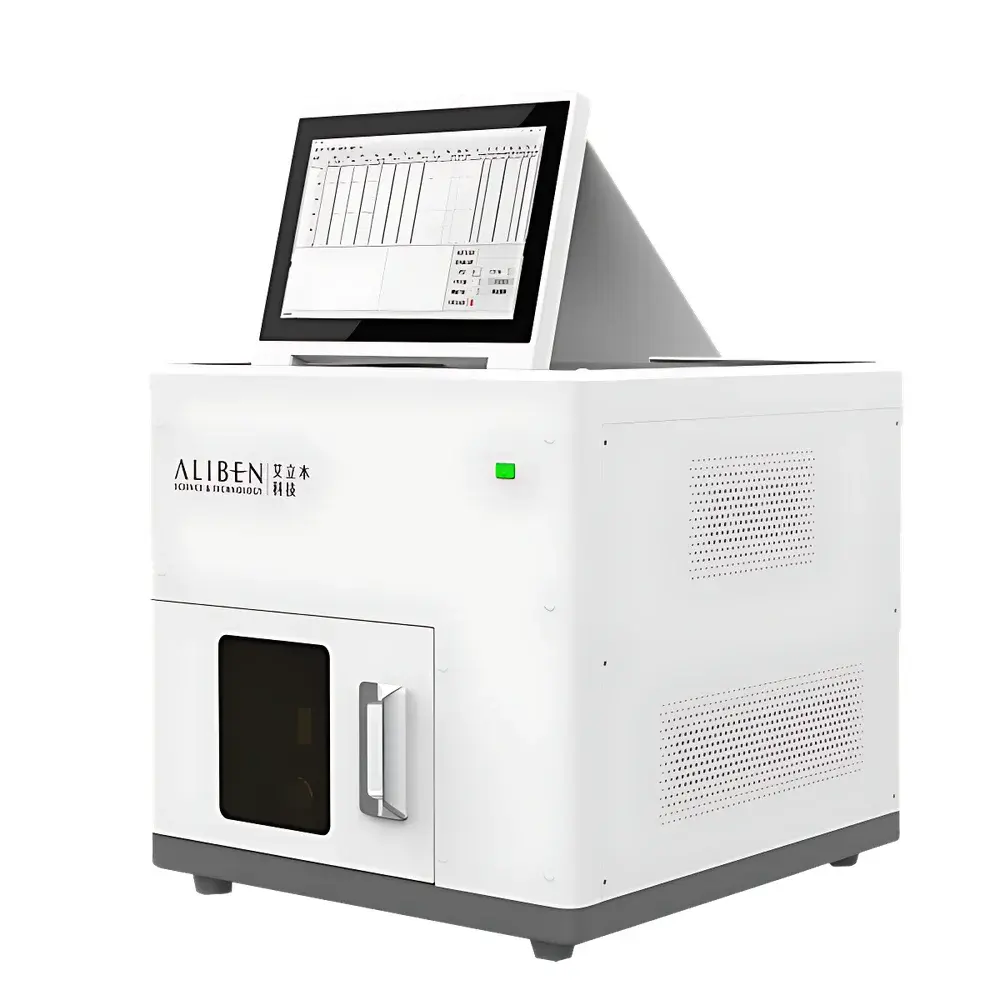
Aliben LT.D00 Benchtop Laser-Induced Breakdown Spectroscopy (LIBS) Analyzer
| Brand | Aliben |
|---|---|
| Origin | Sichuan, China |
| Manufacturer Type | Direct Manufacturer |
| Country of Origin | China |
| Model | LT.D00 |
| Instrument Type | Benchtop |
| Integration | Fully Integrated |
| Laser Pulse Energy | 100 mJ |
| Spectral Range | 185–340 nm (expandable to 180–960 nm) |
| Optical Resolution | 0.10–0.45 nm |
| Sample Analysis Time | 1–60 s (user-configurable) |
| Sample Stage | Motorized 3D Positioning + Automatic Rotation |
| Imaging System | Integrated HD Camera + Real-time Video Feed |
| Operating System | Embedded Windows-based Industrial PC |
| Display | Color Touchscreen Interface |
| Cooling Method | Air-Cooled Laser |
| Dimensions (L×W×H) | 405 × 510 × 430 mm (screen closed) |
| Weight | 43 kg |
| Operating Voltage | AC 220 V |
| Ambient Temperature Range | 10–40 °C (optimal at 20 °C) |
| Relative Humidity | <60% RH (non-condensing) |
Overview
The Aliben LT.D00 is a fully integrated benchtop Laser-Induced Breakdown Spectroscopy (LIBS) analyzer engineered for rapid, in-situ elemental analysis of solid geological and industrial materials. LIBS operates on the principle of laser ablation: a high-energy, nanosecond-duration pulsed laser (100 mJ per pulse) is focused onto the sample surface, generating a transient microplasma (>10,000 K). As the plasma cools, excited atoms and ions emit characteristic atomic and ionic line spectra across the ultraviolet–visible–near-infrared range. The LT.D00 captures this emission using a high-throughput Czerny–Turner spectrometer with calibrated CCD detection, enabling direct qualitative and semi-quantitative multi-element analysis without chemical digestion or vacuum requirements. Its compact architecture, embedded industrial computing platform, and real-time optical feedback make it suitable for laboratory-based geochemical screening, field-deployable QA/QC, and process monitoring environments where speed, minimal sample preparation, and light-element sensitivity (e.g., Li, Be, B, C, N, O, F, Na, Mg, Al, Si, P, S, Cl) are critical.
Key Features
- Fully self-contained benchtop design with integrated laser source, spectrometer, imaging system, and industrial PC — no external computer or peripherals required.
- Motorized 3D sample stage with programmable XYZ translation and automatic rotational control for reproducible ablation positioning and surface mapping.
- Real-time HD optical imaging and video capture synchronized with laser firing — enables precise targeting of heterogeneous samples such as core sections, breccias, or weathered surfaces.
- Wide spectral coverage (185–340 nm standard; optionally extendable to 180–960 nm) supports detection of major, minor, and trace elements including Si, Al, Fe, Ca, Mg, K, Mn, Na, Ti, Ba, Sr, S, Cl, P, V, Ni, Zr, Th, and U.
- Embedded Windows OS with dedicated LIBS acquisition and processing software — includes spectral preprocessing (background subtraction, peak deconvolution), multivariate calibration tools, and customizable spectral libraries.
- Air-cooled Nd:YAG laser ensures operational stability and low maintenance over extended duty cycles — optimized for continuous operation in ambient lab conditions (10–40 °C, <60% RH).
Sample Compatibility & Compliance
The LT.D00 is validated for direct analysis of unprepared solid samples, including but not limited to sedimentary rocks (shale, limestone, sandstone, dolomite, gypsum), igneous and metamorphic specimens, ores, slags, soils, and industrial powders. Its non-contact, micro-destructive nature (<100 µm crater diameter) preserves sample integrity while delivering representative bulk composition data. The system adheres to fundamental principles outlined in ASTM E2926-22 (“Standard Test Method for Determination of Elements in Solid Samples by Laser-Induced Breakdown Spectroscopy”) and supports method development aligned with ISO/IEC 17025 quality management requirements. Data acquisition logs include timestamped spectra, laser energy monitoring, stage coordinates, and environmental metadata — facilitating GLP-compliant recordkeeping and audit readiness.
Software & Data Management
The embedded software suite provides full control over acquisition parameters (laser delay, integration gate, number of accumulations, spectral binning), automated spectral library matching, and quantitative analysis via univariate peak intensity ratios or multivariate regression (PLS, PCA). All raw and processed data are stored in vendor-neutral HDF5 format with embedded metadata compliant with FAIR (Findable, Accessible, Interoperable, Reusable) principles. Audit trails record user actions, parameter changes, and calibration updates — supporting compliance with FDA 21 CFR Part 11 when configured with electronic signature and role-based access controls. Export options include CSV, TXT, and XML for integration with LIMS or third-party chemometric platforms.
Applications
- Geological survey and core logging: rapid lithological classification and elemental trend mapping in drill core, cuttings, and outcrop samples.
- Mining and exploration: on-site grade estimation of ore-bearing elements (e.g., Fe, Cu, Ni, Zn, REEs) and gangue composition assessment.
- Environmental monitoring: detection of heavy metals (Pb, Cd, As, Cr) and anions (Cl⁻, SO₄²⁻) in soil, sediment, and industrial waste matrices.
- Metallurgical process control: real-time slag analysis, alloy verification, and inclusion characterization in castings and rolled products.
- Academic research: fundamental plasma diagnostics, calibration-free LIBS studies, and method transfer between laboratory and portable platforms.
FAQ
Does the LT.D00 require vacuum or inert gas purging for operation?
No — the system operates under ambient air conditions. Optional argon purge kits are available for enhanced signal-to-noise ratio in specific applications.
Can the LT.D00 perform quantitative analysis without matrix-matched standards?
It supports both calibration-based quantification (using certified reference materials) and calibration-free LIBS (CF-LIBS) approaches, though accuracy improves with matrix-matched standards for routine QA/QC.
Is spectral data export compatible with third-party chemometric software?
Yes — all spectra are saved in HDF5 format with documented metadata schema, enabling seamless import into MATLAB, Python (SciPy, scikit-learn), Unscrambler, or Pirouette.
What maintenance is required for the air-cooled laser module?
Annual inspection of cooling fans and optical alignment verification is recommended; no consumables or laser gas refills are required.
How is measurement reproducibility ensured across different operators?
The motorized stage, auto-focus imaging, and scriptable acquisition protocols minimize operator-dependent variability; built-in performance verification checks (e.g., NIST-traceable spectral line positions) support daily system suitability testing.
Related Products






