
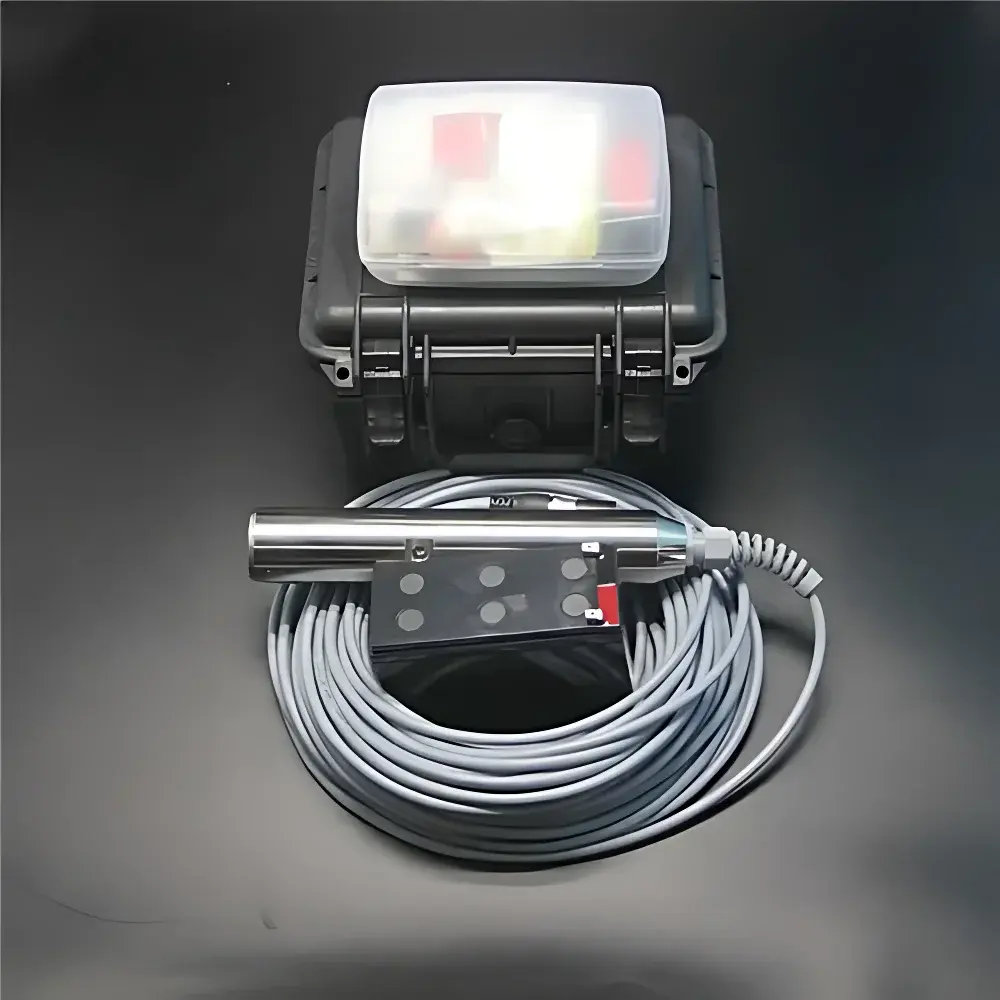
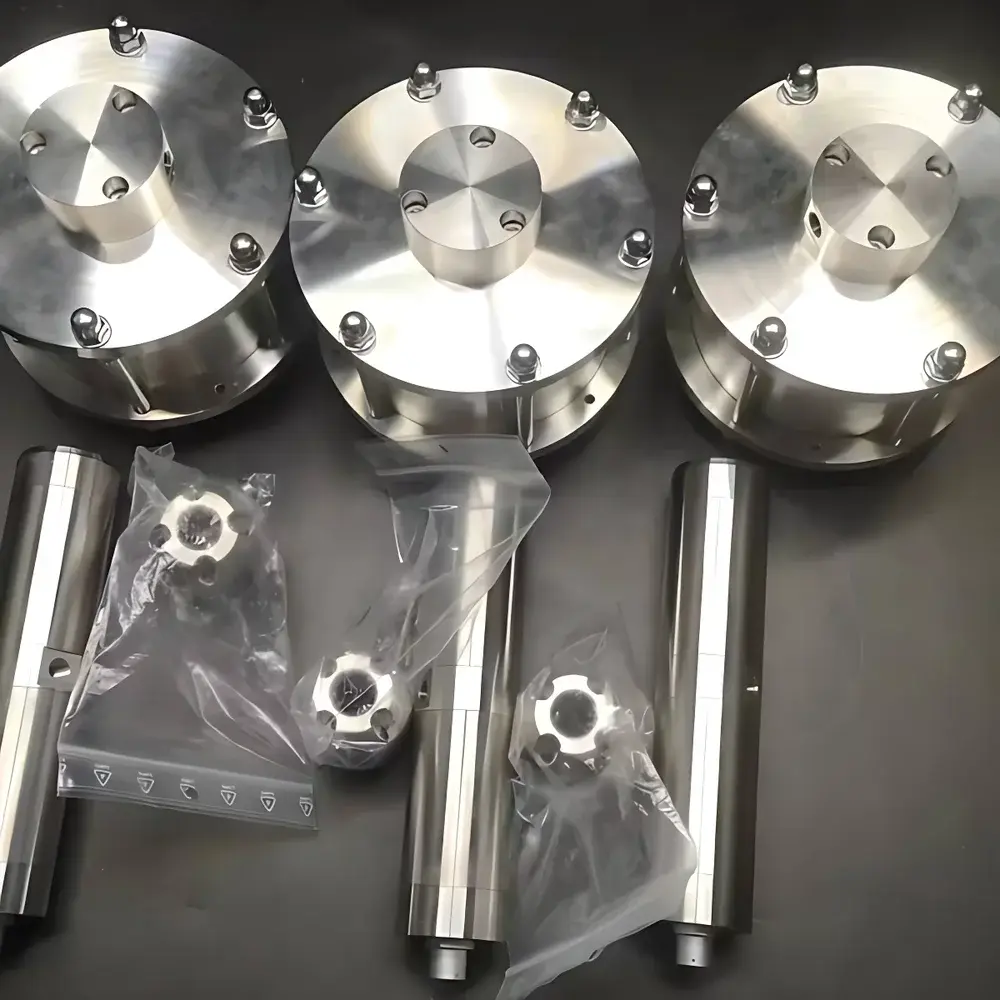
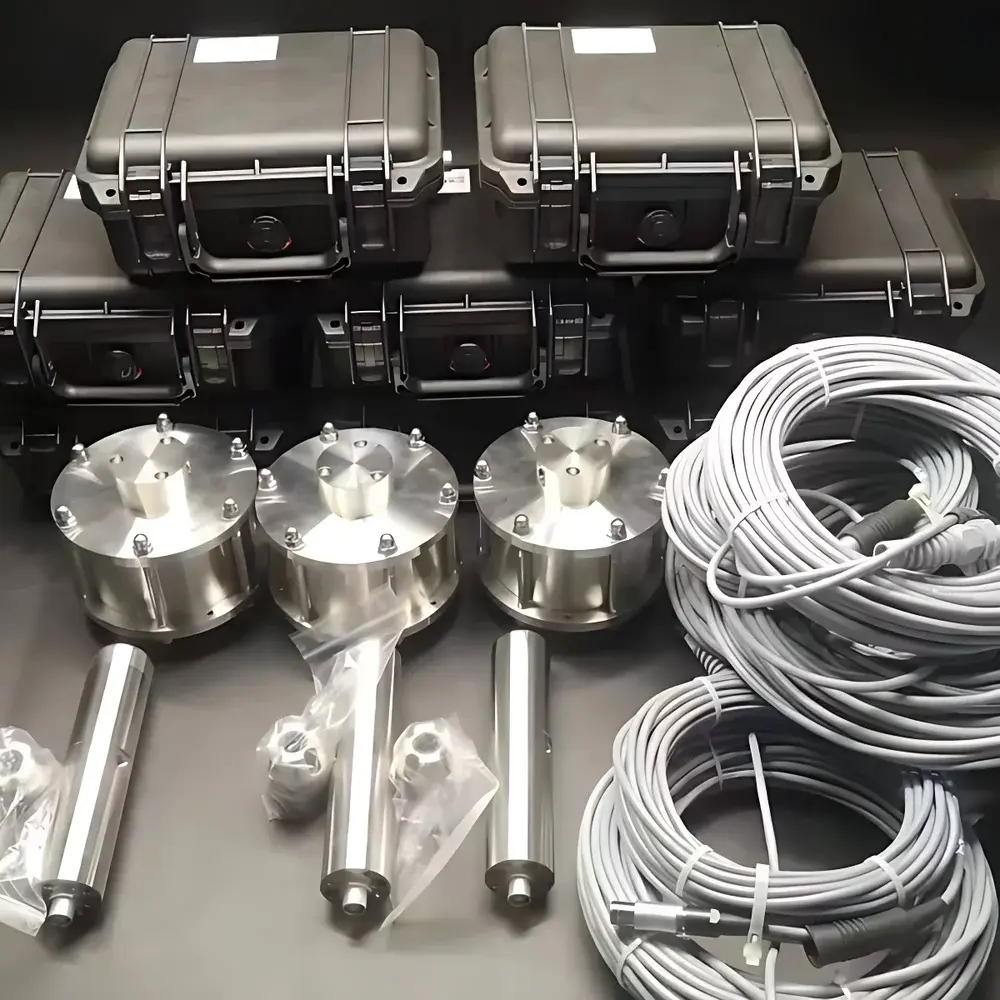
Alibillia GGUN-FL24 Borehole Fluorescence Tracer Detector
| Brand | Alibillia |
|---|---|
| Origin | Switzerland |
| Model | GGUN-FL24 |
| Instrument Type | Laboratory & Field-Deployable Water Quality Analyzer |
| Detection Parameters | Fluorescence (e.g., sodium fluorescein, rhodamine WT, sodium naphthionate), Turbidity, Temperature, Conductivity |
| Fluorescence Detection Limit (sodium fluorescein) | 2 × 10⁻¹¹ g/mL (typ.) |
| Turbidity Range | 0.02–400 NTU |
| Minimum Sampling Interval | 4 s |
| Optical Modules | 4 |
| Temperature Accuracy | ±0.1 °C |
| Temperature Resolution | 0.034 °C |
| ADC Resolution | 24-bit unipolar |
| Operating Current | 8–28 mA |
| Enclosure Material | Stainless Steel |
| Ingress Protection | IP68 |
| Dimensions | Ø48 mm × 270 mm |
| Weight | 2.2 kg |
| Cable Length Options | ≥30 m (cable weight: ~1 kg per 10 m) |
| Power Supply | TRMC-series data loggers (TRMC-GGUN or TRMC-GGUN-COM) |
Overview
The Alibillia GGUN-FL24 Borehole Fluorescence Tracer Detector is a high-sensitivity, submersible optical instrument engineered for quantitative detection of fluorescent tracers in groundwater and surface water systems. Based on multi-wavelength excitation and synchronous emission detection, the GGUN-FL24 employs four independent optical modules to enable simultaneous, cross-calibrated measurement of fluorescence intensity across multiple tracer compounds—including sodium fluorescein, rhodamine WT, and sodium naphthionate—while concurrently monitoring turbidity (0.02–400 NTU), temperature (±0.1 °C accuracy), and electrical conductivity. Its compact cylindrical form factor (Ø48 mm × 270 mm) and IP68-rated stainless steel housing allow direct deployment into boreholes, piezometers, wells, and open-channel installations without external pressure housings. Designed for long-term unattended operation, the sensor draws power exclusively from compatible TRMC-series data loggers (TRMC-GGUN for local storage; TRMC-GGUN-COM for remote telemetry), eliminating reliance on internal batteries and ensuring consistent metrological traceability across field campaigns.
Key Features
- Four-channel optical architecture enabling parallel, interference-minimized detection of multiple fluorescent tracers under varying environmental matrices.
- Detection limit of 2 × 10⁻¹¹ g/mL for sodium fluorescein—validated per ISO 7027 and ASTM D2777 protocols—supporting nanogram-level tracer quantification in low-conductivity aquifer systems.
- Integrated 24-bit unipolar analog-to-digital conversion with 4-second minimum sampling interval, delivering high temporal resolution for dynamic flow-path characterization.
- Stainless steel construction and IP68 ingress protection ensure mechanical robustness and chemical resistance in aggressive subsurface environments, including saline, sulfidic, and hydrocarbon-contaminated formations.
- Temperature-compensated fluorescence signal processing with 0.034 °C resolution, reducing thermal drift artifacts during extended deployments (>30 days).
- Modular cabling system supporting ≥30 m lengths; standardized RS232 serial interface for seamless integration with industry-standard dataloggers and telemetry gateways.
Sample Compatibility & Compliance
The GGUN-FL24 is validated for use in natural waters ranging from ultrapure recharge zones (conductivity <50 µS/cm) to brackish aquifers (conductivity up to 50 mS/cm). Its optical design minimizes quenching effects from dissolved organic carbon (DOC) and suspended solids through spectral deconvolution algorithms embedded in firmware. The instrument conforms to key regulatory frameworks governing environmental monitoring: it supports audit-ready data logging compliant with GLP principles, provides timestamped raw signal outputs required for US EPA Method 1603/1604 validation, and enables traceable calibration via factory-certified reference standards (NIST-traceable fluorescein solutions). All firmware and configuration files are version-controlled and exportable for FDA 21 CFR Part 11-compliant workflows when paired with TRMC-GGUN-COM loggers equipped with secure authentication and electronic signature modules.
Software & Data Management
Data acquisition is managed through Alibillia’s TRMC Logger Suite—a cross-platform application supporting Windows, Linux, and macOS. The suite enables real-time visualization of fluorescence kinetics, automatic baseline correction, and multi-parameter correlation analysis (e.g., tracer breakthrough vs. hydraulic gradient). Raw datasets are stored in open-format CSV and HDF5 containers, facilitating interoperability with MATLAB, Python (Pandas/NumPy), and GIS platforms (QGIS, ArcGIS Pro). Remote units (TRMC-GGUN-COM) support MQTT and HTTP(S) API endpoints for integration into centralized SCADA or cloud-based environmental data infrastructure (e.g., AWS IoT Core, Azure IoT Hub). Firmware updates and calibration coefficients are deployed over-the-air via signed binary packages, maintaining cryptographic integrity throughout the device lifecycle.
Applications
- Groundwater Flow Path Mapping: High-resolution tracer arrival timing enables calculation of effective pore-water velocity, dispersion coefficients, and preferential flow channel identification in karst and fractured bedrock systems.
- Contaminant Plume Tracking: Real-time detection of tracer surrogates allows reconstruction of contaminant migration vectors during spill response, satisfying ISO 22475-1 requirements for geotechnical investigation reporting.
- Lake and Wetland Exchange Studies: Coupled with meteorological and hydraulic boundary data, fluorescence time-series inform residence time distribution modeling and solute transport parameterization in ecohydrological models.
- Industrial Leak Verification: Installed in monitoring wells adjacent to buried pipelines or containment basins, the GGUN-FL24 delivers early-warning alerts for seepage events at detection thresholds below regulatory reporting limits (e.g., EPA RCRA Subpart F).
FAQ
Can the GGUN-FL24 operate independently without a TRMC logger?
No—the GGUN-FL24 has no internal power source or onboard memory; it requires continuous power and command signaling from a TRMC-GGUN or TRMC-GGUN-COM logger.
Is factory recalibration required annually?
Calibration stability is verified at manufacture against NIST-traceable standards; field recalibration using certified reference solutions is recommended every 6 months for GLP-compliant studies.
Does the sensor support wireless telemetry natively?
Wireless capability is provided exclusively through the TRMC-GGUN-COM logger, which offers optional GPRS, LoRaWAN, or NB-IoT modules—not integrated into the GGUN-FL24 itself.
What is the maximum operational depth rating?
Rated to 100 m H₂O static pressure (equivalent to ~10 bar), validated per IEC 60529 and EN 61000-6-2 for electromagnetic compatibility in subterranean installations.
How is turbidity measurement affected by biofouling?
The optical windows feature hydrophobic nano-coating and are designed for periodic manual cleaning; long-term deployments (>6 months) in eutrophic wells require scheduled maintenance per Alibillia’s Field Service Protocol v3.2.
Related Products







