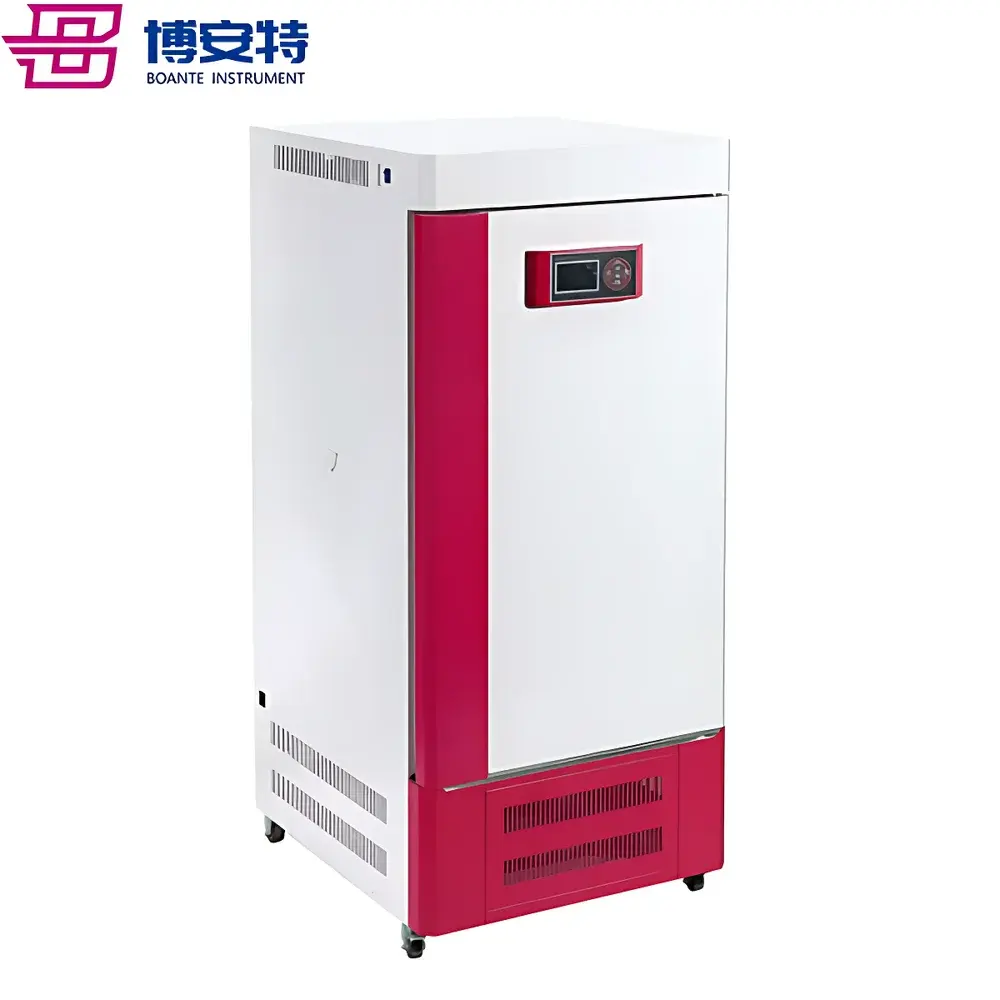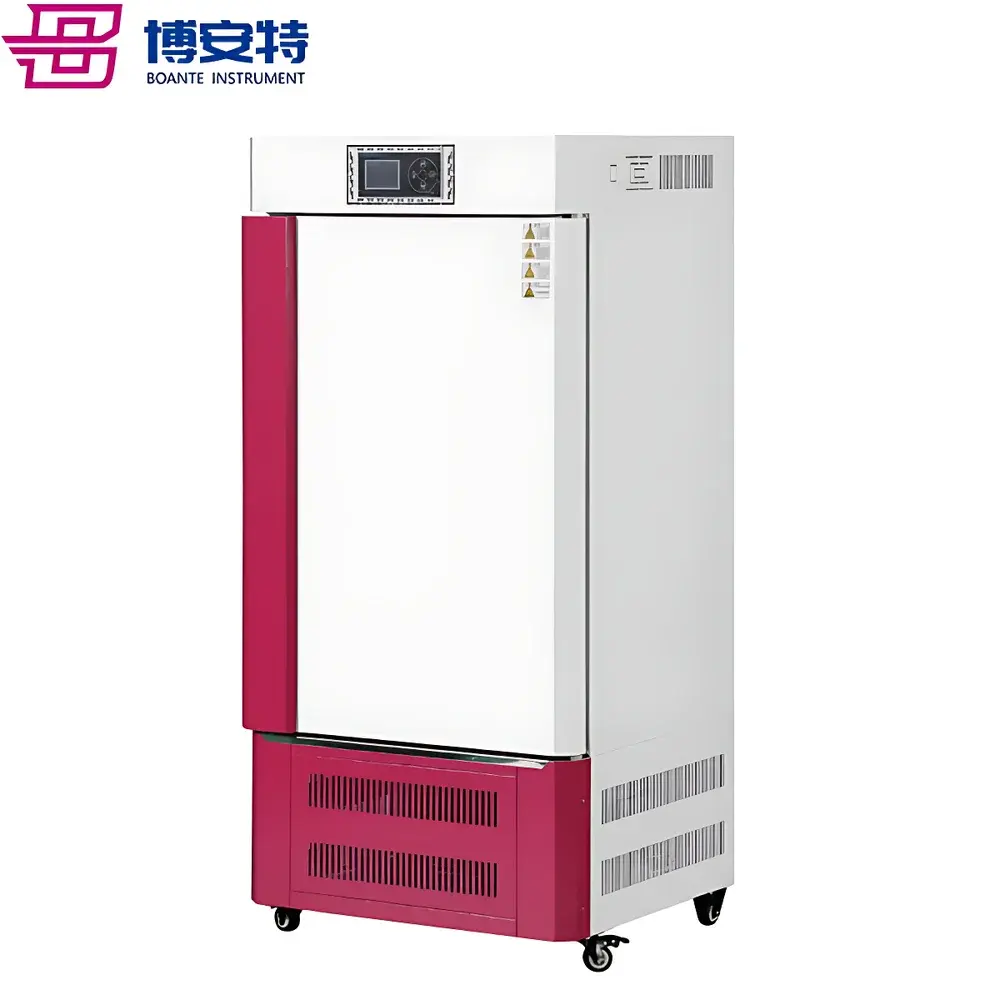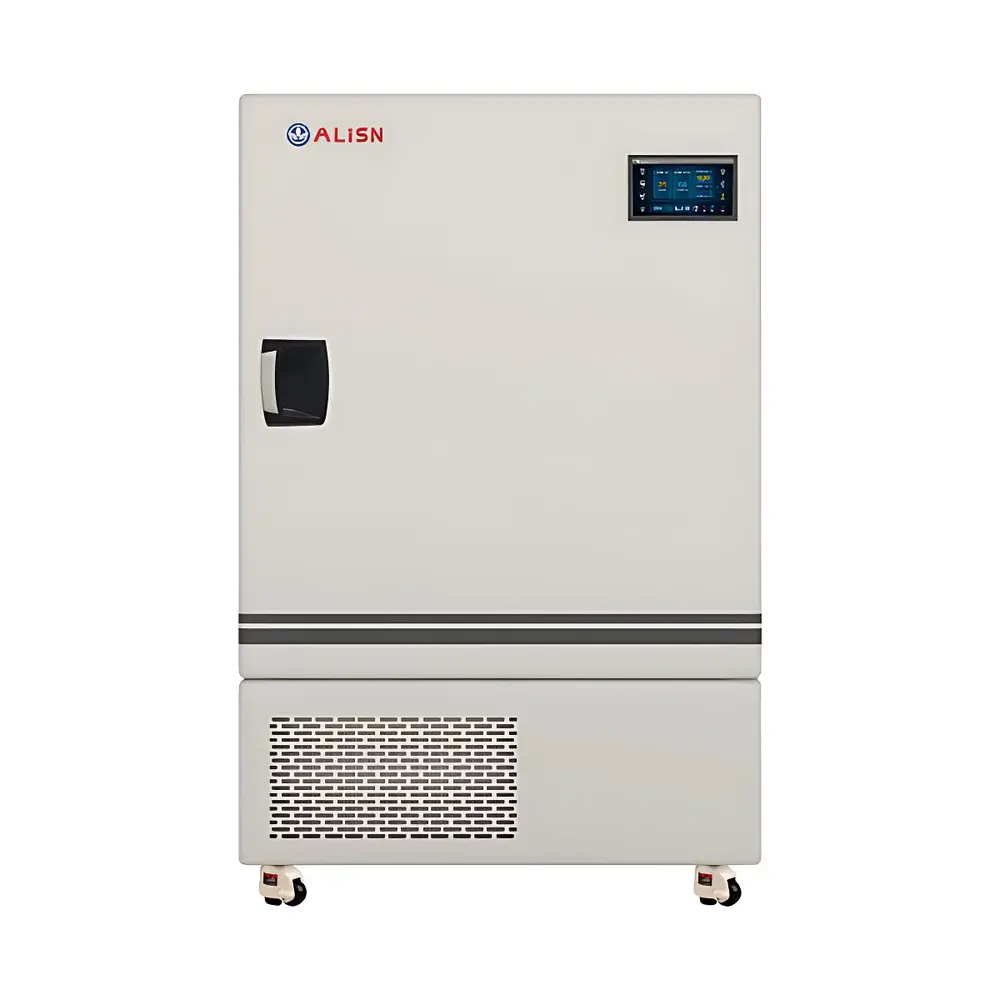
ALISN CNT 150plus Low-Temperature Biochemical Incubator
| Brand | ALISN |
|---|---|
| Origin | Shanghai, China |
| Model | CNT 150plus |
| Cooling Method | Compressor-based refrigeration |
| Air Circulation | Natural convection |
| Temperature Range | −10 °C to +90 °C |
| Temperature Accuracy | ±0.1 °C |
| Temperature Uniformity (at 37 °C) | ±0.1 °C |
| Chamber Volume | 150 L |
| Compressor | SECOP (Danfoss Group), Germany |
| Condenser Fan | EBM-Papst, Germany |
| Insulation | Monolithic polyurethane foam injection |
| Display | 7-inch full-color TFT touch screen |
| Control System | PID + fuzzy logic algorithm |
| Data Logging | ≥10 years of uneditable timestamped temperature records (exportable via USB) |
| Audit Trail | 16,000+ immutable operation and alarm entries (USB export) |
| User Management | 5 configurable user accounts with role-based permissions |
| Communication Interfaces | RS232, RS485, USB |
| Language Options | English / Chinese |
| Power Supply | AC 220 V, 50/60 Hz |
| Safety Features | Over-temperature alarm, door-open alert, compressor overpressure protection, leakage current protection, sensor fault detection, auto-restart after power recovery |
Overview
The ALISN CNT 150plus is a precision-engineered low-temperature biochemical incubator designed for stable, long-term environmental control in life science laboratories. It operates on a dual-mode thermal management principle—combining high-efficiency compressor-based refrigeration (using SECOP compressors and EBM-Papst condenser fans) with resistive heating and PID-fuzzy hybrid control—to maintain setpoint stability across its full operational range of −10 °C to +90 °C. Unlike forced-air units, the CNT 150plus employs natural convection to minimize mechanical disturbance to sensitive biological samples while ensuring uniform thermal distribution (±0.1 °C at nominal setpoints). Its monolithic polyurethane insulation structure—formed via one-shot foaming—achieves superior thermal resistance (U-value ≤0.25 W/m²·K), resulting in >40% energy reduction compared to conventional incubators under identical ambient conditions (25 °C, 70% RH). The system meets fundamental design criteria for GLP-compliant environments, including deterministic temperature response, traceable calibration paths, and hardware-enforced data integrity.
Key Features
- PID-fuzzy logic temperature controller with multi-segment programmable profiles (up to 32 steps per program), enabling complex ramp-hold-cool cycles without external scripting
- 7-inch capacitive TFT touchscreen interface with intuitive icon-driven navigation, supporting real-time temperature curve visualization and historical trend replay
- Immutable audit trail storage (≥16,000 entries) capturing timestamped operator actions, parameter changes, alarms, and system events—fully compliant with FDA 21 CFR Part 11 electronic record requirements when paired with validated USB export workflows
- Role-based access control supporting five distinct user profiles (Administrator, Technician, Operator, Reviewer, Auditor) with granular permission assignment for parameter editing, data export, and system configuration
- Multi-point temperature offset calibration function (up to 9 independent probe locations) to compensate for spatial non-uniformity—critical for ISO 13485-certified medical device stability studies
- Dual-door architecture: outer door with magnetic seal and inner tempered glass door for continuous visual monitoring without thermal load disruption
- Standardized communication interfaces (RS232, RS485, USB) enabling integration into centralized laboratory information management systems (LIMS) and supervisory control networks
Sample Compatibility & Compliance
The CNT 150plus accommodates standard ISO/IEC 60068-2-1 (cold) and 60068-2-2 (dry heat) test specimens, including microbiological cultures (e.g., E. coli, S. cerevisiae), primary cell lines, vaccine vials (2–8 °C and −20 °C storage validation), plant tissue explants, and enzymatic assay plates. Its chamber geometry (600 × 620 × 405 mm internal) supports up to three adjustable stainless-steel shelves (standard: two; optional third shelf available). All materials contacting the interior environment comply with USP Class VI biocompatibility standards. The unit satisfies IEC 61010-1:2010 safety requirements for laboratory equipment and includes CE marking per EU Directive 2014/30/EU (EMC) and 2014/35/EU (LVD). Temperature performance validation follows ASTM E2874-22 protocols for incubator uniformity and stability assessment.
Software & Data Management
Data acquisition occurs at 10-second intervals by default, with all raw temperature readings stored in a write-once, read-many (WORM) memory partition. Exported datasets (CSV format via USB flash drive) retain embedded digital signatures verifying origin, timestamp, and immutability—preventing post-acquisition modification. The embedded firmware implements AES-128 encryption for audit log storage and enforces password complexity policies aligned with NIST SP 800-63B. Remote monitoring is supported through optional Modbus RTU (RS485) integration, allowing connection to SCADA platforms for enterprise-wide environmental surveillance. Software updates require signed firmware packages verified via ECDSA-256 cryptographic signatures, ensuring supply chain integrity.
Applications
- Vaccine cold chain validation studies requiring sustained −20 °C or +2–8 °C storage per WHO TRS 961 Annex 9 guidelines
- Long-term stability testing of biologics and diagnostic reagents under ICH Q5C conditions
- Low-temperature microbial growth kinetics (e.g., psychrophilic strain cultivation at 4–10 °C)
- Agricultural seed germination assays under controlled chilling stress (0–10 °C)
- Enzyme activity profiling across sub-physiological temperature gradients
- Reference standard storage for metrology labs performing ISO/IEC 17025-accredited calibrations
FAQ
What is the temperature recovery time after a 30-second door opening at 4 °C?
Typical recovery to ±0.3 °C of setpoint is achieved within 8.2 minutes (measured per ASTM E2874-22 Annex A2, empty chamber, 25 °C ambient).
Does the unit support 21 CFR Part 11 compliance out of the box?
Yes—when deployed with administrator-enforced password policies, electronic signatures for critical operations, and immutable USB-exported audit logs, it fulfills core technical requirements for Part 11 adherence.
Can the temperature sensor be calibrated externally?
The integrated HERAEUS Pt100 sensor supports two-point field calibration using NIST-traceable reference probes; calibration coefficients are stored in protected EEPROM with tamper-evident logging.
Is remote firmware update capability available?
Firmware updates must be performed locally via USB; network-based updates are intentionally disabled to prevent unauthorized code injection and maintain regulatory auditability.
What is the expected service life of the SECOP compressor under continuous operation?
Rated for ≥50,000 hours MTBF at 25 °C ambient; service intervals recommended every 24 months or 12,000 operating hours, whichever occurs first.
Related Products