
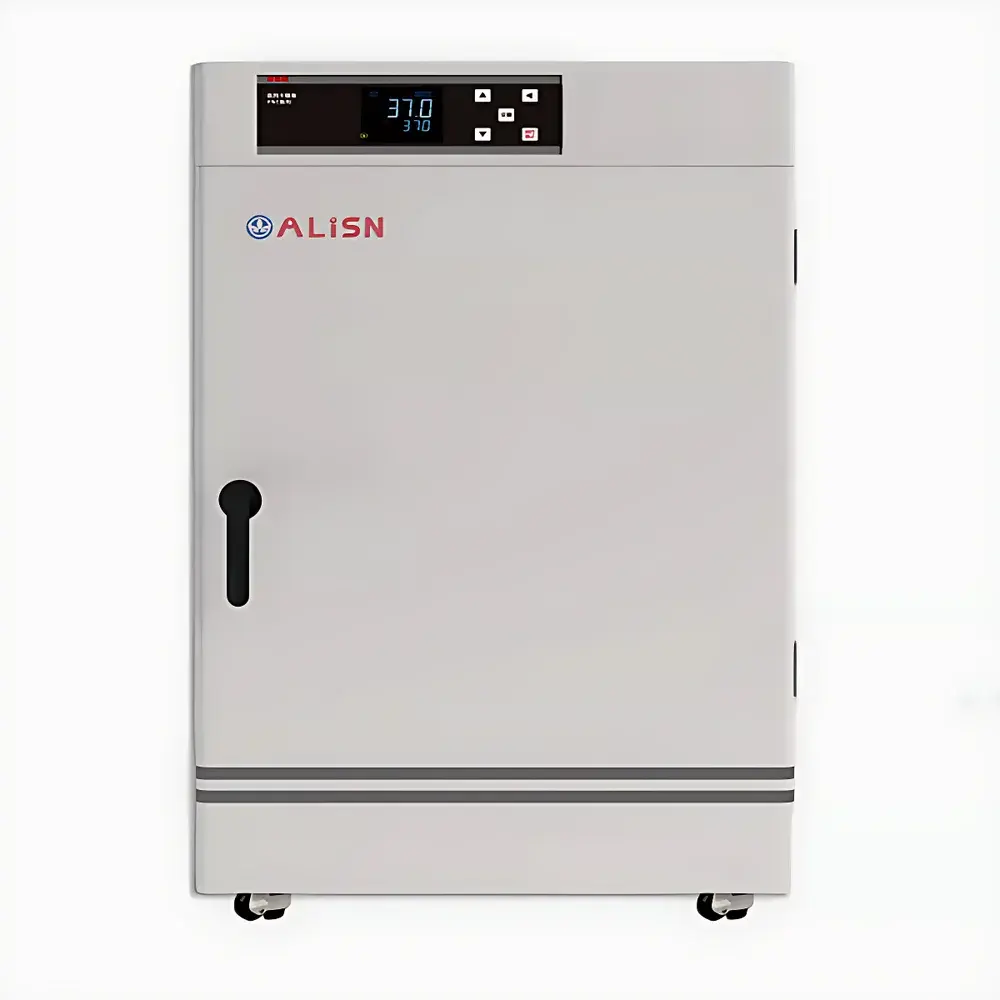
ALISN HKC-250 Electric Constant Temperature Incubator
| Brand | ALISN |
|---|---|
| Origin | Shanghai, China |
| Model | HKC-250 |
| Convection Type | Forced Air |
| Control Method | Digital PID Temperature Control |
| Temperature Range | Ambient +5°C to 70°C |
| Temperature Control Accuracy | ±0.1°C |
| Temperature Uniformity | <1.0°C |
| Temperature Fluctuation | ±0.1°C |
| Chamber Volume | 250 L |
| Heating Power | 2500 W |
| Inner Chamber Dimensions (W×H×D) | 700 × 760 × 470 mm |
| Exterior Dimensions (W×H×D) | 820 × 1070 × 720 mm |
| Net Weight | 115 kg |
| Inner Material | Thickened SUS304 Stainless Steel |
| Insulation | High-Density Polyurethane Foam (≥80 mm) |
| Air Inlet/Outlet | Two bottom inlets, one top exhaust |
| Safety Features | Leakage protection, over-temperature cutoff, door-open alarm, sensor fault detection |
| Shelf Configuration | Three removable stainless steel shelves |
| Power Supply | AC 220 V, 50/60 Hz |
Overview
The ALISN HKC-250 Electric Constant Temperature Incubator is a precision-engineered forced-air incubation system designed for stable, repeatable thermal environments in life science laboratories. It operates on the principle of active air circulation via a centrifugal fan and optimized duct geometry, ensuring rapid temperature equilibration and minimal spatial gradients across the 250 L working chamber. Engineered for applications requiring strict thermal consistency—such as microbial culture, cell line maintenance, enzyme activity assays, and seed germination studies—the HKC-250 delivers a controlled range from ambient +5°C to 70°C with high reproducibility under continuous operation. Its robust architecture integrates thermal inertia management through high-density polyurethane insulation (≥80 mm thick) and a fully welded SUS304 stainless steel inner chamber, eliminating cold bridges and resisting corrosion in humid or CO₂-supplemented environments.
Key Features
- Digital PID temperature control with 0.1°C setpoint resolution and real-time feedback compensation for load-induced drift
- Forced-air convection system with rear-mounted fan and directional airflow baffles to achieve uniformity <1.0°C across the entire chamber volume
- Triple-layer thermal insulation using closed-cell polyurethane foam, minimizing energy consumption while maintaining stability during extended runs
- Three-tier removable SUS304 stainless steel shelving with reinforced support brackets; each shelf rated for ≥15 kg static load
- Integrated safety suite including dual-stage over-temperature cutoff (mechanical + electronic), ground-fault circuit interruption (GFCI), audible/visual door-open alert, and sensor failure diagnostics
- Front-access fresh air inlet with adjustable dampers and top-mounted passive exhaust port to support aerobic culture requirements without compromising chamber integrity
- Leveling feet with lockable swivel casters (two with brakes) enabling precise horizontal alignment on uneven laboratory flooring
- Rounded internal corners and seamless welds facilitate ISO 5 cleanroom-compatible cleaning protocols and reduce microbial harborage points
Sample Compatibility & Compliance
The HKC-250 accommodates standard microbiological vessels—including Petri dishes, flasks (up to 2 L), multi-well plates, and test tubes—as well as larger custom containers up to 700 mm wide. Its chamber geometry supports simultaneous multi-tier cultivation without airflow obstruction. The unit complies with IEC 61010-1:2010 for electrical safety in laboratory equipment and meets essential requirements of EN 60335-1 for household and similar electrical appliances. While not certified for GMP or GLP environments out-of-the-box, its logging-capable controller and audit-ready alarm history support integration into validated workflows compliant with FDA 21 CFR Part 11 when paired with external data acquisition systems. Documentation includes full traceability of calibration certificates for factory-set reference sensors.
Software & Data Management
The HKC-250 features an embedded LCD interface supporting both constant-setpoint and multi-segment programmable operation (up to 8 steps per program). All operational parameters—including setpoint, actual temperature, elapsed time, alarm status, and power-on history—are retained during mains interruption via non-volatile memory (power-loss recovery function). While the base model does not include Ethernet or USB connectivity, optional RS-485 Modbus RTU output enables integration with building management systems (BMS) or centralized lab monitoring platforms. Data export requires manual screen capture or external thermocouple-based validation loggers meeting ASTM E2850–22 standards for incubator mapping studies.
Applications
- Maintenance of bacterial, fungal, and yeast cultures in clinical microbiology and pharmaceutical QC labs
- Long-term incubation of mammalian cell lines under non-CO₂ conditions (e.g., CHO, HEK293, MCF-7)
- Enzymatic reaction kinetics studies requiring precise thermal staging between 30°C and 65°C
- Agricultural research involving seed stratification, pollen germination, and tissue culture propagation
- Biochemical assay development where temperature-dependent reaction rates must be isolated from ambient variation
- Educational use in undergraduate biology and biotechnology curricula for standardized growth experiments
FAQ
What is the minimum operating temperature relative to ambient?
The HKC-250 cannot cool below ambient temperature; its lower limit is ambient +5°C.
Is the incubator suitable for use with volatile organic solvents?
No—it lacks explosion-proof certification and should not be used with flammable vapors or solvents.
Can the shelves be repositioned during operation?
Yes, all three stainless steel shelves are fully removable and height-adjustable without tools, even at elevated temperatures.
Does the unit include a built-in temperature validation port?
No, but a dedicated 6 mm diameter access port is provided on the rear panel for external probe insertion during IQ/OQ verification.
How often does the temperature sensor require recalibration?
ALISN recommends annual verification against a NIST-traceable reference thermometer per ISO/IEC 17025 guidelines.
Related Products





