
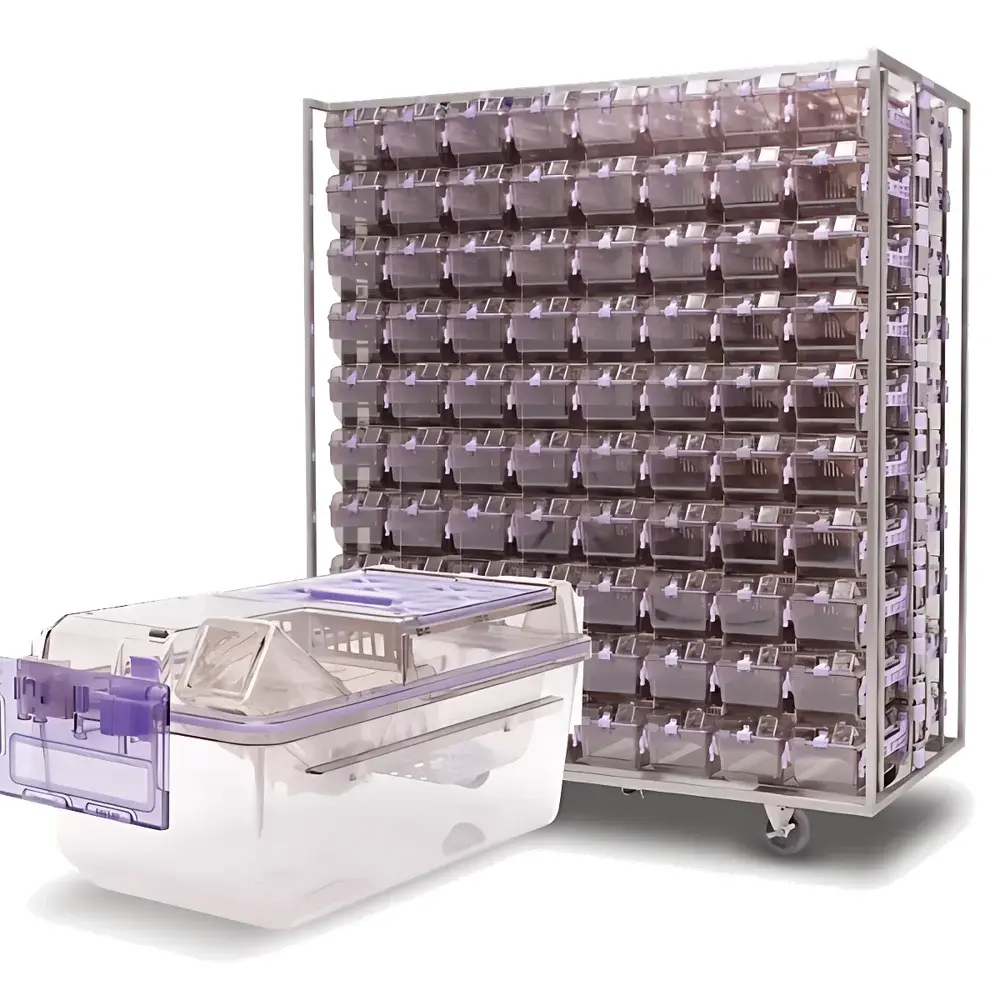
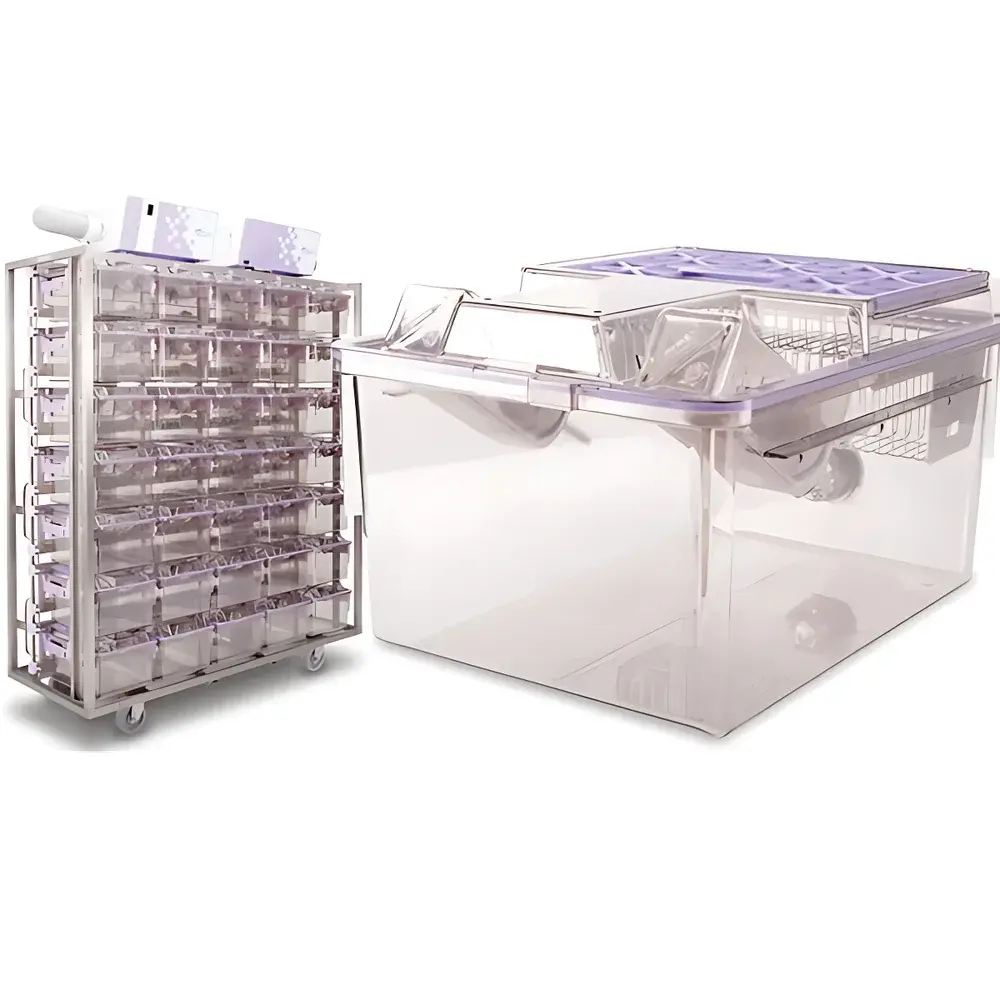
Allentown NexGen Series Positive/Negative Pressure Adjustable IVC Systems for Mice and Rats
| Brand | Allentown |
|---|---|
| Origin | Canada |
| Model | NexGen |
| Construction | 304 Stainless Steel Frame |
| Sterilization Compatibility | Autoclavable at 134°C |
| Cage Material | Polysulfone (High-Transparency, USP Class VI Compliant) |
| System Integration | EcoFlo™ Blower, WiVarium Plus™ Wireless Monitoring, Sentinel™ Health Surveillance, Wi-Com Sensus™ RFID Tracking |
| Compliance | CCAC, AAALAC, NIH Guide, EU Directive 2010/63/EU |
Overview
The Allentown NexGen Series Independent Ventilated Cage (IVC) systems represent a purpose-engineered evolution in laboratory animal housing infrastructure. Designed for precision-controlled environments in biomedical research facilities, the NexGen platform operates on dual-mode pressure regulation—supporting both positive-pressure (for immunocompromised or pathogen-sensitive colonies) and negative-pressure (for biocontainment or allergen-sensitive operations) configurations. Each system integrates laminar airflow principles with low-turbulence ventilation, delivering consistent air exchange rates (typically 40–70 air changes per hour, configurable via EcoFlo™ blower modules) while maintaining static pressure differentials within ±5 Pa tolerance. The core architecture adheres to ISO 14644-1 Class 7 cleanroom-equivalent particulate control standards for cage interiors, ensuring reproducible microenvironmental conditions critical for longitudinal studies, behavioral assays, and preclinical efficacy testing.
Key Features
- Human-centered ergonomics validated by third-party industrial hygiene assessment: spring-assisted cage docking mechanism enables one-finger engagement with tactile and visual alignment feedback, reducing operator fatigue and misalignment risk.
- Ultra-low vibration (<0.5 µm RMS) and acoustic emission (<42 dBA at 1 m) achieved through balanced centrifugal blower design and vibration-dampened mounting—minimizing stress-induced physiological artifacts in behavioral and neuroendocrine endpoints.
- Polysulfone cage bodies (USP Class VI certified) provide optical clarity >90% transmittance across 400–700 nm spectrum, enabling non-invasive observation without cage removal; integrated flip-up ID card holders support real-time phenotypic annotation.
- Structural integrity verified for repeated autoclaving: fully welded 304 stainless steel rack frames withstand 134°C/30 min steam sterilization cycles (>500 cycles demonstrated), with corrosion resistance validated per ASTM A967 for nitric acid passivation.
- Modular interoperability: native protocol-level compatibility with WiVarium Plus™ (IEEE 802.15.4 mesh network), Sentinel™ (pathogen-specific PCR-based environmental monitoring), and Wi-Com Sensus™ (ISO 18000-63 compliant RFID cage tracking).
Sample Compatibility & Compliance
The NexGen platform supports murine models across developmental stages—from neonatal pups to aged cohorts—and accommodates standard and genetically engineered strains requiring defined microbiota status (SPF, germ-free, gnotobiotic). Cage dimensions comply with CCAC Guidelines (2020) for rat upright posture (Rat 1800 Tall: 303 mm internal height), NIH Guide Appendix A space allowances, and EU Directive 2010/63/EU enrichment mandates. All polysulfone components meet USP and biological reactivity requirements. System validation documentation supports GLP-compliant facility audits per OECD Principles of Good Laboratory Practice (ENV/MC/CHEM(98)17) and FDA 21 CFR Part 58 readiness.
Software & Data Management
WiVarium Plus™ provides role-based web interface access (local LAN or secure cloud gateway) for real-time monitoring of cage static pressure, temperature (±0.3°C accuracy), humidity (±3% RH), and airflow velocity (±2% full scale). Audit trails comply with 21 CFR Part 11 requirements—including electronic signatures, user-defined permission hierarchies, and immutable data logging with SHA-256 hashing. Sentinel™ integration enables automated alerting upon detection of murine pathogens (e.g., MHV, MPV, EDIM) via environmental swab PCR quantification, with data export in MIAME-compliant XML format. Wi-Com Sensus™ generates cage-level inventory reports with timestamped location history, supporting IACUC-mandated census verification.
Applications
- Longitudinal oncology studies requiring stable microbiome maintenance and minimal handling-induced cortisol elevation.
- Neurobehavioral phenotyping where acoustic/vibrational noise must be excluded from experimental variables (e.g., fear conditioning, open field, rotarod).
- Gnotobiotic colony management with strict pressure cascade integrity between anterooms, procedure rooms, and IVC suites.
- High-throughput drug screening using transgenic mouse models where cage-to-cage environmental consistency directly impacts pharmacokinetic variability.
- Regulatory toxicology studies conducted under GLP conditions requiring full traceability of housing parameters throughout study duration.
FAQ
Does the NexGen system support both positive and negative pressure operation within the same rack configuration?
Yes—pressure mode is selected at the EcoFlo™ blower module level and independently configurable per rack zone, with differential pressure sensors providing continuous closed-loop verification.
Can existing Allentown 1800-series cages be used on NexGen Rat 1800 Tall racks?
Yes—except for wire mesh lid components, all mechanical interfaces and footprint dimensions are backward-compatible, preserving prior capital investment.
Is polysulfone cage material compatible with hydrogen peroxide vapor (HPV) decontamination protocols?
Yes—validated exposure to 35% w/w HPV at 50°C for 120 minutes shows no measurable degradation in tensile strength (ASTM D638) or optical transmission.
How does Wi-Com Sensus™ ensure cage identification accuracy in high-density MAX configurations?
Each cage features dual-frequency RFID tags (LF 125 kHz for proximity initialization + UHF 860–960 MHz for bulk scanning), with anti-collision algorithms achieving >99.98% read reliability in 192-cage stacks.
What validation documentation is provided for regulatory submissions?
All systems ship with IQ/OQ protocols aligned with ISO 14644-3, plus pressure decay test reports, airflow mapping datasets, and sterilization cycle validation summaries per ANSI/AAMI ST79.





