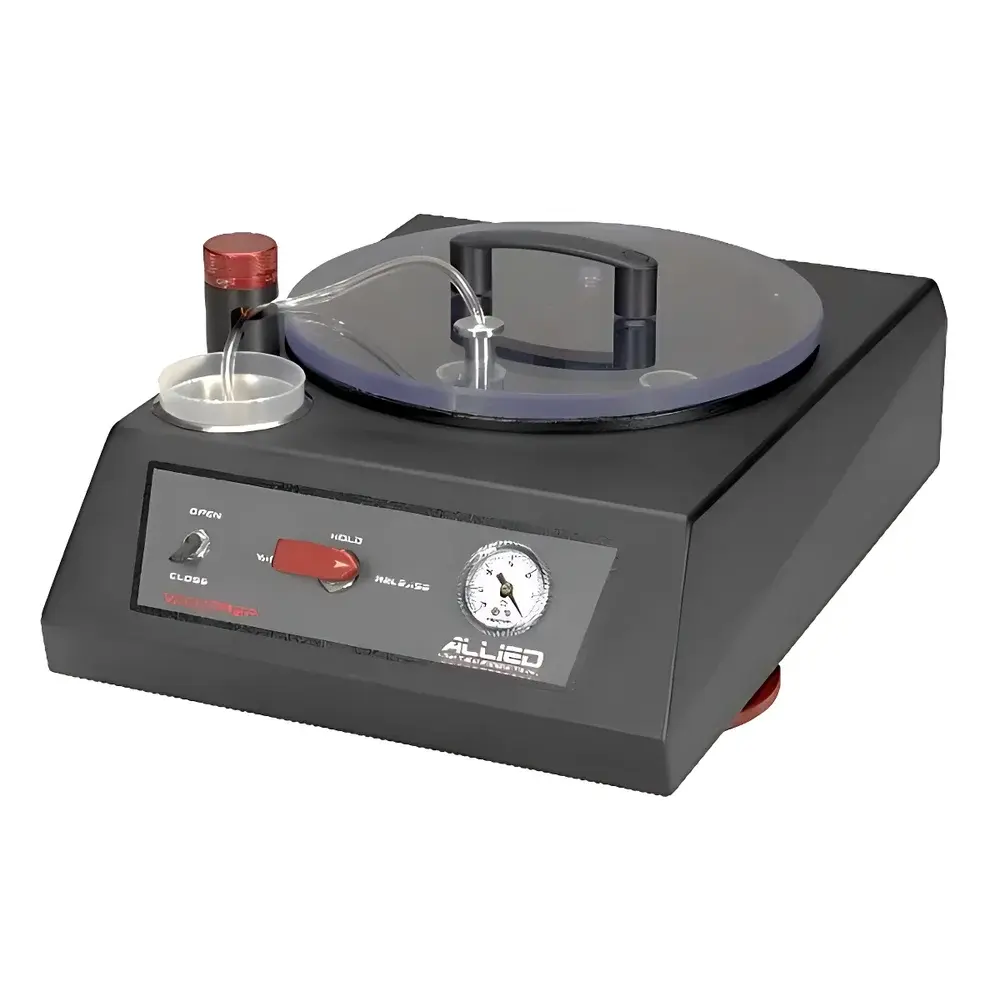
Allied VacuPrep™ Vacuum Epoxy Impregnation System
| Brand | Allied |
|---|---|
| Origin | USA |
| Model | VacuPrep™ |
| Configuration | Turntable-Integrated Vacuum Impregnation System with PTFE-Lined Rotating Platform and Precision Pinch Valve Flow Control |
| Vacuum Compatibility | Compatible with standard laboratory vacuum sources (≤100 mTorr typical operating range) |
| Tube Guidance | Integrated aluminum tube guide for directional resin delivery |
| Compliance | Designed for GLP-compliant sample preparation workflows |
Overview
The Allied VacuPrep™ Vacuum Epoxy Impregnation System is an engineered solution for controlled, repeatable vacuum-assisted resin infiltration of porous or micro-void-containing electronic components—particularly critical in the preparation of cross-section specimens for SEM, FIB, and optical microscopy analysis. Operating on the principle of vacuum-degassed impregnation, the system evacuates air from microstructural voids within semiconductor packages, PCB laminates, ceramic substrates, and hermetic seals, enabling complete capillary-driven penetration of low-viscosity epoxy resins (e.g., Epofix®, EpoThin™, or equivalent 2-part systems). Unlike atmospheric pouring methods, vacuum impregnation eliminates entrapped air bubbles that compromise sectioning integrity and imaging fidelity. The VacuPrep™ integrates a purpose-built mechanical architecture optimized for reproducible specimen mounting, consistent resin distribution, and operator-controlled sequencing—making it a foundational tool in failure analysis (FA), quality assurance (QA), and reliability testing laboratories.
Key Features
- Turntable-integrated specimen platform with calibrated angular indexing—enables sequential positioning of up to six standard 30 mm specimen cups directly beneath the fill tube without breaking vacuum
- PTFE-lined rotating chamber interior—minimizes resin adhesion, facilitates cleaning, and ensures long-term chemical resistance against amine-cured epoxies and solvent-based cleaners
- Externally mounted rotation knob (right-side, base-mounted)—provides ergonomic, glove-compatible manual actuation with tactile feedback and positional stability
- Redesigned precision pinch valve assembly—offers stepless flow modulation from external mixing cup to fill tube, reducing resin waste and improving dosing repeatability
- Integrated aluminum tube guide—maintains fixed vertical alignment of the dispensing tube during rotation, eliminating lateral deflection and preventing resin spillage onto chamber walls or O-rings
- Modular cover design with dual-seal vacuum interface—compatible with standard 1/4″ NPT or ISO-KF vacuum ports and supports rapid chamber evacuation (<60 s to ≤100 mTorr using a two-stage rotary vane pump)
Sample Compatibility & Compliance
The VacuPrep™ accommodates standard metallographic specimen cups (25–35 mm diameter), silicone molds, and custom fixtures for irregularly shaped electronic assemblies—including QFN, BGA, stacked-die packages, and flex-rigid PCBs. Its chamber geometry supports both upright and inverted orientation of specimens during impregnation, allowing optimization for resin wicking directionality. The system complies with ASTM D2765 (Standard Test Methods for Determining Dimensions of Plastic Specimens), ISO 13788 (Hygrothermal performance of building components), and aligns with IPC-J-STD-033 and JEDEC JESD22-A108 humidity preconditioning workflows when used in conjunction with controlled environmental chambers. All wetted surfaces are non-reactive per USP Class VI requirements, and the pinch valve housing meets RoHS Directive 2011/65/EU material restrictions.
Software & Data Management
The VacuPrep™ is a manually operated, hardware-only system with no embedded firmware or digital control interface. This analog architecture ensures electromagnetic compatibility (EMC) in high-sensitivity metrology environments—eliminating RF noise interference with adjacent SEM, AFM, or parameter analyzers. Process documentation is maintained externally via laboratory notebooks or LIMS integration; users may log vacuum hold time, resin batch ID, cup position sequence, and ambient temperature/humidity per ASTM E1527-22 guidelines. For regulated environments, the unit supports 21 CFR Part 11-compliant audit trails when paired with validated electronic lab notebooks (ELN) platforms such as LabArchives or Benchling—provided all manual steps (valve actuation, rotation, vacuum initiation) are timestamped and user-identified.
Applications
- Failure analysis of delaminated die attach interfaces in power modules and SiC MOSFET packages
- Void quantification in underfill and molding compound layers via post-impregnation micro-CT or serial sectioning
- Preparation of encapsulated MEMS devices for focused ion beam (FIB) lift-out without fracture-induced artifact generation
- Quality control of conformal coating adhesion on automotive ECUs subjected to thermal cycling stress
- Reliability qualification of solder joint integrity in high-reliability aerospace PCBAs per MIL-STD-883 Method 2007
- Research-scale infiltration of porous silicon anodes for battery electrode microstructure characterization
FAQ
Is the VacuPrep™ compatible with low-viscosity acrylic resins used for rapid curing?
Yes—the pinch valve and PTFE-lined chamber support viscosities ranging from 100 to 1,200 mPa·s at 25°C, including methyl methacrylate (MMA)-based systems. Cure inhibition by residual vacuum chamber moisture is mitigated by pre-evacuation drying cycles.
Can the turntable be locked in place for single-cup operation?
Yes—mechanical detents at 0°, 60°, 120°, 180°, 240°, and 300° allow fixed-position use without unintended rotation during vacuum hold.
What vacuum source specifications are recommended?
A two-stage oil-sealed rotary vane pump achieving ≤50 mTorr base pressure is optimal. Dry scroll pumps may be used but require verification of epoxy vapor tolerance per manufacturer specifications.
Does Allied provide validation protocols for IQ/OQ/PQ?
Allied supplies a User Requirement Specification (URS) template and installation checklist. Full qualification documentation must be developed in-house per ISO/IEC 17025 or internal QA procedures.
Is replacement tubing for the aluminum guide available as a spare part?
Yes—Part No. 175-30050-TG includes the guide assembly with replaceable 316 stainless steel inner liner and Viton® O-ring set.