
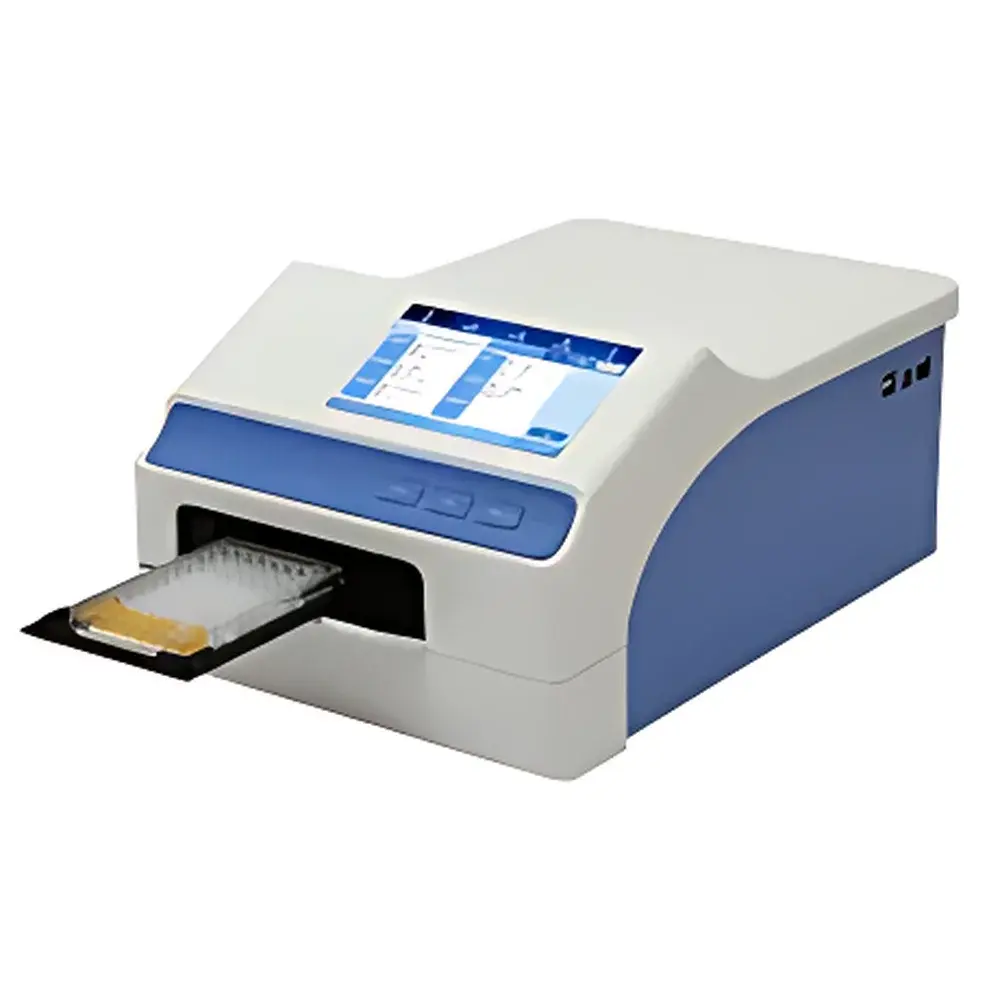
Allsheng AMR-100 Automated Microplate Spectrophotometer
| Brand | Allsheng |
|---|---|
| Origin | Zhejiang, China |
| Model | AMR-100 |
| Function Type | Multimode |
| Automation Level | Fully Automated |
| Measurement Principle | Filter-Based Absorbance Detection |
| Wavelength Range | 400–750 nm |
| Absorbance Range | 0.000–4.000 Abs |
| Linearity | ±1% (0–2.000 Abs), ±2% (2.000–4.000 Abs) |
| Accuracy (405 nm) | ±1% (0–3 Abs), ±2% (3–4 Abs) |
| Precision (CV, 405 nm) | ≤0.2% (0–3 Abs), ≤1.0% (3–4 Abs) |
| Detection Speed | <6 s/96-well (single wavelength), <9 s/96-well (dual wavelength) |
| Optical System | 8-channel high-precision fiber-optic path with automatic well-centering |
| Filter Capacity | 8-position filter wheel (standard filters: 405, 450, 490/492, 630 nm) |
| Display | 7-inch color TFT touchscreen (800 × 480 px) |
| Plate Compatibility | Standard 96-well microplates and strip formats |
| Onboard Storage | 200 protocols + 100,000 assay results (96-well format) |
| Interfaces | 3 × USB (PC, printer, USB drive), Wi-Fi |
| Power Supply | AC 100–240 V, 50–60 Hz |
| Lamp Type | Long-life halogen lamp (≥4000 h) |
| Built-in Diagnostics | Real-time self-check of optical path, mechanical positioning, plate loading, and filter alignment |
| Shaking Function | Adjustable speed and duration |
| Safety Mechanism | Motorized door with obstacle-detection reversal |
Overview
The Allsheng AMR-100 Automated Microplate Spectrophotometer is a dedicated absorbance-based microplate reader engineered for precision, reproducibility, and operational robustness in regulated and research-intensive laboratory environments. It operates on a fixed-wavelength, filter-based optical architecture—distinct from monochromator-based systems—delivering high signal-to-noise ratio and exceptional photometric stability across the visible spectrum (400–750 nm). Its core measurement principle relies on Beer–Lambert law-compliant transmission photometry, where light intensity attenuation through sample-containing wells is quantified as optical density (OD). Designed for endpoint, dual-wavelength, and kinetic assays, the AMR-100 supports standardized workflows aligned with CLIA, ISO 15197, and FDA-recognized ELISA validation practices. The instrument’s fully automated plate handling—including motorized tray insertion, real-time well-centering via 8-channel fiber-optic detection, and intelligent door safety reversal—minimizes user intervention while maintaining strict positional repeatability (±0.1 mm well-to-well registration). Its halogen light source, rated for ≥4000 hours, ensures long-term photometric consistency without recalibration drift.
Key Features
- 7-inch high-resolution color touchscreen (800 × 480 px) with intuitive graphical interface—no external keyboard or mouse required for standalone operation
- 8-position programmable filter wheel supporting up to eight user-configurable interference filters; standard set includes 405 nm, 450 nm, 490/492 nm, and 630 nm—optimized for common ELISA, Bradford, BCA, and NAD(P)H assays
- 8-channel parallel optical path with precision fiber-optic coupling, enabling simultaneous acquisition across all columns of a 96-well plate and eliminating well-to-well timing variance
- Automated onboard diagnostics: real-time verification of lamp output, filter positioning accuracy, plate presence, carriage homing, and optical path integrity prior to each run
- Programmable orbital shaking with adjustable amplitude (3 levels) and duration (0–10 min), facilitating homogeneous mixing for cell-based or immunoassay protocols
- Energy-efficient halogen illumination with thermal management circuitry, reducing power draw by 32% versus legacy designs while preserving spectral output stability
- Mechanically interlocked motorized access door featuring dynamic obstacle detection—immediately reverses motion if physical obstruction is sensed during closure
- No-tool maintenance design: lamp and filter replacement performed externally via front-access service panel, compliant with ISO 13485 preventive maintenance requirements
Sample Compatibility & Compliance
The AMR-100 accommodates ANSI/SBS-standard 96-well microplates (flat, U-bottom, V-bottom) and individual strips (1×8 or 1×12), with automatic plate type recognition based on reflective edge detection. It complies with IEC 61010-1:2010 for electrical safety and IEC 61326-1:2013 for electromagnetic compatibility. Data integrity features include timestamped audit trails, user-level access control (admin/operator/guest), and immutable result logs—supporting GLP and GMP-aligned documentation per FDA 21 CFR Part 11 when used with validated software configurations. While not CE-marked for IVD use in the EU, its performance parameters meet ASTM E2518-22 criteria for microplate reader verification, including linearity, repeatability, and wavelength accuracy assessment protocols.
Software & Data Management
The AMR-100 ships with Allsheng Microplate Analysis Suite (AMAS) v3.2—a platform-independent application supporting Windows, macOS, and Android OS. AMAS provides full protocol authoring (including multi-step kinetic sequences), visual plate mapping with color-coded well status, and 12 built-in curve-fitting algorithms: linear, quadratic, 4-parameter logistic (4PL), 5-parameter logistic (5PL), log-log, spline, exponential decay, and user-defined parameter regression. Raw OD data export is supported in CSV, Excel (.xlsx), and XML formats; PDF report generation includes metadata (operator ID, timestamp, instrument serial number, calibration date). Onboard storage retains 200 protocols and 100,000 result sets (each representing a full 96-well read), with automatic rollover and SD-card backup capability via USB interface. Wi-Fi connectivity enables remote monitoring and scheduled firmware updates without physical access.
Applications
The AMR-100 serves quantitative and qualitative applications across clinical diagnostics, academic research, agricultural testing, and food safety laboratories. Typical use cases include: ELISA-based serological screening (e.g., IgG/IgM detection for infectious disease markers); enzyme activity profiling (e.g., LDH, ALP, HRP kinetics); protein quantification via Bradford or BCA assays; microbial growth monitoring (OD600); endotoxin detection using chromogenic LAL reagents; pesticide residue analysis (e.g., organophosphate inhibition assays); and cytotoxicity evaluation (MTT/CCK-8). Its dual-wavelength correction capability (e.g., 450 nm/630 nm) effectively eliminates background interference from turbidity or plate imperfections—critical for high-variability samples such as serum or plant extracts.
FAQ
Does the AMR-100 support kinetic measurements?
Yes—it performs time-resolved absorbance readings at user-defined intervals (1–3600 seconds), with up to 100 cycles per assay and real-time plot rendering on the touchscreen.
Can custom filters be installed by the end user?
Yes—the 8-position filter wheel accepts standard 12.5-mm diameter interference filters with FWHM ≤10 nm; installation requires only a Phillips #0 screwdriver and takes <90 seconds.
Is the onboard software compliant with 21 CFR Part 11?
The embedded firmware supports electronic signatures, audit trails, and role-based permissions; full Part 11 compliance requires deployment within a validated network environment and documented SOPs per your organization’s quality system.
What is the warm-up time before first measurement?
The halogen lamp achieves photometric stability within 8 minutes after power-on; optional “Quick Start” mode reduces this to 3 minutes with ±0.005 Abs short-term drift tolerance.
How is carryover prevented between plates?
The AMR-100 uses non-contact plate handling—no fluidics or wash steps are involved. Cross-contamination risk is mitigated solely by operator adherence to standard lab hygiene and plate disposal protocols.




