
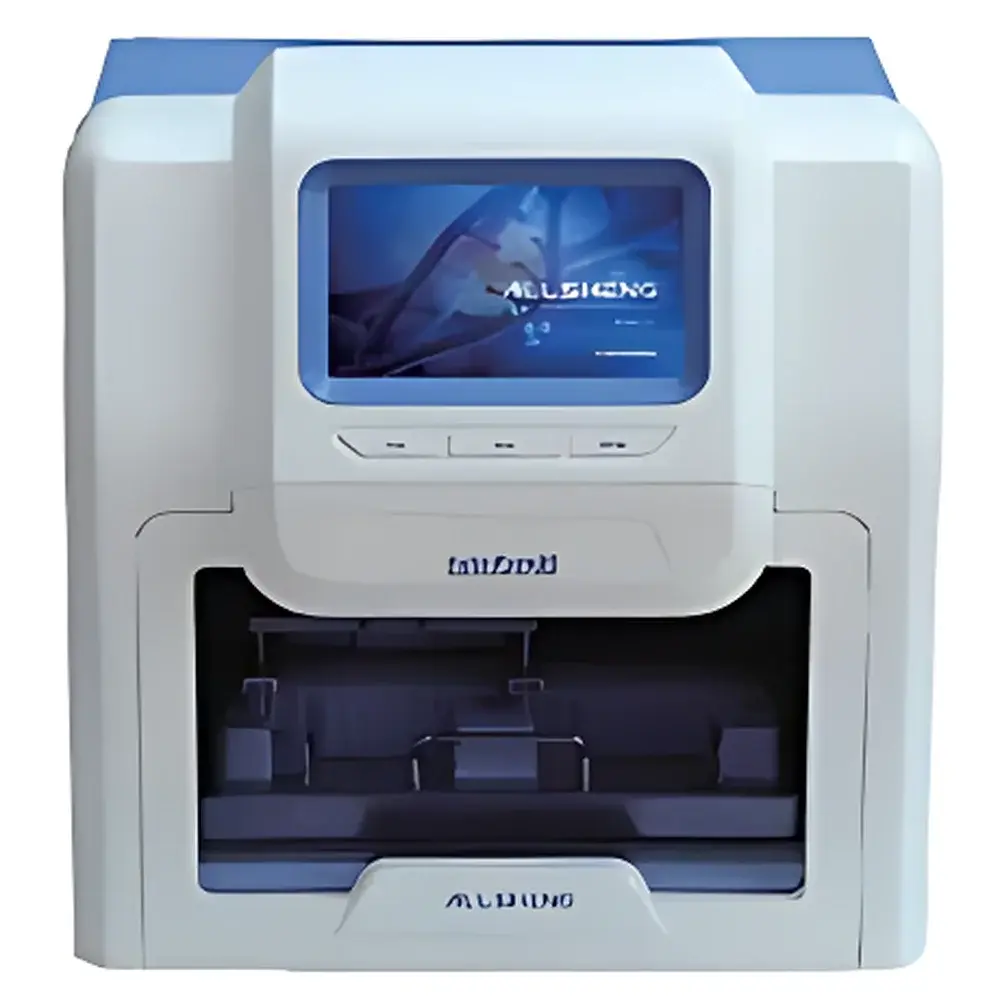
Allsheng Auto-Pure20 Automated Magnetic Bead-Based Nucleic Acid Extraction System
| Brand | Allsheng |
|---|---|
| Origin | Zhejiang, China |
| Model | Auto-Pure20 |
| Instrument Type | Magnetic Bead-Based Extraction |
| Automation Level | Dedicated Fully Automatic |
| Sample Throughput per Run | 1–20 samples |
| Sample Volume Range | 20–1000 µL |
| Processing Time per Batch | 15–45 minutes |
| Magnetic Rod Count | 20 |
| Magnetic Bead Recovery Rate | >95% |
| Inter-Well CV | <3% |
| Lysis & Elution Temperature Range | Ambient to 90 °C |
| Touchscreen Interface | 7-inch high-resolution color LCD |
| Preloaded Protocols | >100 (15 factory-default) |
| UV Sterilization | Integrated |
| Connectivity | 4× USB-A, 1× USB-B, Ethernet, Wi-Fi, SD card slot |
| Power Supply | AC 110–220 V, 50/60 Hz |
| Dimensions | 440 × 467 × 453 mm |
Overview
The Allsheng Auto-Pure20 is a dedicated fully automated nucleic acid purification system engineered for high-reproducibility magnetic bead-based isolation of DNA and RNA from diverse biological matrices. It operates on the principle of solid-phase paramagnetic particle separation—where superparamagnetic beads functionalized with silane or carboxyl groups bind nucleic acids under controlled chaotropic salt and pH conditions, followed by sequential washing and low-salt elution. This platform eliminates manual pipetting, centrifugation, and organic solvent handling, significantly reducing hands-on time and inter-operator variability. Designed for laboratories requiring consistent, scalable, and audit-ready workflows—including clinical diagnostics, public health surveillance, food safety testing, forensic casework, and academic research—the Auto-Pure20 delivers ISO 15189- and CLIA-aligned process robustness without reliance on external PCs or proprietary software ecosystems.
Key Features
- Fully open-system architecture compatible with third-party magnetic bead kits—enabling method transfer, reagent cost optimization, and protocol customization across vendor-neutral chemistries.
- 20-channel independent magnetic rod array ensures uniform field distribution and minimizes cross-contamination risk during simultaneous processing of 1–20 samples.
- Integrated UV-C germicidal lamp (254 nm) deactivates residual nucleases and amplicons in the sample chamber between runs, supporting GLP-compliant batch segregation.
- Drawer-style sample loading mechanism with mechanical interlock prevents accidental access during operation—meeting IEC 61010-1 mechanical safety requirements.
- Onboard 7-inch capacitive touchscreen with intuitive icon-driven navigation; no external computer required for routine operation or protocol execution.
- Thermally regulated lysis and elution modules (ambient to 90 °C, ±0.5 °C accuracy) support optimized denaturation and efficient nucleic acid release from challenging matrices including FFPE tissue, whole blood, and environmental swabs.
- Preloaded library of >100 customizable extraction protocols—including 15 validated out-of-the-box methods—with full edit/delete functionality and version-controlled parameter logging.
Sample Compatibility & Compliance
The Auto-Pure20 accommodates primary and secondary sample types—including EDTA/ACD whole blood, saliva, buccal swabs, plasma, serum, bacterial cultures, plant tissues, and viral transport media—within a 20–1000 µL input volume range. Its magnetic bead recovery rate exceeds 95%, with inter-well coefficient of variation (CV) maintained below 3% across all throughput configurations, satisfying internal QC benchmarks aligned with ISO/IEC 17025 clause 7.7. The system supports traceability through embedded timestamped run logs stored locally on SD card and optionally synchronized via Ethernet or Wi-Fi. While not FDA 510(k)-cleared, its hardware and firmware architecture permits integration into 21 CFR Part 11–compliant environments when deployed with validated SOPs, electronic signature controls, and audit-trail-enabled third-party LIMS interfaces.
Software & Data Management
The Auto-Pure20 features an embedded Linux-based control system with local storage of all run metadata—including operator ID, protocol name, start/end timestamps, temperature profiles, and magnetic actuation cycles. An optional Android-compatible companion app enables remote monitoring of instrument status, real-time progress visualization, and push notifications upon completion or error condition. All protocol modifications are recorded with user attribution and change timestamps. Data export is supported in CSV format via USB or network transfer, enabling downstream analysis in R, Python, or commercial bioinformatics platforms. Firmware updates are performed offline using signed binary packages to ensure integrity and prevent unauthorized modification.
Applications
This system is routinely deployed in molecular pathology labs for pre-analytical processing prior to qPCR, digital PCR, and NGS library preparation. Its ability to recover ≥100-copy templates with >95% detection sensitivity makes it suitable for low-abundance pathogen detection in wastewater surveillance and early-stage infectious disease screening. In food microbiology, it enables rapid isolation of bacterial genomic DNA from enrichment broths for subsequent MALDI-TOF or CRISPR-based identification. Forensic laboratories leverage its closed-tube workflow and UV decontamination cycle to maintain chain-of-custody integrity during STR profiling. Academic users benefit from the flexible 9-well extraction tube format—allowing partial loading to conserve reagents while preserving inter-sample comparability.
FAQ
Is the Auto-Pure20 compatible with non-Allsheng magnetic bead kits?
Yes—the system’s open architecture accepts any commercially available magnetic bead chemistry, provided the kit’s binding/wash/elution volumes and timing parameters fall within the instrument’s fluidic and thermal specifications.
What is the minimum detectable nucleic acid concentration this system can reliably extract?
When used with validated protocols and high-efficiency beads, the system achieves >95% positive detection rate for templates present at ≥100 copies per reaction, as confirmed by orthogonal qPCR validation.
Does the instrument support 21 CFR Part 11 compliance?
The Auto-Pure20 provides foundational capabilities—including electronic logs, user authentication, and audit-trail export—but final Part 11 validation must be performed by the end-user laboratory in accordance with their internal quality management system.
Can I modify incubation times or temperatures during an active run?
No—protocol parameters are locked during execution to ensure result reproducibility; however, new protocols with adjusted settings can be created and saved prior to initiation.
How often does the UV lamp require replacement?
The integrated UV-C lamp has a rated service life of 8,000 hours; system firmware tracks cumulative exposure and alerts users when replacement is recommended.



