
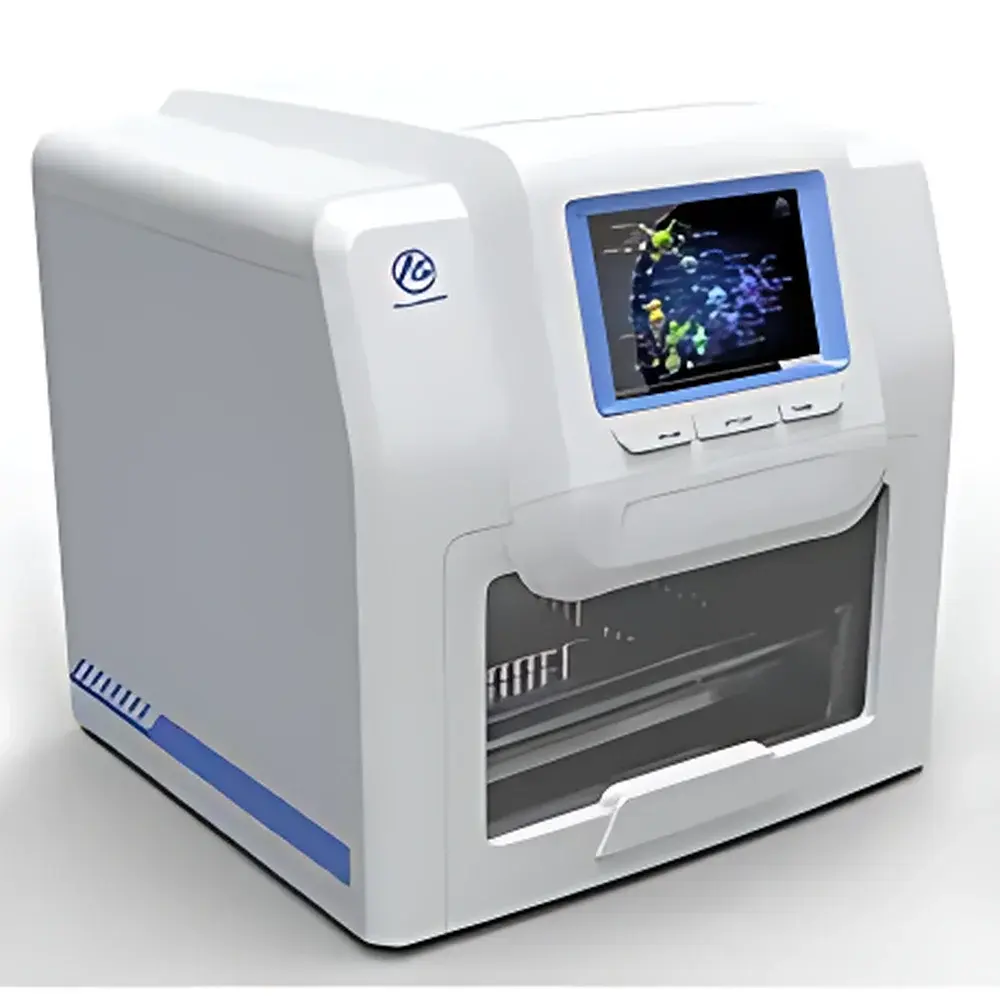
Allsheng Auto-Pure32 Automated Magnetic Bead-Based Nucleic Acid Extraction System
| Brand | Allsheng |
|---|---|
| Origin | Zhejiang, China |
| Model | Auto-Pure32 |
| Instrument Type | Magnetic Bead-Based Extraction |
| Automation Level | Dedicated Fully Automatic |
| Sample Throughput | 1–32 samples per run |
| Sample Volume Range | 20–1000 µL |
| Processing Time per Run | 15–40 min |
| Magnetic Rod Count | 32 |
| Magnetic Bead Recovery Rate | >95% |
| Inter-Well CV | <3% |
| Lysis & Elution Temperature Range | Ambient to 90 °C |
| Touchscreen Interface | 7-inch high-resolution color LCD |
| Preloaded Protocols | ≥100 (15 factory-default) |
| UV Sterilization | Integrated |
| Connectivity | 4× USB-A, 1× USB-B, Ethernet, Wi-Fi, SD card slot |
| Power Supply | AC 110–220 V, 50/60 Hz |
| Dimensions | 440 × 467 × 453 mm |
Overview
The Allsheng Auto-Pure32 is a dedicated, fully automated nucleic acid purification system engineered for high-reproducibility magnetic bead-based isolation from diverse biological matrices. It operates on the principle of solid-phase reversible immobilization (SPRI), leveraging superparamagnetic nanoparticles functionalized with surface chemistries that selectively bind nucleic acids under controlled chaotropic and pH conditions. During lysis, binding, washing, and elution cycles, the system precisely manipulates magnetic rods to capture, transfer, and release beads—eliminating manual pipetting, centrifugation, or vacuum manifolds. Designed for walk-away operation in regulated and non-regulated environments alike, the Auto-Pure32 delivers consistent yield and purity across sample types including whole blood, saliva, buccal swabs, tissue homogenates, plasma, and environmental swabs—enabling seamless integration into molecular workflows such as qPCR, digital PCR, next-generation sequencing library preparation, and pathogen detection.
Key Features
- Open-platform architecture compatible with third-party magnetic bead kits—supports protocol optimization via adjustable incubation times, mixing speeds, temperature profiles, and wash step counts
- 32 independent magnetic rods ensure parallel processing without cross-contamination; each rod engages individual wells with mechanical precision and positional repeatability
- Integrated UV-C irradiation chamber (254 nm) deactivates residual nucleases and amplicons between runs, validated per ISO 15212-1 for carryover mitigation
- 7-inch capacitive touchscreen interface with intuitive icon-driven navigation—no external PC required for routine operation
- Drawer-style sample loading mechanism complies with IEC 61000-3-2 safety standards, preventing operator contact with moving components during runtime
- Onboard thermal control modules independently regulate lysis (ambient–90 °C) and elution (ambient–90 °C) zones, minimizing thermal gradient effects across the plate
- Preloaded protocol library includes 15 validated methods (e.g., viral RNA from nasopharyngeal swabs, genomic DNA from FFPE tissue); users may store >100 custom protocols with version timestamps
- Low-bead-consumption design achieves >95% magnetic recovery and maintains >95% positive detection rate for targets as low as 100 copies—verified using WHO International Standards for SARS-CoV-2 RNA
Sample Compatibility & Compliance
The Auto-Pure32 accommodates primary and secondary sample containers ranging from 0.2-mL PCR tubes to 96-well deep-well plates (with adapter). Its fluid handling tolerates viscous lysates (up to 15 cP), particulate suspensions, and inhibitors commonly found in stool, soil, or plant extracts. The system meets electromagnetic compatibility (EMC) requirements per IEC 61326-1 and electrical safety standards per IEC 61010-1. While not certified under FDA 21 CFR Part 11 out-of-the-box, audit-ready features—including user-level access control, electronic signature support via optional App software, and full activity logging (including parameter changes, run start/stop, error events)—enable alignment with GLP and GMP documentation practices. UV sterilization cycles are logged with duration and timestamp for internal quality review.
Software & Data Management
The embedded operating system supports local protocol editing, scheduling, and real-time status monitoring without network dependency. Optional Android-compatible App (v3.2+) enables remote instrument supervision, live run visualization, and push notifications for completion or fault conditions—data encrypted in transit using TLS 1.2. All run logs, protocol versions, and calibration records are exportable in CSV or PDF format via USB or Ethernet. Internal SD card retains ≥6 months of operational history (configurable retention policy). Firmware updates are delivered via signed packages verified through SHA-256 checksums to ensure integrity.
Applications
- Clinical microbiology labs performing high-volume respiratory virus screening (influenza A/B, RSV, SARS-CoV-2)
- Public health surveillance programs requiring standardized extraction across decentralized testing sites
- Food safety laboratories conducting pathogen detection (Salmonella, Listeria monocytogenes) in enriched food homogenates
- Forensic units processing low-template DNA from touch evidence or degraded biological stains
- Academic core facilities supporting NGS library prep for transcriptomics, epigenetics, and metagenomics studies
- Veterinary diagnostics labs extracting pathogen nucleic acids from avian, porcine, or bovine clinical specimens
FAQ
Does the Auto-Pure32 require proprietary reagents to operate?
No—it is an open-system platform validated for use with multiple commercial magnetic bead kits, including those compliant with ISO 20387:2018 biobanking requirements.
Can the system be integrated into a LIMS environment?
Yes—via Ethernet or Wi-Fi, using RESTful API endpoints (documentation available under NDA) for bidirectional data exchange, including sample ID mapping and QC flagging.
What maintenance intervals are recommended?
Magnetic rod cleaning every 200 runs; UV lamp replacement annually or after 8,000 hours; full performance verification semiannually per manufacturer’s PQ checklist.
Is the instrument suitable for BSL-2 laboratories?
Yes—when used with sealed consumables and activated UV decontamination, it satisfies containment recommendations in CDC/NIH Biosafety in Microbiological and Biomedical Laboratories (BMBL), 6th Edition.
How is inter-run carryover assessed during validation?
Using a three-tiered approach: blank extraction controls (n=12), limit-of-detection spike experiments (100-copy HIV-1 RNA standard), and aerosol challenge tests per CLSI EP30-A guidelines.




