
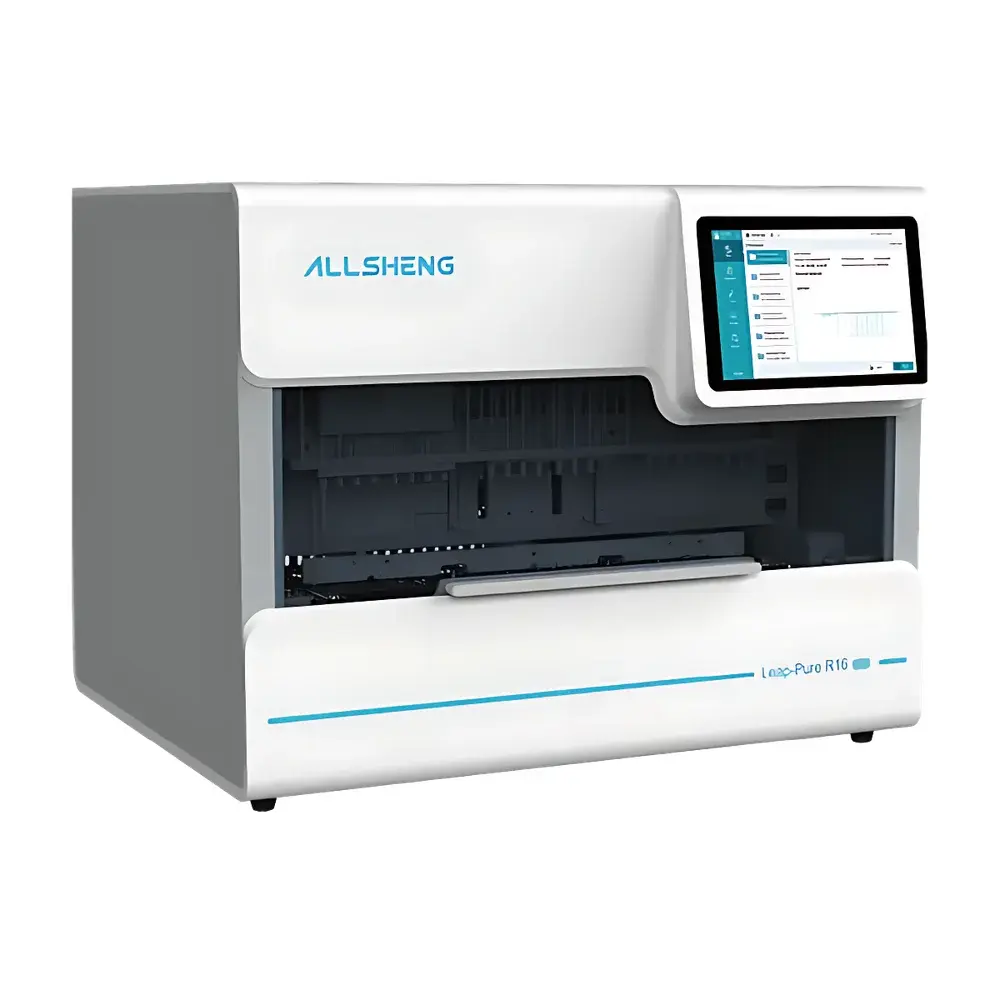
Allsheng Leap-Pure S24/H24 Fully Automated Nucleic Acid Extraction System
| Brand | Allsheng |
|---|---|
| Origin | Zhejiang, China |
| Model | Leap-Pure S24/H24 |
| Principle | Magnetic Bead-Based Extraction with Pipetting & Magnetic Rod Transfer |
| Sample Throughput | 1–24 samples per run |
| Input Volume Range (S24) | 1–15 mL |
| Input Volume Range (H24) | 1–20 mL |
| Elution Volume Range | 20–200 µL |
| Pipetting Range | 20–1000 µL |
| Pipetting Accuracy | ±8% at 20 µL, ±2% at 100 µL, ±1% at 500/1000 µL |
| Pipetting Precision (CV) | ≤5% across all volumes |
| Temperature Control | 37–120 °C |
| Heating Rate | ≤5 min (40–100 °C, ambient 25 °C) |
| Elution Well Capacity | 20–200 µL |
| Reagent Compatibility | Pre-filled 2/8/15 mL strips (S24), 20 mL strips (H24) |
| Software Platform | Android-based 10-inch touchscreen UI with role-based access control |
| Data Interface | USB, LAN, optional barcode scanner integration |
| Contamination Control | Dual UV lamps, HEPA filtration + active exhaust fan, disposable tip architecture |
| Optional Vision Module | Auto-verification of consumable placement and format |
| Power Supply | AC 220 V, 50 Hz, 450 W |
| Dimensions (W×D×H) | 740 × 586 × 640 mm |
| Weight | 70 kg |
Overview
The Allsheng Leap-Pure S24/H24 Fully Automated Nucleic Acid Extraction System is an engineered platform for high-integrity, walk-away nucleic acid isolation from diverse clinical and research specimens. It implements a hybrid magnetic separation architecture—combining pipette-based liquid handling with magnetic bead immobilization via integrated magnetic rods—to achieve robust, reproducible recovery of DNA and RNA across variable sample matrices. Unlike conventional column-based or vacuum-driven systems, the Leap-Pure platform utilizes direct magnetic capture within disposable tips, eliminating tube transfers and minimizing manual intervention. This design supports end-to-end automation for formalin-fixed paraffin-embedded (FFPE) tissue processing—including deparaffinization, lysis, binding, washing, and elution—without requiring off-instrument pre-treatment steps. The system’s dual configuration (S24 and H24) enables application-specific optimization: the S24 accommodates flexible reagent strip formats (2 mL, 8 mL, 15 mL), while the H24 is dedicated to high-volume 20 mL extraction workflows. Both models operate under programmable thermal control (37–120 °C), ensuring precise lysis, binding, and elution kinetics aligned with ISO 20387:2018 biobanking requirements and CLIA-compliant laboratory practices.
Key Features
- Hybrid magnetic separation architecture: Simultaneous use of magnetic rod arrays and positive-displacement pipetting ensures efficient bead capture, mixing, and transfer—critical for viscous or particulate-laden samples such as FFPE lysates and stool suspensions.
- Scalable throughput with modular consumables: Process 1–24 samples per run using standardized strip-format reagent cartridges; no fixed plate constraints allow partial runs without reagent waste.
- Large-input, low-elution capability: Supports up to 15 mL (S24) or 20 mL (H24) input volumes with elution down to 20 µL—enabling high-concentration nucleic acid recovery essential for low-abundance targets in liquid biopsy or microbiome analysis.
- Integrated contamination mitigation: Dual UV-C lamps (254 nm) irradiate internal workspaces between runs; HEPA-filtered laminar airflow prevents aerosol escape; all fluid paths employ single-use, DNase/RNase-free tips.
- Pre-filled reagent compatibility: Patented membrane-piercing mechanism enables automated reagent release from sealed strips—eliminating manual film removal and reducing pipetting error risk per CLSI EP29-A3 guidelines.
- Android-based 10-inch touchscreen interface: Role-based account management (administrator, operator, viewer) enforces audit trail compliance per FDA 21 CFR Part 11 Annex 11 requirements; software logs all user actions, protocol executions, and thermal/pipetting events.
Sample Compatibility & Compliance
The Leap-Pure S24/H24 is validated for nucleic acid extraction from whole blood, plasma, serum, saliva, buccal swabs, fecal suspensions, sputum, cultured cells, and FFPE tissue sections. Its ability to automate FFPE deparaffinization—via integrated heating and organic solvent-compatible reagent delivery—aligns with CAP checklist MOL.40500 and ISO/IEC 17025:2017 clause 7.2.2 for method validation of molecular pathology workflows. All consumables are manufactured under ISO 13485-certified conditions and supplied sterile, pyrogen-free, and certified nuclease-free. Instrument firmware supports GLP/GMP traceability through timestamped electronic records, including temperature calibration logs, pipette performance verification reports, and consumable lot tracking.
Software & Data Management
The embedded Android OS delivers a responsive, icon-driven workflow interface with drag-and-drop protocol builder functionality. Users can import custom extraction protocols or select from pre-validated methods for common kits (e.g., QIAGEN QIAamp, Thermo Fisher MagMAX, Takara NucleoSpin). All protocols enforce parameter locking per user privilege level—administrators define allowable volume ranges, temperature profiles, and incubation times; operators execute only approved configurations. Data export options include CSV-formatted extraction reports, thermal curve logs, and pipette accuracy verification summaries. Optional LAN connectivity enables centralized monitoring via LIMS integration (HL7 v2.x, ASTM E1384), while USB ports support encrypted backup of audit trails. Remote diagnostics and over-the-air firmware updates maintain regulatory alignment without on-site service visits.
Applications
- Clinical molecular diagnostics: High-yield cfDNA extraction from plasma for oncology NGS panels, with minimal background genomic DNA carryover.
- Pathogen detection in complex matrices: Direct RNA isolation from stool for enteric virus screening (e.g., norovirus, rotavirus) and sputum for Mycobacterium tuberculosis detection.
- Biobanking and translational research: Standardized FFPE DNA/RNA co-extraction supporting multi-omics correlation studies under ISO 20387 biobank accreditation criteria.
- Veterinary and agricultural testing: Scalable pathogen nucleic acid purification from field-collected tissue homogenates or environmental swabs.
- Quality control in oligonucleotide synthesis: Recovery of full-length modified RNA/DNA from synthesis resins prior to HPLC purification.
FAQ
Does the Leap-Pure S24 support FFPE tissue processing without external deparaffinization equipment?
Yes—the instrument integrates heated lysis with xylene- and ethanol-compatible reagent delivery, enabling complete deparaffinization, proteinase K digestion, and nucleic acid binding in a single automated run.
Can the same protocol be deployed across both S24 and H24 models?
No—protocol parameters (especially heating profiles and pipette motion paths) are model-specific due to differences in thermal block geometry, reagent strip dimensions, and magnetic rod positioning.
Is the system compatible with third-party magnetic bead kits?
Yes—open software architecture permits configuration of custom binding/wash/elution volumes and timings; however, optimal performance requires validation against kit-specific magnetic responsiveness and buffer viscosity specifications.
What documentation is provided for regulatory submissions?
Allsheng supplies IQ/OQ documentation templates, 21 CFR Part 11 compliance statements, ISO 13485 manufacturing certificates, and detailed instrument qualification reports covering thermal uniformity, pipette accuracy/precision, and UV irradiance mapping.
How is maintenance tracked and scheduled?
The onboard maintenance scheduler logs usage hours, UV lamp cycles, and HEPA filter lifetime; alerts trigger at configurable thresholds and generate PDF service reports exportable via USB.




