
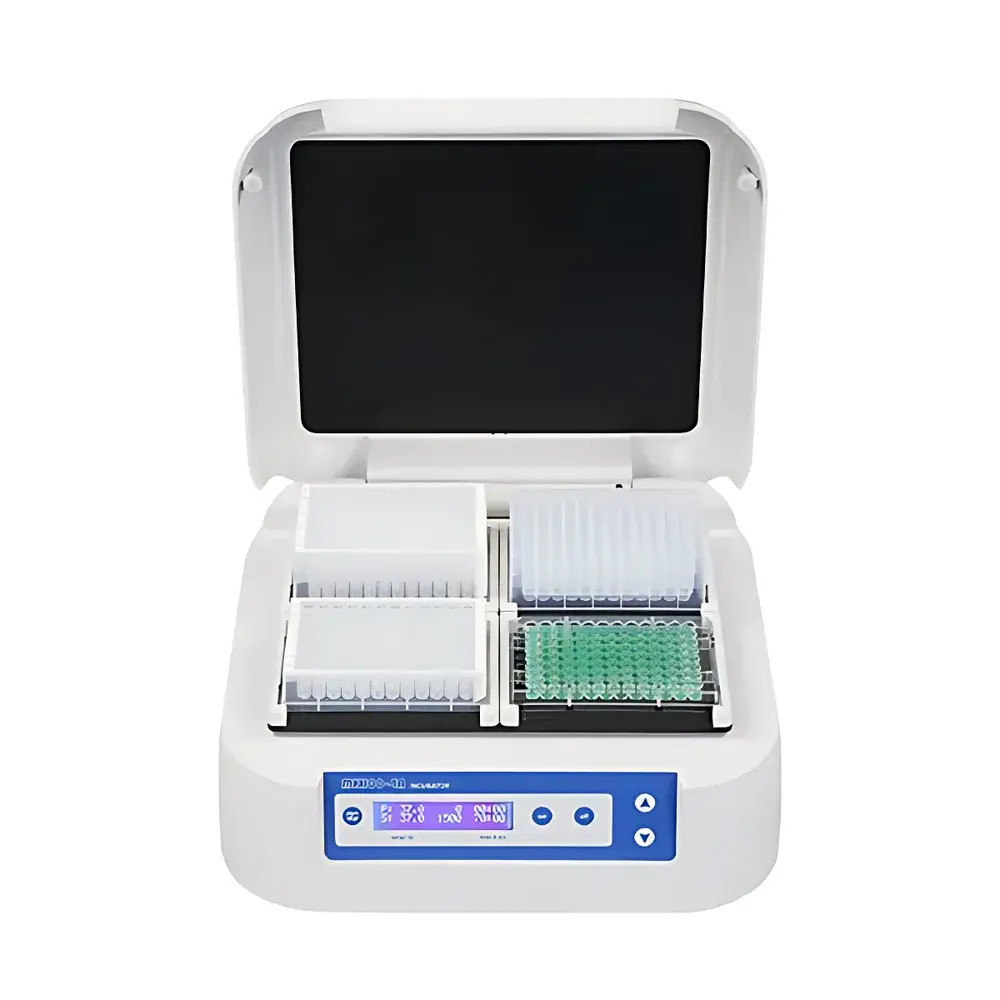
Allsheng MB100-4A Microplate Incubator Shaker
| Brand | Allsheng |
|---|---|
| Origin | Zhejiang, China |
| Model | MB100-4A |
| Temperature Range | Ambient +5°C to 70°C |
| Temperature Accuracy | ±0.5°C |
| Display Resolution | ±0.1°C |
| Timer Range | 1 min to 99 h 59 min |
| Orbital Speed | 100–1500 rpm |
| Heating Ramp (25°C → 70°C) | ≤20 min |
| Capacity | 4 standard microplates (96-well or deep-well) |
| Orbit Diameter | 2 mm |
| Dimensions (W×D×H) | 320 × 350 × 185 mm |
| Net Weight | 8 kg |
| Power Supply | AC 120/220 V, 50/60 Hz |
| Rated Power | 300 W |
| Safety Certification | CE-compliant |
Overview
The Allsheng MB100-4A Microplate Incubator Shaker is an integrated thermal and mechanical platform engineered for precise temperature-controlled orbital shaking of multi-well plates in life science laboratories. It operates on a PID-regulated resistive heating system with dual-sided (top and bottom) plate contact heating—ensuring uniform thermal distribution across all wells of 96-well, 384-well, 24-well, 48-well, and deep-well microplates. Unlike ambient-air convection incubators, the MB100-4A employs direct conductive heating via aluminum heating plates, minimizing thermal gradients and enabling rapid stabilization (≤20 min from 25°C to 70°C). Its compact footprint (320 × 350 × 185 mm) and lightweight design (8 kg) make it suitable for benchtop deployment in high-density lab environments—including core facilities, QC labs, and academic research spaces where space efficiency and operational reliability are critical.
Key Features
- Dual-zone heating architecture: Independent top and bottom aluminum heating plates ensure symmetrical heat transfer—critical for maintaining consistent well-to-well temperature uniformity in enzymatic assays and cell-based readouts.
- PID-controlled thermal regulation with ±0.5°C accuracy and 0.1°C display resolution, validated across the full operating range (ambient +5°C to 70°C).
- Brushless DC motor drive delivering stable orbital agitation at speeds from 100 to 1500 rpm, with minimal speed fluctuation (<±2% at setpoint) and acoustic output <50 dB(A) at 1 m distance.
- Intuitive LCD interface displaying real-time values for temperature, time remaining, and orbital speed—simultaneously showing both setpoints and actual measured parameters.
- Programmable timer with 1-minute to 99-hour 59-minute range; auto-shutdown and audible end-of-run alarm for unattended operation.
- Four-plate capacity accommodating up to four standard microplates (e.g., two 96-well + two 384-well, or four deep-well plates) without cross-contamination risk or mechanical interference.
- Comprehensive safety architecture including overtemperature cutoff, motor stall detection, and short-circuit protection—all compliant with CE marking requirements under EN 61010-1:2010 for laboratory electrical equipment.
Sample Compatibility & Compliance
The MB100-4A supports standard ANSI/SBS-format microplates (including low-profile, skirted, and non-skirted variants) as well as deep-well plates (up to 2 mL per well) and cell culture plates. Its 2 mm horizontal orbital diameter ensures gentle yet effective mixing for sensitive biological samples—including primary cells, adherent cell monolayers, and enzyme-immunoassays—without inducing shear stress-induced detachment or denaturation. The device meets general-purpose laboratory safety standards (CE, RoHS), and its thermal and timing performance is traceable to internal calibration routines aligned with ISO/IEC 17025 principles. While not FDA 21 CFR Part 11–enabled out-of-the-box, audit-ready operation logs can be manually documented for GLP/GMP-aligned workflows requiring process verification.
Software & Data Management
The MB100-4A operates as a standalone instrument with no embedded data logging or PC connectivity. All operational parameters—including start time, duration, target temperature, and set rpm—are retained in volatile memory during active use but are not stored post-power-down. For regulated environments requiring electronic records, users may integrate external environmental monitoring systems (e.g., calibrated thermocouple arrays + time-stamped DAQ units) to capture temperature and timing metadata. The absence of firmware-updatable software eliminates cybersecurity exposure vectors while preserving long-term operational stability—a design priority for core facility managers managing multi-user access.
Applications
- Enzyme-linked immunosorbent assay (ELISA) plate incubation with simultaneous shaking to accelerate antigen–antibody binding kinetics.
- Cell-based assays requiring controlled temperature and gentle agitation—such as cytokine secretion studies, viability assays (e.g., MTT, CCK-8), and reporter gene expression profiling.
- High-throughput screening (HTS) workflows involving serial dilution, reagent addition, or compound solubilization in microplate formats.
- Molecular biology applications including hybridization steps in DNA/RNA probe-based assays and PCR plate pre-incubation prior to thermal cycling.
- Quality control testing of biologics and diagnostics where temperature consistency across plate rows/columns directly impacts assay precision and inter-lot comparability.
FAQ
Does the MB100-4A support USB or Ethernet connectivity for remote monitoring?
No. The unit is designed as a dedicated, stand-alone incubator shaker without digital communication interfaces.
Can it accommodate 384-well plates alongside 96-well plates simultaneously?
Yes—its universal plate tray accepts mixed configurations, provided total height does not exceed mechanical clearance limits (max. 22 mm per plate stack).
Is the temperature uniformity validated per ASTM E2234 or ISO 15197?
No formal third-party validation report is supplied; however, internal mapping per ICH Q5C guidelines confirms ≤±0.8°C well-to-well variation at 37°C across a full 96-well plate.
What maintenance is required for the brushless DC motor?
None—the motor is sealed and rated for >20,000 hours of continuous operation without lubrication or service intervention.
Is the device suitable for use inside a CO₂ incubator chamber?
No. It is not rated for humidified, CO₂-enriched atmospheres and must be operated in ambient laboratory air only.



