
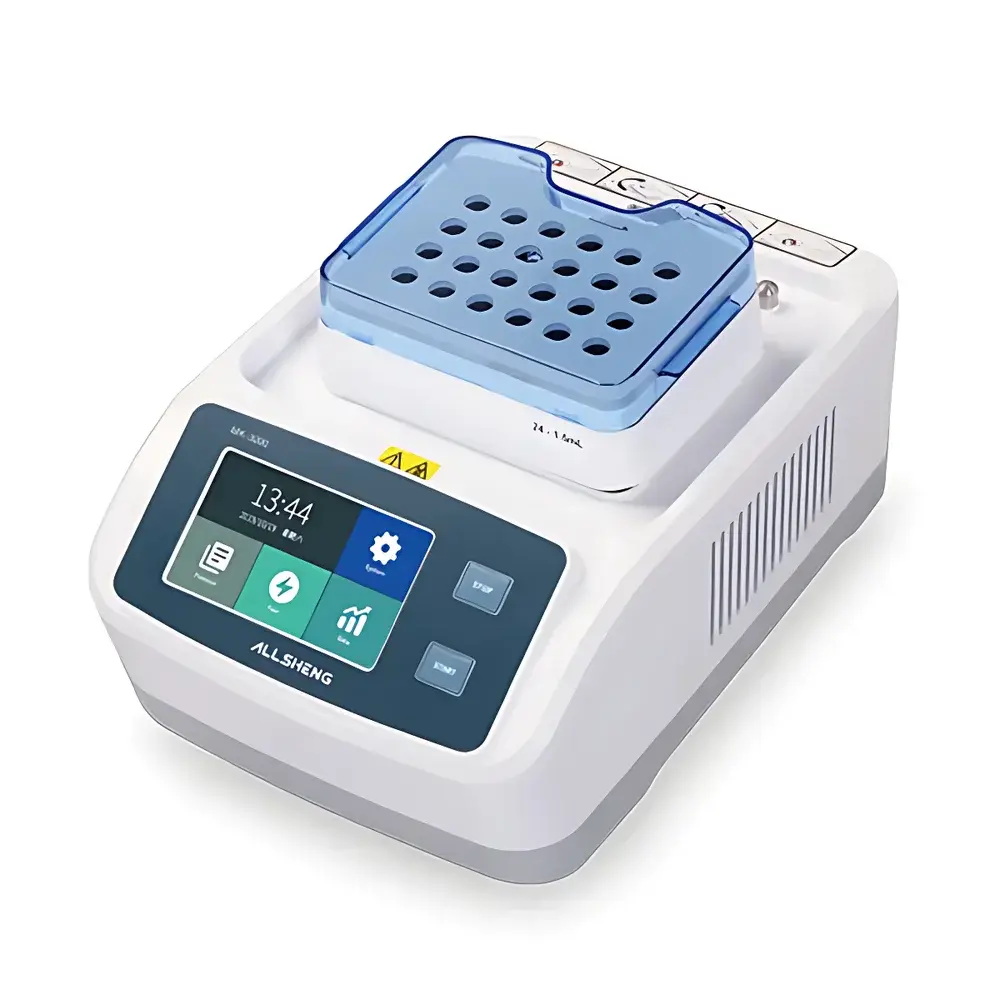
Allsheng MK-3000 Peltier-Based Dry Block Thermostat
| Brand | Allsheng |
|---|---|
| Model | MK-3000 |
| Type | Dry Block Thermostat (Heating & Cooling) |
| Temperature Range | −10 °C to 105 °C |
| Temperature Accuracy | ±0.5 °C (@ 20–50 °C) |
| Temperature Uniformity | ±0.5 °C (@ 20–50 °C) |
| Display Resolution | 0.1 °C |
| Heating Time | ≤10 min (20 °C → 100 °C) |
| Cooling Time | ≤10 min (100 °C → 20 °C), ≤15 min (25 °C → −10 °C) |
| Ramp Rate Control | 5 heating / 4 cooling presets (MAX, 3 °C/min, 2 °C/min, 1 °C/min, 0.1 °C/min) |
| Programmable Segments | 5 per protocol |
| Max Protocols Stored | 50 |
| Cycle Repetition | up to 99 |
| Module Auto-Detection | Yes |
| Touchscreen | 4.3″ capacitive LCD |
| Interfaces | USB (protocol export/import), 4-pin thermal lid connector |
| ThermoLid™ (optional) | 25–110 °C |
| Power Input | 100–240 VAC |
| Max Power Consumption | 200 W |
| Net Weight (with module) | ≤7 kg |
| Dimensions (W×D×H) | 220 × 318 × 154 mm |
Overview
The Allsheng MK-3000 is a precision Peltier-based dry block thermostat engineered for bidirectional thermal control in molecular biology, clinical diagnostics, and analytical sample preparation workflows. Unlike traditional resistive-heating metal baths, the MK-3000 integrates solid-state thermoelectric modules to deliver both active heating and active cooling—enabling rapid, reversible temperature transitions across a wide operational range of −10 °C to 105 °C. Its core architecture eliminates reliance on external chillers or ice baths while maintaining high thermal reproducibility (±0.5 °C accuracy and uniformity at 20–50 °C) and fine-grained ramp rate control. Designed for benchtop integration in ISO 15189-accredited labs and GLP-compliant environments, the MK-3000 supports traceable temperature management through programmable protocols, automatic module recognition, and audit-ready operation logs.
Key Features
- Peltier-driven dual-mode control: Simultaneous heating and cooling without consumables or external refrigeration—ideal for enzymatic reactions requiring precise thermal cycling (e.g., restriction digests, ligations, PCR setup).
- Intelligent modular platform: Interchangeable aluminum blocks with embedded RFID tags enable automatic detection and parameter optimization; supports standard tube formats (0.2 mL, 0.5 mL, 1.5 mL, 2.0 mL) and custom well configurations.
- High-resolution programmability: 50 user-defined protocols, each supporting up to 5 temperature/time segments and 99-cycle repetition; ramp rates configurable across 5 heating and 4 cooling presets (including MAX, 3 °C/min, 1 °C/min, and 0.1 °C/min).
- 4.3″ capacitive touchscreen interface: Graphical real-time display of setpoint, actual temperature, elapsed time, and full run curve; intuitive drag-and-drop protocol editing and one-touch start/stop.
- Robust operational safeguards: Auto-restart after power interruption (resumes from last saved state), over-temperature and short-circuit protection, and thermal lid compatibility (ThermoLid™ optional, 25–110 °C) for evaporation-sensitive applications.
- Regulatory-ready connectivity: USB port for protocol backup, firmware updates, and CSV-formatted temperature log export; supports 21 CFR Part 11–compliant data integrity when paired with validated LIMS or ELN systems.
Sample Compatibility & Compliance
The MK-3000 accommodates diverse sample containers—including microcentrifuge tubes, PCR strips, deep-well plates, and low-profile vials—via field-swappable, anodized aluminum blocks optimized for thermal conductivity and chemical resistance. Each module undergoes individual calibration verification against NIST-traceable reference standards. The device complies with IEC 61010-1:2010 for laboratory electrical safety and meets EMC requirements per EN 61326-1:2013. For regulated environments, its deterministic thermal response, non-volatile protocol storage, and timestamped event logging support adherence to ISO/IEC 17025, USP , and FDA-aligned validation protocols (IQ/OQ/PQ). No moving parts or compressors ensure long-term mechanical stability and minimal maintenance overhead.
Software & Data Management
While the MK-3000 operates autonomously via its embedded controller, its USB interface enables seamless integration into digital lab infrastructures. Users may export full temperature/time logs (with timestamps, setpoints, and deviations) as CSV files for post-run analysis in Excel, Python (Pandas), or statistical software. Firmware updates preserve all stored protocols and calibration offsets. When deployed in GxP settings, the system supports electronic signature-capable workflow integration via third-party ELN platforms that enforce role-based access control and change history tracking. Audit trails include operator ID (if configured), start/stop events, parameter modifications, and thermal fault alerts—all retained in non-erasable memory.
Applications
- Enzyme incubation (restriction endonucleases, ligases, polymerases) requiring strict thermal fidelity
- Sample thawing and pre-chilling prior to nucleic acid extraction or mass spectrometry injection
- Controlled denaturation/renaturation studies in protein biochemistry
- Calibration standard equilibration for viscometers, spectrophotometers, and microplate readers
- Stability testing of reagents and reference materials under defined thermal stress profiles
- Pre-analytical conditioning in clinical microbiology (e.g., blood culture bottle warming)
FAQ
Does the MK-3000 require external cooling water or refrigerant?
No—the unit uses solid-state Peltier elements for closed-loop heating and cooling; no external utilities are needed.
Can multiple temperature ramps be executed within a single protocol?
Yes—each protocol supports up to five independent segments with unique setpoints, dwell times, and ramp rates.
Is ThermoLid™ included or optional?
ThermoLid™ is an optional accessory; it mounts directly to compatible modules and maintains programmable lid temperature independently of block temperature.
How is temperature uniformity verified across the block surface?
Uniformity is measured using nine calibrated PT100 probes positioned at standardized locations per ISO 8573-1 Annex B methodology; results are documented in the factory certificate of conformance.
What happens during a power failure?
The device retains all active protocol parameters and resumes operation automatically upon power restoration, preserving experimental continuity.



