
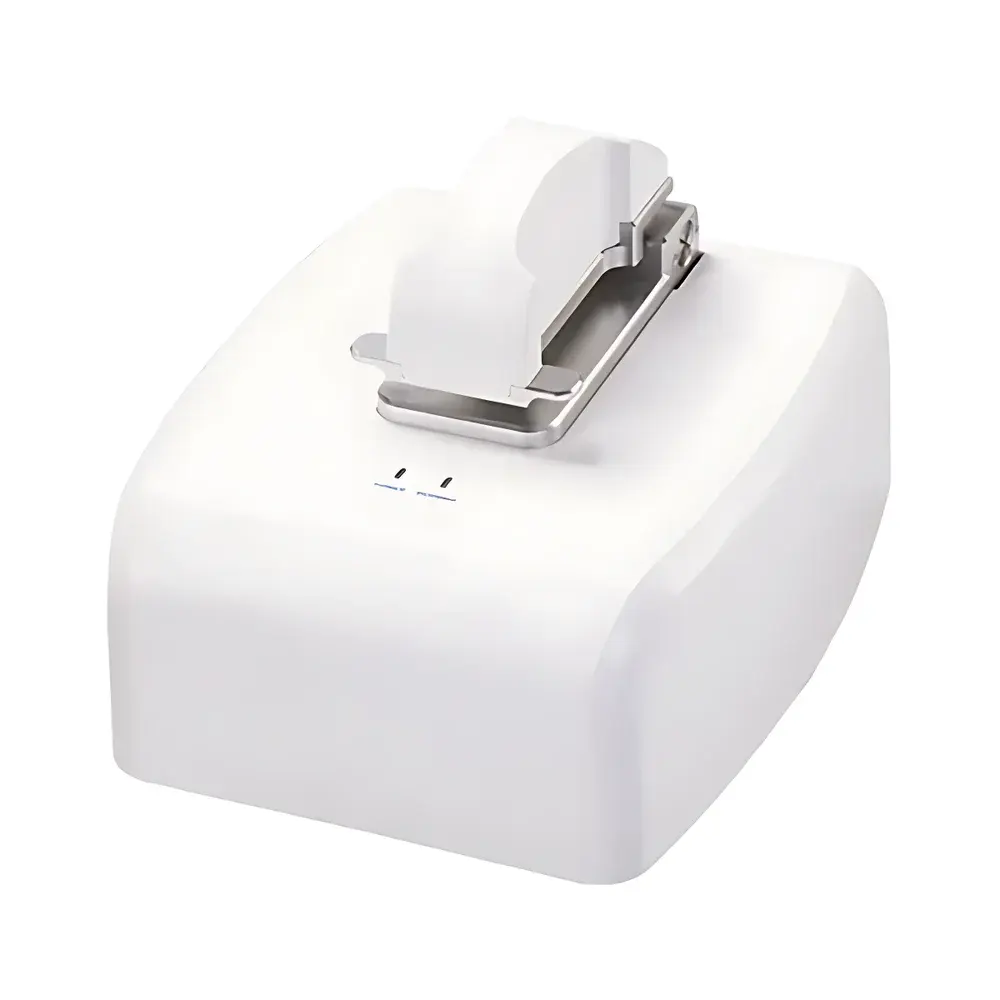
Allsheng Nano-100 Microvolume UV-Vis Spectrophotometer
| Brand | Allsheng |
|---|---|
| Origin | Zhejiang, China |
| Model | Nano-100 |
| Optical Design | Single-beam |
| Detector | 2048-pixel linear CCD array |
| Wavelength Range | 200–800 nm |
| Wavelength Accuracy | ±1 nm |
| Wavelength Repeatability | <0.5 nm |
| Spectral Bandwidth | ≤3 nm |
| Stray Light | <0.01% T at 220 nm and 340 nm |
| Sample Volume | 0.5–2.0 µL |
| Pathlength Options | 0.2 mm (high-concentration mode), 1.0 mm (standard mode) |
| Absorbance Accuracy | ±1% at 7.332 A (260 nm) |
| Absorbance Precision | ±0.003 A |
| Absorbance Range (10-mm equivalent) | 0.04–90 A |
| dsDNA Quantification Range | 2–4500 ng/µL |
| Measurement Time | <5 s |
| Light Source | Pulsed xenon flash lamp (rated lifetime ≥1×10⁹ flashes, ~10 years) |
| Power Supply | DC 24 V, 2 A |
| Power Consumption | 20 W (operational), 5 W (standby) |
| Dimensions (W×D×H) | 200×250×166 mm |
| Weight | 2.6 kg |
| Software Compatibility | Windows XP/7/8 |
| Data Export | CSV, PDF, Excel-compatible formats |
| Compliance | CE-marked, RoHS-compliant |
Overview
The Allsheng Nano-100 Microvolume UV-Vis Spectrophotometer is an engineered solution for rapid, label-free quantification and spectral characterization of nucleic acids, proteins, and cell lysates using direct-drop microvolume absorbance spectroscopy. Based on the Beer–Lambert principle, it employs a high-stability pulsed xenon light source and a 2048-element linear CCD detector to acquire full-spectrum data (200–800 nm) in a single scan. Unlike conventional cuvette-based instruments requiring dilution and alignment, the Nano-100 utilizes fixed-pathlength measurement via precision-machined quartz fiber and hardened aluminum sample pedestals—enabling reproducible quantification without consumables. Its optical architecture eliminates mechanical wavelength scanning, ensuring stability across repeated measurements and minimizing photodegradation risk for light-sensitive biomolecules.
Key Features
- Microvolume operation: Requires only 0.5–2.0 µL of undiluted sample; ideal for precious or low-yield isolates including CRISPR gRNA, single-cell lysates, and FFPE-derived DNA.
- Dual-pathlength capability: Automatically selects between 0.2 mm (for concentrated samples up to 4500 ng/µL dsDNA) and 1.0 mm (for routine quantification), eliminating manual dilution steps and associated pipetting error.
- Pulsed xenon illumination: Delivers uniform spectral output across UV-Vis range with no warm-up delay; rated for >1 billion flashes, supporting daily use over a decade without intensity drift or lamp replacement.
- High-fidelity detection: 2048-pixel linear CCD array provides ≤3 nm spectral resolution and ±0.003 A absorbance precision—meeting ISO 8579-1:2021 requirements for spectrophotometric repeatability in QC laboratories.
- Integrated software platform: Proprietary Windows-based application supports real-time spectrum visualization, automatic peak identification (e.g., 260/280, 260/230 ratios), baseline correction, and compliance-ready audit trails for GLP/GMP environments.
Sample Compatibility & Compliance
The Nano-100 accommodates aqueous solutions containing nucleic acids (dsDNA, ssDNA, RNA), proteins (BSA, IgG), purified enzymes, viral particles, and bacterial suspensions. Its non-contact measurement geometry avoids contamination between runs; sample residue is removed via lint-free wipe or recovered quantitatively using low-retention tips. The instrument complies with IEC 61010-1 (safety), EN 61326-1 (EMC), and RoHS directives. While not FDA 21 CFR Part 11–certified out-of-the-box, its software supports user-defined electronic signatures, time-stamped data logs, and exportable metadata—facilitating validation under ISO/IEC 17025 and USP guidelines for analytical instrument qualification.
Software & Data Management
Controlled via a dedicated Windows application (XP/7/8 compatible), the Nano-100 enables method-driven workflows: users define assay templates (e.g., “dsDNA Quantitation”, “Protein A280”), assign calibration standards, and configure auto-reporting parameters. All spectra and calculated results—including A260/A280 purity ratios, extinction coefficients, and molar concentrations—are stored with timestamp, operator ID, and instrument serial number. Data exports support CSV (for LIMS integration), PDF (for audit documentation), and Excel-compatible formats. Optional password-protected user roles align with laboratory access control policies, while raw spectral files (.spc) retain full wavelength-intensity matrices for secondary analysis in third-party tools such as MATLAB or Python SciPy.
Applications
- Routine QC of nucleic acid preparations prior to NGS library construction, qPCR, or transfection
- Concentration verification of monoclonal antibody batches during upstream bioprocessing
- Assessment of RNA integrity via 260/230 ratio in ribosomal RNA isolation workflows
- Quantitative analysis of dye-labeled oligonucleotides without interference from free fluorophore absorption
- Field-deployable screening of environmental water samples for chlorophyll-a and dissolved organic carbon (DOC) proxies
FAQ
Does the Nano-100 require wavelength calibration with NIST-traceable standards?
Yes—initial factory calibration uses NIST SRM 2034 (UV-Vis transmission standard); users may perform optional verification using supplied holmium oxide or didymium filters per ASTM E275-22.
Can the instrument measure turbid or viscous samples?
It is optimized for clear, low-viscosity aqueous solutions; highly scattering or glycerol-rich samples (>15% v/v) may require centrifugation or dilution to avoid pathlength distortion.
Is the sample pedestal replaceable, and what is its service life?
The quartz-fiber pedestal is field-replaceable (part #AS-PED-01) and rated for >10,000 measurements under proper cleaning protocol (70% ethanol, lint-free wipe).
How does the Nano-100 handle background subtraction for buffer-matched samples?
The software supports blank subtraction against user-defined reference spectra, including dynamic baseline correction using adjacent non-absorbing regions (240–250 nm and 320–340 nm).
What maintenance is required beyond routine cleaning?
No optical alignment or lamp replacement is needed within the first 10 years; annual verification of absorbance accuracy using certified neutral density filters is recommended per ISO/IEC 17025 Clause 6.4.10.



