
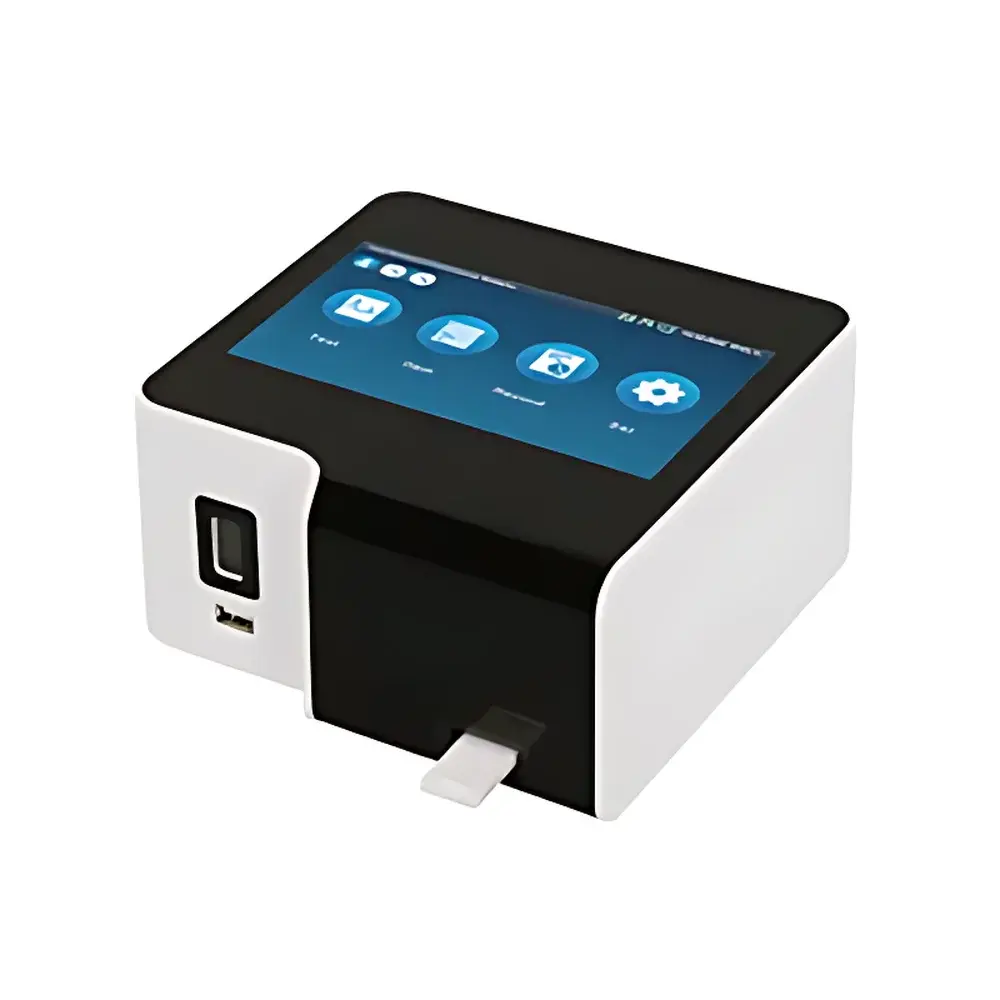
Allsheng TSR-300 Colloidal Gold Reader
| Brand | Allsheng |
|---|---|
| Origin | Zhejiang, China |
| Manufacturer Type | Authorized Distributor |
| Country of Origin | China |
| Model | TSR-300 |
| Pricing | Upon Request |
| Light Source Wavelength | 525 ± 30 nm |
| Detection Element | Silicon Photocell |
| Sample Width Compatibility | 3–6 mm |
| Minimum Test Line Spacing | 3 mm |
| Detection Output | Qualitative, Semi-quantitative, and Quantitative |
| Data Storage | NAND Flash memory |
| Display | 7-inch high-resolution capacitive touchscreen |
| Interface | Dual USB-A ports, optional Ethernet port |
| Built-in Printer | Thermal mini-printer |
| Power Supply | DC 12–24 V, 2 A (grounded) |
| Power Consumption | ≤ 30 W |
| Dimensions (W × D × H) | 185 × 186 × 97 mm |
| Net Weight | 2.2 kg |
| Shipping Weight | 4.0 kg |
| Operating System | Linux + Qt framework |
| Analysis Algorithms | Linear, Logarithmic, Polynomial curve fitting |
| T/C Ratio CV | ≤1% (T/C > 0.2), ≤2% (T/C ≤ 0.2) |
| Stability CV | ≤3% (T/C > 0.2), ≤5% (T/C ≤ 0.2) |
| Scan Time | < 10 s per strip or cassette |
| Result Validation | Automatic invalid result rejection |
Overview
The Allsheng TSR-300 Colloidal Gold Reader is an optical reflectance-based quantitative immunoassay analyzer engineered for precision measurement of test line (T) and control line (C) intensities on lateral flow immunochromatographic strips and cassettes. It operates on the principle of monochromatic LED illumination at 525 ± 30 nm—optimized for peak absorption of colloidal gold nanoparticles—and captures reflected light intensity via a calibrated silicon photocell array. The instrument delivers objective, operator-independent quantification by computing the T/C ratio, enabling reliable semi-quantitative and fully quantitative interpretation when paired with validated calibration curves. Designed for routine use in clinical laboratories, public health screening centers, veterinary diagnostics, and point-of-care testing environments, the TSR-300 meets essential performance benchmarks for reproducibility, linearity, and analytical stability under ambient operating conditions.
Key Features
- High-fidelity optical detection system with wavelength-tuned LED source and low-noise silicon photocell sensor
- Adaptive sample stage accommodating lateral flow strips 3–6 mm wide, with minimum line spacing resolution of 3 mm
- Real-time validation logic to automatically flag and exclude invalid runs (e.g., missing C-line, insufficient signal-to-noise, saturation)
- Onboard thermal printer for immediate hardcopy output of concentration values, units, timestamps, and raw scan profiles
- 7-inch capacitive touchscreen interface with intuitive Qt-based GUI optimized for glove-compatible operation
- Dual USB-A host ports for peripheral expansion (e.g., external storage, barcode scanner); optional Ethernet interface for network integration
- Embedded Linux OS ensuring deterministic boot behavior, firmware integrity, and long-term software maintainability
- Low-power architecture (≤30 W) compatible with uninterruptible power supplies and mobile deployment scenarios
Sample Compatibility & Compliance
The TSR-300 supports all standard colloidal gold–based lateral flow assays—including rapid antigen tests, infectious disease serology (e.g., HIV, HBV, HCV, malaria), cardiac biomarkers, and veterinary analytes—without modification. Its mechanical design accommodates both single-strip formats and dual-cassette configurations. While not certified to IVD regulatory standards (e.g., FDA 510(k), CE-IVDR, or NMPA Class II/III) out-of-the-box, the device complies with general electrical safety requirements per IEC 61010-1 and electromagnetic compatibility per IEC 61326-1. When deployed within quality-managed workflows, it supports GLP/GMP-aligned documentation practices through timestamped data logging and immutable NAND Flash storage. Raw scan curves and processed results are stored in vendor-neutral binary+CSV hybrid format for audit trail reconstruction.
Software & Data Management
The embedded Linux + Qt application layer provides full local control over assay configuration, calibration management, and result export. Users define custom assay parameters—including line position offsets, background correction zones, and curve-fitting models (linear, log-log, 4PL, polynomial)—via a structured configuration wizard. All measurement metadata (operator ID, lot number, expiration date, environmental temperature) can be manually entered or imported via USB-connected barcode reader. Data exports support CSV and PDF formats; no cloud dependency or proprietary database is required. Audit-ready features include tamper-evident file naming conventions, write-once storage policy enforcement, and full traceability from raw pixel intensity to final concentration value. Optional firmware updates are delivered via signed USB image files to ensure integrity and version control.
Applications
- Clinical laboratory QC/QA for rapid diagnostic test kit verification and lot release testing
- Public health surveillance programs requiring standardized readout across decentralized sites
- Veterinary field diagnostics where portable, battery-optional instrumentation is critical
- Research labs developing novel lateral flow assays requiring high-throughput reflectance profiling
- Contract manufacturing organizations performing method transfer and validation per ISO 13485
- Epidemiological studies leveraging semi-quantitative trend analysis across serial samples
FAQ
What types of lateral flow formats does the TSR-300 support?
It accepts both single-line strips (3–6 mm width) and enclosed cassettes, with automatic recognition of up to five distinct test lines per assay.
Can the TSR-300 be integrated into a LIMS environment?
Yes—via optional Ethernet connectivity and configurable CSV export protocols, enabling automated ingestion into common laboratory information management systems.
Is calibration traceable to national standards?
The optical subsystem is factory-calibrated using NIST-traceable reflectance standards; end-user recalibration is performed using supplied reference strips.
Does the device meet FDA 21 CFR Part 11 requirements?
While the TSR-300 itself is not Part 11–certified, its audit log structure, electronic signature readiness, and immutable data storage align with foundational elements required for regulated deployment when implemented within a validated workflow.
What is the maximum storage capacity for assay data?
The onboard NAND Flash supports ≥100,000 test records with full metadata and raw scan profiles, expandable via USB mass storage devices.




