
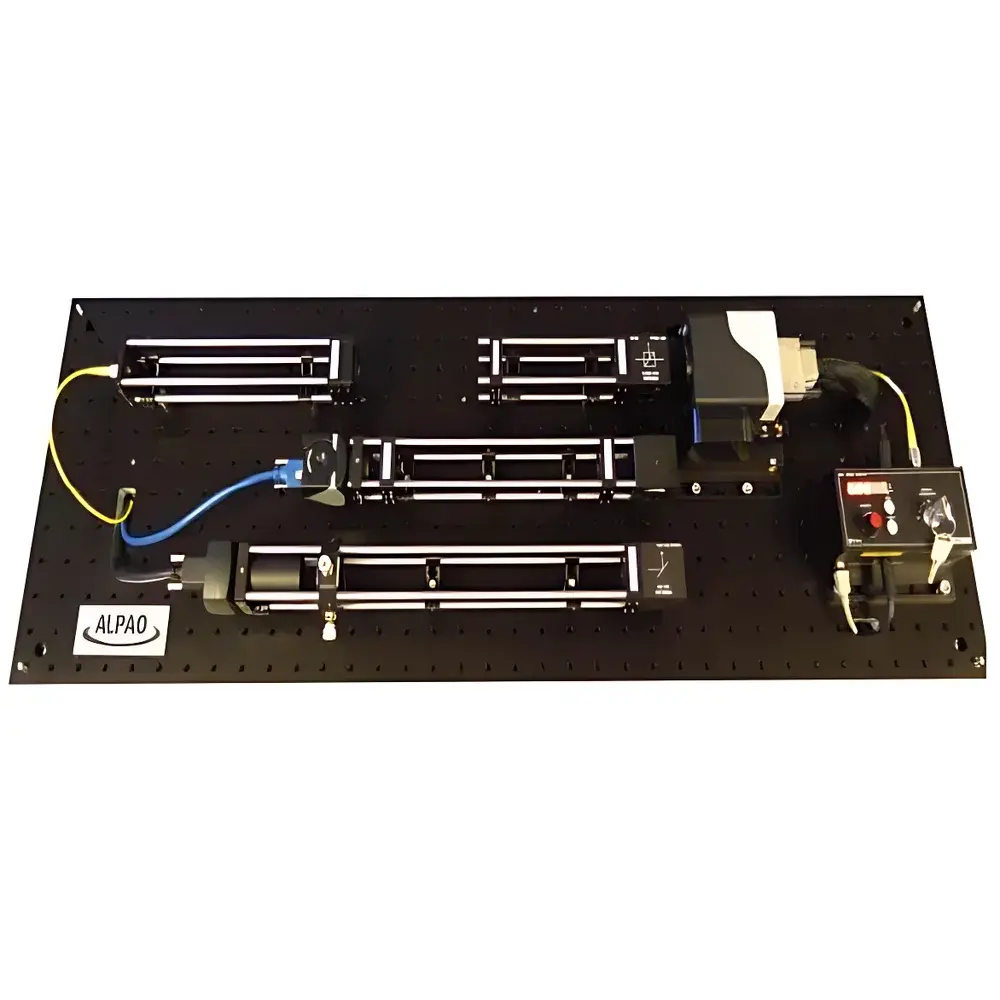
Alpao AOS-0 Adaptive Optics High-Speed Closed-Loop System
| Brand | Alpao |
|---|---|
| Origin | France |
| Model | AOS-0 |
| Deformable Mirror Options | DM69 (69 actuators, 10.5 mm pupil) or DM97-15 (97 actuators, 13.5 mm pupil) |
| Wavefront Sensor Options | HASO4 First (VIS, 32×40 res., λ/100 RMS acc., 400–1100 nm) or WFS-VIS (23×23 res., λ/20 RMS acc., 250–1100 nm) |
| Max Closed-Loop Bandwidth | 800 Hz |
| Min Settling Time | 800 µs |
| Mirror Surface Flatness (Closed Loop) | ≤7.0 nm RMS |
| Tip/Tilt Stroke (PV, wavefront) | ≥60 µm |
| Focus/Astigmatism Stroke (PV, wavefront) | ≥40 µm |
| Operating Temperature | −10 to +35 °C |
| Coating | Protected Silver |
| Wavefront Sensor Interface | USB 3.0 or Camera Link |
| Imaging Monitor Camera | IDS UI-3240 (1280×1024, 60 fps, 10-bit, 60 dB DR) |
Overview
The Alpao AOS-0 Adaptive Optics High-Speed Closed-Loop System is a fully integrated, turnkey solution engineered for real-time wavefront correction in demanding optical research and industrial applications. Based on the proven principles of Shack-Hartmann wavefront sensing and electrostatically actuated deformable mirror (DM) control, the AOS-0 implements a deterministic, high-fidelity closed-loop architecture optimized for stability, repeatability, and low-latency correction. It operates across the visible to short-wave infrared spectrum (250–1100 nm), enabling use in confocal microscopy, retinal imaging, laser beam shaping, free-space optical communications, and astronomical instrumentation. The system’s modular design centers on three core subsystems: a high-speed deformable mirror (DM69 or DM97-15), a precision wavefront sensor (HASO4 First or WFS-VIS), and Alpao’s proprietary real-time control software — all synchronized via deterministic timing protocols to ensure sub-millisecond loop closure.
Key Features
- Real-time closed-loop operation with configurable bandwidth up to 800 Hz, supporting dynamic aberration compensation in fast-varying optical environments.
- Two deformable mirror options: DM69 (69 actuators, 10.5 mm clear aperture, 1.5 mm actuator pitch) and DM97-15 (97 actuators, 13.5 mm clear aperture), both featuring protected silver coating for broadband reflectivity and low wavefront error in closed loop (≤7.0 nm RMS best flat).
- High-accuracy wavefront sensing: HASO4 First delivers λ/100 RMS absolute accuracy over 400–1100 nm; WFS-VIS extends spectral coverage down to 250 nm with λ/20 RMS accuracy and enhanced UV sensitivity.
- Deterministic latency performance: minimum settling time of 800 µs at ±10% tolerance ensures rapid convergence and minimal residual error during transient correction events.
- Open software architecture with C/C++, Python, and MATLAB APIs — enabling seamless integration into custom optical platforms, OEM instruments, or automated test benches.
- Robust mechanical design with passive thermal stabilization and vibration-damped mounting interfaces, suitable for laboratory, cleanroom, and field-deployable configurations.
Sample Compatibility & Compliance
The AOS-0 is compatible with standard optical breadboards (M6/M4 tapped holes), 30 mm and 60 mm cage systems, and common lens tube mounts (SM1, SM2). Its optical path is designed for collimated or near-collimated input beams with diameters matching the selected DM pupil size (10.5 mm or 13.5 mm). All components comply with CE marking requirements for electromagnetic compatibility (EMC Directive 2014/30/EU) and low-voltage safety (LVD Directive 2014/35/EU). The control software supports audit-trail logging and user-access controls aligned with GLP and ISO/IEC 17025 documentation practices. While not FDA-certified as a medical device, the system meets essential performance criteria referenced in ISO 10110-5 (surface form tolerances) and ISO 21254 (laser-induced damage threshold testing protocols) when used in laser beam control applications.
Software & Data Management
Alpao’s AO Control Suite provides a unified graphical interface for system alignment, calibration, modal decomposition (Zernike, KL, or custom basis sets), and real-time loop monitoring. It includes built-in tools for open-loop characterization, influence function mapping, and temporal noise spectral analysis. Data export is supported in HDF5, CSV, and FITS formats — ensuring compatibility with scientific computing environments (e.g., Python SciPy, MATLAB, LabVIEW). The API supports multithreaded, low-overhead communication via shared memory or TCP/IP sockets, allowing synchronization with external triggers (TTL, LVDS) and third-party acquisition hardware. All configuration files and correction history are timestamped and versioned, satisfying traceability requirements for ISO 9001 quality management systems.
Applications
- High-resolution retinal imaging (AO-OCT, AO-SLO) requiring diffraction-limited correction at frame rates >100 Hz.
- Laser beam cleanup and mode control in ultrafast amplifier chains and high-power fiber laser systems.
- Adaptive correction in multi-photon microscopy to mitigate sample-induced scattering and spherical aberration.
- Free-space optical inter-satellite links where atmospheric turbulence and platform jitter necessitate rapid wavefront compensation.
- Ground-based astronomy instrumentation, including post-focal adaptive optics modules for small-to-medium aperture telescopes.
- Industrial metrology setups involving interferometric surface inspection under non-ideal environmental conditions.
FAQ
What is the maximum supported closed-loop bandwidth, and what factors limit it?
The AOS-0 supports closed-loop bandwidths up to 800 Hz, limited primarily by DM mechanical response time, wavefront sensor frame rate, and computational latency in the control algorithm. Bandwidth selection is user-configurable and depends on the chosen DM and WFS combination.
Can the system be integrated with third-party cameras or lasers?
Yes — the AO Control Suite exposes hardware abstraction layers via documented APIs. Synchronization with external devices is achieved using programmable TTL triggers, PTP time-stamping, or direct SDK calls in C/Python/MATLAB.
Is real-time Zernike mode control supported out of the box?
Yes. Modal control (including Zernike, Karhunen–Loève, and user-defined bases) is implemented natively in firmware and accessible through the GUI or API without additional licensing.
What calibration procedures are required before first use?
Initial setup requires DM influence function measurement, WFS calibration against a known flat reference, and closed-loop gain optimization — all guided by step-by-step workflows in the software. Full calibration typically completes within 30 minutes.
Does the system support vacuum or cryogenic environments?
The standard AOS-0 is rated for ambient operation (−10 to +35 °C). Vacuum-compatible variants (e.g., DM69-VAC) and cryo-rated wavefront sensors are available upon request but require custom configuration and qualification testing.




