
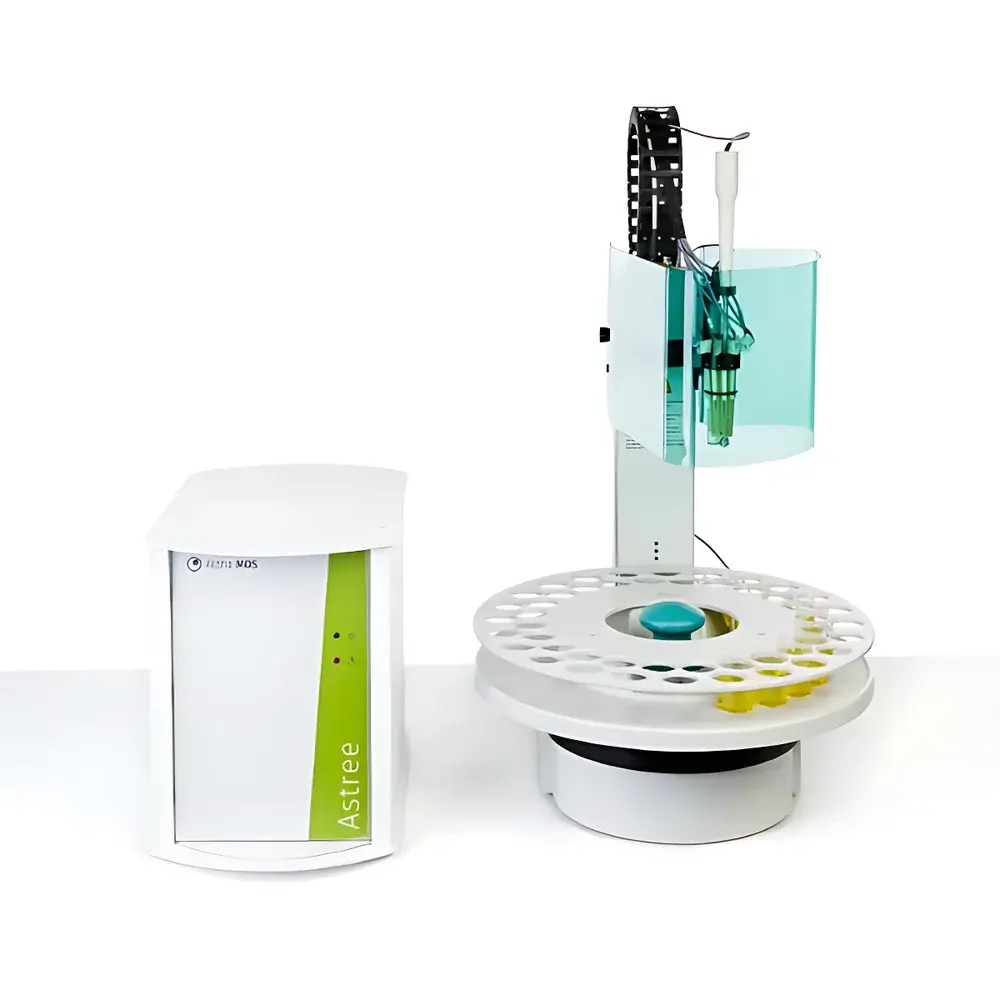
Alpha MOS ASTREE Electronic Tongue
| Brand | Alpha MOS |
|---|---|
| Origin | France |
| Distribution Model | Authorized Distributor |
| Origin Category | Imported Instrument |
| Model | ASTREE |
| Pricing | Available Upon Request |
Overview
The Alpha MOS ASTREE Electronic Tongue is a standardized, potentiometric multisensor system engineered for objective, reproducible taste profiling of liquid and soluble samples. Unlike conventional sensory panels, the ASTREE operates on the principle of non-specific, cross-reactive potentiometric sensing—measuring subtle shifts in interfacial potential between an array of lipid-polymer membrane electrodes and a stable reference electrode upon exposure to complex aqueous matrices. Each sensor responds differentially to ionic species, proton donors/acceptors, hydrophobic compounds, and redox-active molecules, generating a multidimensional response fingerprint. This architecture enables discrimination of subtle compositional differences—such as batch-to-batch variation, degradation markers, or excipient-induced taste modulation—without requiring prior knowledge of target analytes. Designed for routine use in regulated R&D and QC laboratories, the ASTREE delivers high inter- and intra-laboratory reproducibility under GLP-compliant operational protocols.
Key Features
- Seven-channel potentiometric sensor array with chemically diverse, non-enzymatic lipid-polymer membranes—each exhibiting distinct yet overlapping selectivity toward ions, organic acids, amino compounds, and bitter alkaloids.
- Fully automated sample handling via integrated XYZ robotic autosampler with programmable stirring, temperature-controlled sample tray (±0.5 °C), and precise 10–500 µL dispensing accuracy.
- Real-time signal stabilization monitoring with automatic baseline correction and drift compensation algorithms embedded in AlphaSoft software.
- Modular hardware design compliant with ISO/IEC 17025 environmental specifications; CE-marked and RoHS-conformant.
- Robust architecture supporting unattended overnight runs—up to 96 samples per sequence with full audit trail logging.
Sample Compatibility & Compliance
The ASTREE accepts aqueous solutions, suspensions, extracts, and homogenized food/beverage matrices without filtration or derivatization—provided conductivity remains within 0.1–5 mS/cm and pH falls between 2.5 and 8.0. Solid samples (e.g., tablets, powders, dried herbs) must be quantitatively dissolved or extracted under standardized conditions (e.g., USP dissolution media, AOAC 994.02 extraction protocols). The system supports method validation per ICH Q2(R2) guidelines and generates raw data files compliant with FDA 21 CFR Part 11 requirements—including electronic signatures, time-stamped audit trails, and immutable data archiving. All sensor calibration and performance qualification procedures align with Alpha MOS’ PQ/QC documentation package, facilitating GMP-aligned implementation in pharmaceutical stability studies and food safety programs.
Software & Data Management
AlphaSoft v6.x provides end-to-end workflow control—from method setup and instrument calibration to multivariate statistical analysis (PCA, DFA, SIMCA, PLS-DA) and visualization. Raw potential-time curves are processed using proprietary noise-reduction filters before feature extraction (e.g., steady-state potential, response slope, relaxation kinetics). Taste descriptors (sourness, bitterness, saltiness, umami, sweetness) are derived via supervised pattern recognition models trained on reference datasets traceable to ISO 3972:2011 and ASTM E2852-19. Reports export in PDF, CSV, and .ASTR binary formats; raw data archives include full metadata (operator ID, ambient T/RH, sensor lot numbers, calibration timestamps). Optional LIMS integration via ODBC and secure API enables centralized data governance across multi-site deployments.
Applications
- Quantitative bitterness assessment of APIs and pediatric formulations—supporting taste-masking strategy development and regulatory submissions (EMA CHMP/ICH Q5C).
- Shelf-life prediction through time-series taste mapping of dairy, juice, wine, and tea products under real-time and accelerated aging conditions (ISO 20932-1:2019).
- Authentication and origin verification of premium beverages (e.g., Bordeaux wines, Longjing green tea) via discriminant analysis of regional taste fingerprints.
- Formulation optimization in plant-based dairy alternatives and low-sodium food products by correlating sensor responses with consumer hedonic scores.
- Microbial spoilage detection in ready-to-eat meals via early-stage volatile organic acid and biogenic amine signature recognition.
- Cross-comparison of generic vs. innovator drug products for taste equivalence per FDA Guidance for Industry: Bioequivalence Studies with Pharmacokinetic Endpoints.
FAQ
What sample volume is required per analysis?
Typical analysis uses 3–5 mL of homogeneous solution; minimum volume per well is 1.5 mL for reliable signal-to-noise ratio.
Can the ASTREE quantify specific compounds like caffeine or quinine?
No—it performs holistic taste pattern recognition, not targeted quantification. For absolute concentration, coupling with HPLC or LC-MS is recommended.
How often do sensors require recalibration or replacement?
Sensors undergo daily reference solution validation; full recalibration every 72 hours; typical lifetime exceeds 1,200 measurements under standard operating conditions.
Is training provided for method development and statistical interpretation?
Yes—Alpha MOS offers certified on-site and virtual courses covering sensor conditioning, PCA/DFA model building, and regulatory documentation preparation.
Does the system support Good Manufacturing Practice (GMP) environments?
Yes—AlphaSoft includes 21 CFR Part 11 compliance modules, electronic signature workflows, and IQ/OQ/PQ documentation templates validated for pharmaceutical QA/QC use.





