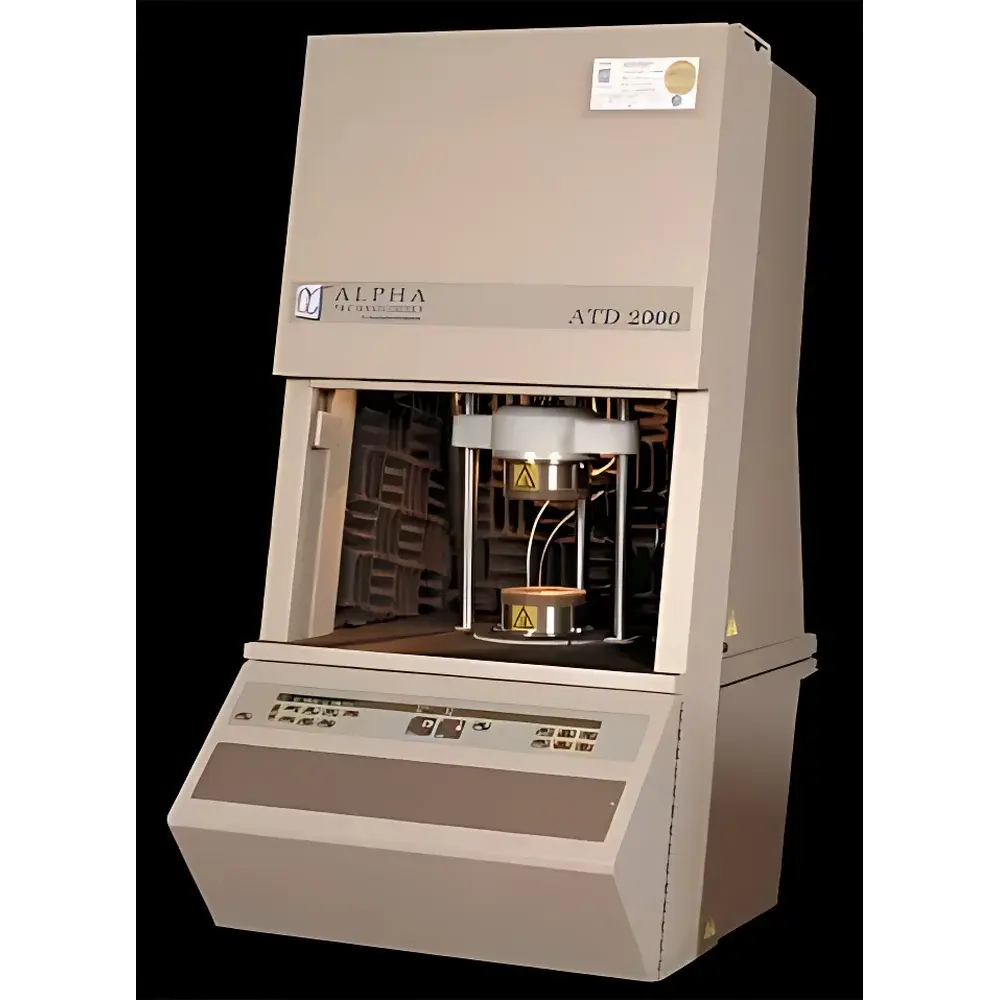
Alpha Technologies ATD2000 ESR™ Energy-Sector Rotational Cure Analyzer
| Brand | Alpha Technologies |
|---|---|
| Origin | USA |
| Model | ATD2000 ESR™ |
| Application Domain | Thermoset Cure Monitoring in Wind Energy Composites |
| Compliance Framework | Supports ASTM D5992, ISO 3417, and USP <1031> for viscoelastic cure characterization |
| Software Platform | PACE™ Modular Process Analytics Suite with GLP/GMP-Ready Audit Trail |
Overview
The Alpha Technologies ATD2000 ESR™ is a precision-engineered rotational cure analyzer specifically designed for real-time viscoelastic monitoring of thermosetting resins during processing—particularly in high-value composite manufacturing for wind turbine blades, nacelles, and structural housings. Operating on the principle of controlled oscillatory shear rheometry under isothermal or programmed temperature ramp conditions, the instrument measures torque response (in dN·m) and phase angle (δ) as a function of time and temperature to quantify evolving storage modulus (G′), loss modulus (G″), and complex viscosity (η*). Unlike conventional dielectric or differential scanning calorimetry (DSC) methods, the ATD2000 ESR™ directly captures mechanical property development under near-process-relevant shear conditions, enabling correlation between laboratory-scale cure kinetics and full-scale autoclave or oven curing cycles.
Key Features
- Encapsulated sample geometry: Pre-encapsulated specimens in standardized aluminum or stainless-steel capsules ensure consistent sample volume, eliminate air entrapment, and prevent volatile loss—critical for reproducible measurement of low-viscosity epoxy and vinyl ester systems.
- Real-time viscoelastic profiling: Continuous acquisition at user-defined intervals (as low as 1-second resolution) delivers high-fidelity G′/G″ crossover detection, gel point identification (via tan δ minimum), and vitrification onset tracking.
- Modular thermal control: Integrated Peltier-based heating/cooling system with ±0.1 °C stability over 30–250 °C range supports both isothermal hold protocols and dynamic ramp profiles compliant with ASTM D5992 Annex A1.
- Patented sample handling fixture: Tool-free capsule insertion and clamping mechanism ensures rapid setup (<60 seconds per test), minimizes operator variability, and enables repeatable alignment—essential for QC-lab throughput and multi-shift operation.
- Process-aligned data output: Direct export of time-stamped, unit-normalized modulus and viscosity traces compatible with MES (Manufacturing Execution Systems) and LIMS integration via OPC UA or CSV/API endpoints.
Sample Compatibility & Compliance
The ATD2000 ESR™ accommodates standard 25-mm-diameter, 1.5-mm-thick disk specimens prepared from resin-infused fiber preforms, neat resins, or formulated gel coats. It is validated for use with epoxy, polyester, vinyl ester, and cyanate ester systems common in blade spar cap and shell layup processes. All measurements adhere to ISO 3417:2021 (Plastics — Determination of dynamic mechanical properties — General principles) and support internal validation against ASTM D5992 (Standard Guide for Dynamic Mechanical Testing of Plastics). The system’s firmware and PACE™ software comply with FDA 21 CFR Part 11 requirements for electronic records and signatures, including role-based access control, immutable audit trails, and electronic signature capture for release-critical cure qualification reports.
Software & Data Management
PACE™ (Process Analytics & Control Environment) is a modular, Windows-based software platform that transforms raw rheological data into actionable process intelligence. Core modules include Cure State Dashboard (real-time visualization of G′/G″ trends vs. specification limits), Kinetic Modeling Engine (Arrhenius and Kamal model fitting), and Specification Mapping Tool (overlay of customer-specified minimum G′ thresholds onto time-temperature profiles). Data files are stored in vendor-neutral HDF5 format with embedded metadata (operator ID, lot number, environmental conditions, calibration timestamp). Export options include PDF reports compliant with ISO/IEC 17025 documentation standards and structured JSON for cloud-based analytics platforms.
Applications
- Wind energy OEMs and Tier-1 suppliers performing incoming resin qualification and batch-to-batch consistency verification prior to infusion.
- R&D labs optimizing cure cycle development for low-exotherm, high-Tg formulations used in offshore blade applications.
- Production floor deployment for first-article testing and periodic in-process verification of resin shelf-life degradation or moisture uptake effects.
- Technical service teams supporting root-cause analysis of delamination, porosity, or interlaminar shear failure by correlating suboptimal cure states with field performance data.
FAQ
What sample preparation method does the ATD2000 ESR™ require?
Standardized encapsulation using Alpha-supplied aluminum capsules; no manual molding or press curing required.
Can the system be integrated into an existing factory automation infrastructure?
Yes—via Ethernet-connected OPC UA server or scheduled CSV exports synchronized with plant SCADA systems.
Is calibration traceable to NIST standards?
Torque and temperature sensors are calibrated annually using NIST-traceable reference standards; calibration certificates are generated within PACE™.
Does the instrument support accelerated aging studies?
Yes—programmable multi-step temperature profiles enable isothermal aging at elevated temperatures followed by recovery scans to assess post-aging network integrity.
How is data integrity maintained during long-duration cure tests (e.g., >24 hours)?
Continuous write-caching with battery-backed RAM and redundant SSD logging ensure zero data loss during power interruption or network latency events.