
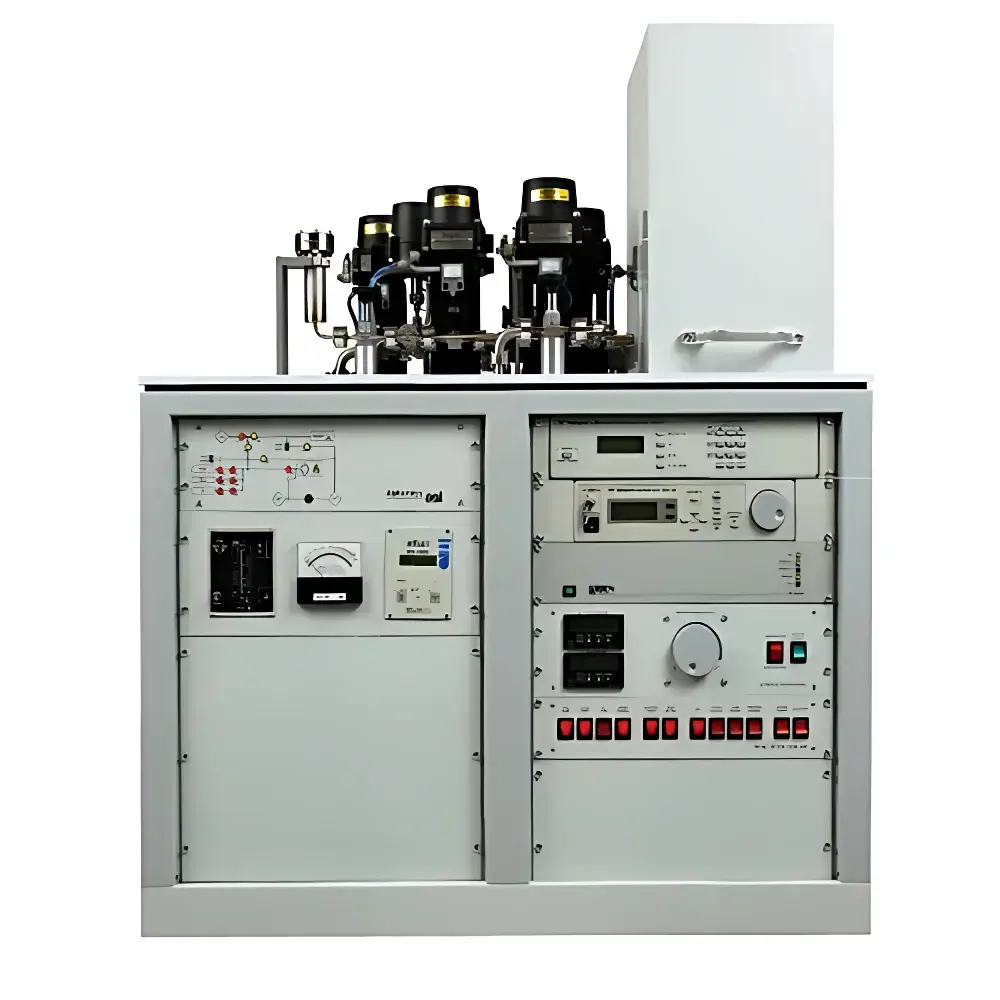
Alphachron He-1 Laser Ablation Helium Extraction and Analysis System
| Brand | ASI |
|---|---|
| Origin | USA |
| Model | Alphachron He-1 |
| Instrument Type | Benchtop |
| Integration | Fully Integrated |
| Laser Wavelength | 915 nm (Diode Laser) |
| Laser Energy | 200 mJ/pulse (typical, configurable) |
| Vacuum System | Hybrid — Dry Diaphragm Roughing Pump + Turbo-Molecular Pump with Controller + Ion Pump with Controller |
| Heating Options | Primary: Nd:YAG or Fiber-Coupled Diode Laser Ablation |
| Optional | Quartz-Halogen Resistive Heating Module |
| Software Platform | LabVIEW-Based Custom Control Suite with Sequence Editor, Audit Trail, and GLP-Compliant Data Logging |
Overview
The Alphachron He-1 Laser Ablation Helium Extraction and Analysis System is a fully integrated, benchtop-scale analytical platform engineered for high-precision, automated radiogenic helium (⁴He) extraction and quantification from geochronologically relevant mineral phases—including apatite, zircon, titanite, and monazite. Unlike conventional furnace-based or step-heating methods, the Alphachron He-1 employs controlled laser ablation—using a stabilized 915 nm diode laser—to induce localized thermal desorption of helium from sub-millimeter mineral grains under ultra-high vacuum (UHV) conditions. This approach minimizes isotopic fractionation, suppresses atmospheric contamination, and enables spatially resolved, grain-specific helium release profiling. The system operates on the principle of in-vacuo laser-induced thermal extraction followed by quantitative gas transfer to an external mass spectrometer (typically a multi-collector ICP-MS or noble gas MS), where ⁴He/³He ratios and absolute ⁴He abundances are measured with sub-femtoliter sensitivity. Its turnkey architecture—pre-aligned, factory-validated, and pre-evacuated—ensures rapid deployment (<48 h post-installation commissioning) and operational consistency across geological laboratories conducting low-temperature thermochronology, basin modeling, and crustal thermal history reconstruction.
Key Features
- Fully integrated UHV gas handling manifold with real-time pressure monitoring (1×10⁻⁹ mbar base pressure achievable), incorporating a dry diaphragm roughing pump, controller-equipped hybrid turbo-molecular pump, and ion pump for long-term stability and helium retention.
- Dual-mode heating capability: primary laser ablation module (915 nm diode laser, pulse energy up to 200 mJ, adjustable repetition rate and spot size) plus optional quartz-halogen resistive heating for comparative or complementary release experiments.
- Modular, optomechanically aligned laser delivery path with fused silica lenses and motorized focusing stage—designed for repeatable beam positioning and minimal thermal drift over extended acquisition sequences.
- LabVIEW-based control software with intuitive graphical sequence editor—enabling users to define multi-step extraction protocols (e.g., incremental power ramping, dwell time per step, gas flush cycles) without coding proficiency.
- Integrated safety interlocks, laser shutter control, and vacuum interlock logic compliant with ANSI Z136.1 and IEC 60825-1 standards; full enclosure with polycarbonate safety shield and interlocked access doors.
- Pre-calibrated gas transfer lines with metal-sealed VCR fittings and bake-out compatible components—ensuring quantitative helium recovery (>98.5% transfer efficiency verified via spike-recovery tests).
Sample Compatibility & Compliance
The Alphachron He-1 accommodates solid mineral separates (20–200 µm grain size) mounted in copper or stainless-steel sample holders, as well as polished thin sections for micro-domain analysis. It supports standard geological reference materials (e.g., Fish Canyon Tuff sanidine, Durango apatite, HBB-1 hornblende) and user-prepared samples conforming to ASTM D7279 and ISO/IEC 17025 requirements for geochemical testing laboratories. All hardware and software modules comply with FDA 21 CFR Part 11 for electronic records and signatures, including audit trail generation, user authentication, and immutable data archiving. System validation documentation (IQ/OQ/PQ protocols) is provided to support GLP and GMP-aligned workflows in academic, government, and commercial geochronology facilities.
Software & Data Management
The native LabVIEW application provides synchronized control of laser parameters, vacuum status, temperature feedback (via optional IR pyrometer), and gas-handling valve sequencing. Experimental metadata—including laser energy, pulse count, chamber pressure, and timestamped gas transfer events—is embedded directly into exported data files (CSV, HDF5). Raw and processed datasets are structured to align with EarthChem and SESAR submission standards. The software supports batch processing of multi-sample trays (up to 48 positions), automatic normalization to internal helium standards, and export of calibrated ⁴He concentrations (in fmol/g) compatible with HeFTy, QTQt, and other thermal history inversion tools. All user actions generate time-stamped, operator-identified audit logs meeting ISO/IEC 17025 clause 7.11 requirements.
Applications
- (U-Th)/He thermochronology for reconstructing exhumation histories and landscape evolution across timescales from 1 Ga.
- Multi-diffusion domain modeling of helium loss in apatite and zircon using controlled, stepwise laser heating profiles.
- Integration with MC-ICP-MS systems for simultaneous measurement of ⁴He, ³He, and ²¹Ne to constrain cosmogenic vs. radiogenic signal contributions.
- High-throughput screening of detrital thermochronology datasets for sedimentary provenance and basin analysis.
- Method development for helium diffusion kinetics, including experimental calibration of Arrhenius parameters under variable grain-size and radiation-damage conditions.
FAQ
What vacuum level does the Alphachron He-1 achieve, and how is it maintained during helium extraction?
The system achieves a base pressure of ≤1×10⁻⁹ mbar using a three-stage pumping strategy: dry diaphragm pump for initial roughing, turbo-molecular pump for intermediate vacuum, and ion pump for ultimate UHV stabilization—ensuring minimal background helium and stable extraction conditions throughout multi-hour runs.
Can the Alphachron He-1 be coupled directly to an ICP-MS without external gas purification?
Yes—the integrated gas handling system includes cold traps and non-evaporable getter (NEG) cartridges to remove H₂O, CO₂, N₂, and reactive species prior to transfer; however, direct coupling requires interface alignment verification and may necessitate minor plumbing adaptation per vendor specifications.
Is the LabVIEW software source-code accessible for custom protocol development?
Source code is not distributed; however, the sequence editor supports drag-and-drop logic blocks, conditional branching, and parameter scripting via built-in expression language—sufficient for advanced method customization without SDK access.
Does the system meet regulatory requirements for contract analytical laboratories?
Yes—it ships with full 21 CFR Part 11 compliance features (electronic signatures, audit trails, role-based access), IQ/OQ/PQ documentation templates, and calibration certificates traceable to NIST standards.
What maintenance intervals are recommended for the vacuum pumps and laser optics?
Dry diaphragm pump oil replacement every 6 months; turbo pump bearing inspection annually; ion pump regeneration every 2 years; laser lens cleaning and alignment verification quarterly—detailed schedules are included in the Operations & Maintenance Manual.
Related Products




