
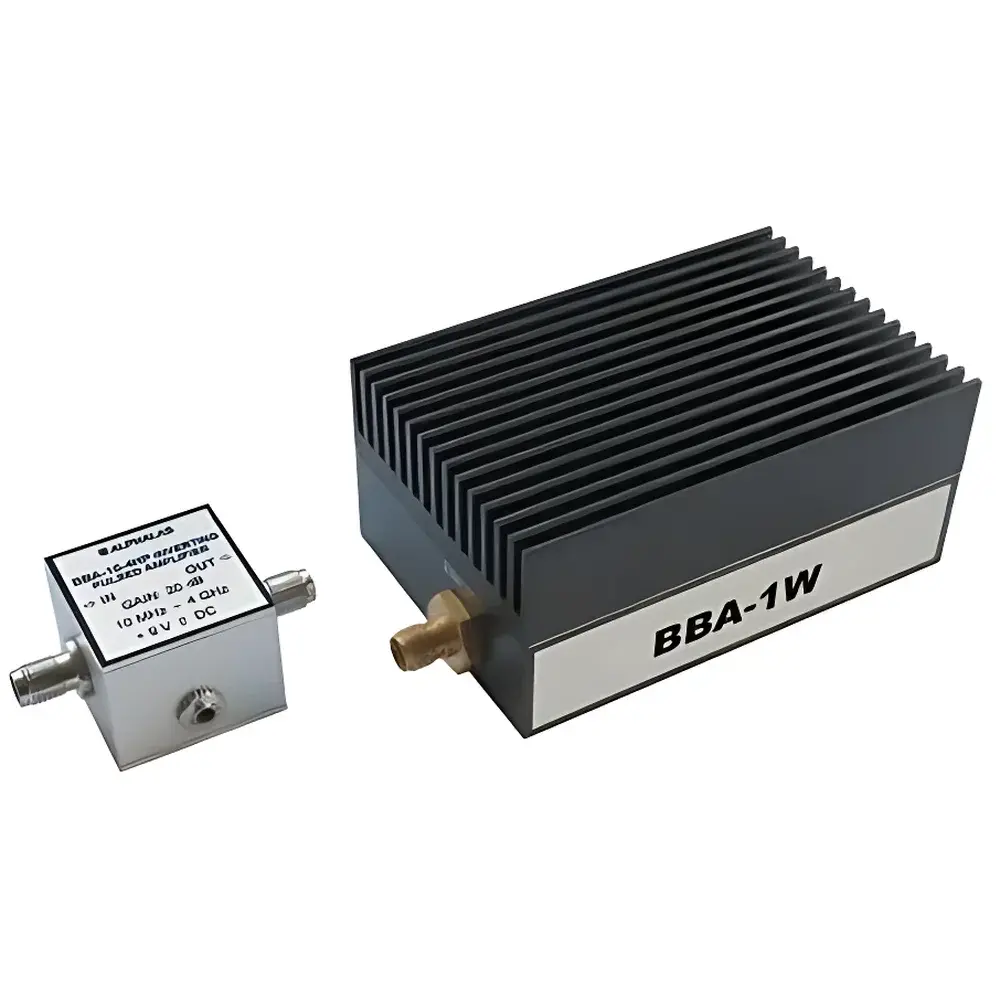
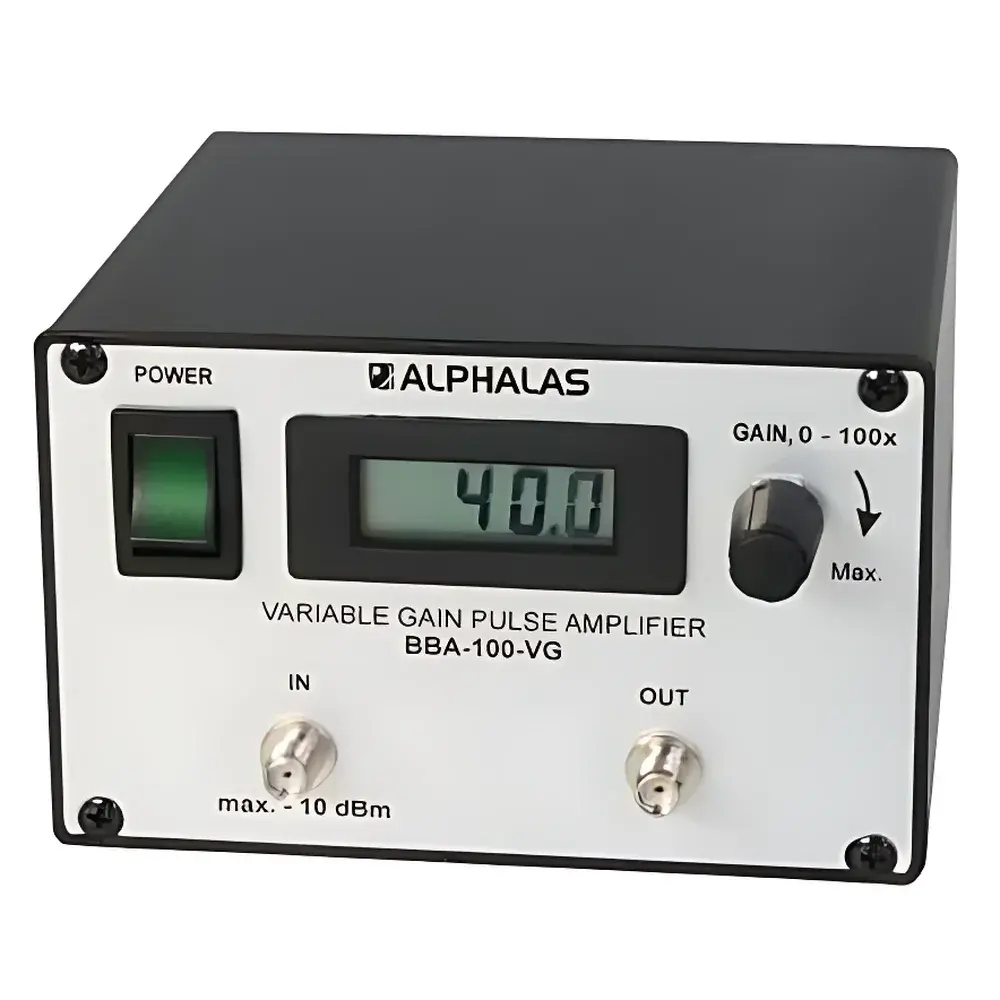
AlphaLas BBA Series Broadband Pulse Amplifier
| Brand | AlphaLas |
|---|---|
| Origin | Germany |
| Model | BBA |
| Type | Inverting/Non-Inverting Broadband RF Amplifier for Ultrafast Optical Detection |
| Key Specifications | Bandwidth up to 4 GHz |
| Compliance | CE, RoHS, IEC 61326-1 (EMC for Laboratory Equipment) |
Overview
The AlphaLas BBA Series Broadband Pulse Amplifier is a high-fidelity, DC-coupled–capable (AC-coupled by default), solid-state RF amplifier engineered specifically for time-resolved optical and electronic signal conditioning in ultrafast science laboratories. Based on low-noise GaAs pHEMT and SiGe HBT architectures, the BBA series operates on the principle of broadband small-signal amplification across defined frequency bands—from 10 MHz up to 4 GHz—while preserving pulse integrity, rise time (<100 ps typical), and amplitude linearity. It is not a laser source but a critical front-end or intermediate-stage amplifier optimized for interfacing with ultrafast photodetectors such as AlphaLas UPD (Ultrafast Photodiodes), enabling high-temporal-resolution measurements without the cost or complexity of avalanche photodiode (APD) modules. Its design prioritizes minimal group delay variation, flat gain response, and impedance-matched 50 Ω input/output ports—making it suitable for time-domain reflectometry (TDR), pump-probe synchronization, optical sampling, and direct digitization of transient photocurrents.
Key Features
- Ultra-broad bandwidth: Selectable models cover 10 MHz–2 GHz (BBA-15, BBA-100), 10 MHz–3 GHz (BBA-10), and 10 MHz–4 GHz (BBA-10-4HP), with gain flatness ≤ ±1.5 dB over specified band
- Low-noise performance: Equivalent input noise voltage as low as 347 µV rms (BBA-10-4HP); noise figure down to 2.8 dB @ 1 GHz ensures high signal-to-noise ratio for weak transient signals
- High dynamic range: Maximum input power handling up to +13 dBm (20 mW); saturated output power up to +30 dBm (1 W) in BBA-1W variant, supporting direct AOM or laser diode gate driving
- Configurable topology: Inverting (BBA-10, BBA-10-4HP, BBA-1W) and non-inverting (BBA-100, BBA-100-VG) variants accommodate differential signaling, feedback loop integration, and polarity-sensitive measurement setups
- Robust coaxial architecture: All models feature SMA female connectors, hermetically sealed metal housings, and thermal management optimized for continuous operation under laboratory ambient conditions (15–30 °C)
- Gain flexibility: BBA-100-VG includes a precision 6-turn potentiometer enabling continuously variable gain from 0 to 43.5 dB, eliminating need for external attenuators in multi-dynamic-range experiments
Sample Compatibility & Compliance
The BBA amplifier is routinely deployed downstream of ultrafast photodiodes (e.g., UPD-xx-IR, UPD-xx-UV), electro-optic sampling heads, and RF-output photoreceivers. It interfaces natively with 50 Ω oscilloscopes (Keysight, Tektronix, LeCroy), digitizers (Spectrum Instrumentation, AlazarTech), and lock-in amplifiers (Zurich Instruments HF2LI). All units comply with EU Directive 2014/30/EU (EMC) and 2011/65/EU (RoHS), certified per IEC 61326-1:2013 for electromagnetic immunity in laboratory environments. Mechanical and electrical safety conforms to IEC 61010-1:2010. While not FDA-regulated, its stable gain calibration and traceable noise performance support GLP-aligned test protocols where amplifier linearity and repeatability are documented per SOP.
Software & Data Management
The BBA is a fully analog, firmware-free instrument—no drivers, USB interface, or proprietary software required. Gain, offset, and bandwidth are hardware-defined; thus, it introduces zero latency or jitter into timing-critical paths. For system-level calibration, users integrate it into automated test sequences via SCPI-compatible instruments (e.g., signal generators triggering photodiode illumination while oscilloscopes record amplified transients). Gain vs. frequency sweeps can be performed using vector network analyzers (e.g., Keysight PNA-L) and logged into CSV/HDF5 formats for traceable metrology records. All specifications—including noise floor, gain compression point (P1dB), and third-order intercept (IP3)—are provided in the factory calibration report shipped with each unit, supporting ISO/IEC 17025-compliant lab accreditation workflows.
Applications
- Time-resolved photoluminescence and carrier lifetime measurements in semiconductor physics
- Optical time-domain reflectometry (OTDR) for fiber fault localization and dispersion analysis
- Driving acousto-optic modulators (AOMs) requiring fast, high-amplitude RF gating pulses
- Direct amplification of photocurrents from streak cameras and single-photon avalanche diodes (SPADs) in time-correlated single-photon counting (TCSPC)
- Characterization of ultrafast laser pulse trains (fs–ps regimes) via balanced optical cross-correlation
- High-speed electronic testing: jitter analysis, eye diagram generation, and bit-error-rate (BER) validation in 5G/mmWave R&D
- THz time-domain spectroscopy (THz-TDS) signal boosting prior to electro-optic sampling detection
FAQ
Is the BBA amplifier compatible with cryogenic photodetectors?
Yes—provided the detector’s output is 50 Ω terminated and its voltage swing remains within the BBA’s linear input range (typically ±200 mV for low-gain models), operation down to 4 K has been validated in published literature using vacuum feedthrough-mounted configurations.
Can multiple BBA units be cascaded for higher gain?
Cascading is technically feasible but requires inter-stage 50 Ω matching, isolation filtering, and careful stability analysis (risk of oscillation increases above 2 GHz); AlphaLas recommends using the BBA-100-VG or BBA-1W instead for single-stage solutions.
Does the BBA support DC coupling?
Standard units are AC-coupled (0.01 Hz high-pass), but DC-coupled variants (BBA-DC series) are available upon request with modified input stage and ±5 V common-mode range.
How is gain accuracy maintained over temperature?
Each unit undergoes 72-hour burn-in and thermal soak testing (15–35 °C); gain drift is specified as ≤ ±0.02 dB/°C across the operating range, verified via NIST-traceable RF power meters.
Are S-parameter files available for SPICE or EM simulation?
Yes—S11/S21/S22 touchstone (.s2p) files for all standard models are provided in the technical download portal, including de-embedded connector models for PCB layout integration.




