
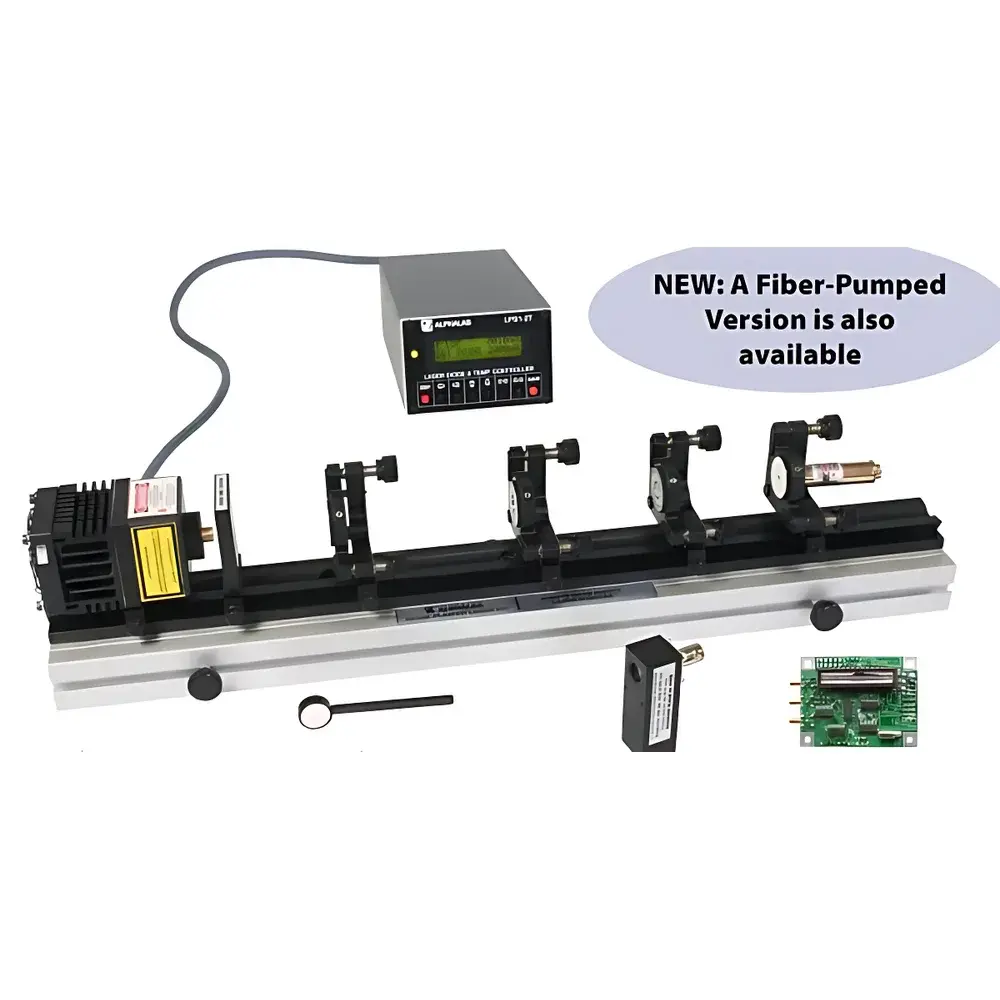
AlphaLas LASKIT-500 Diode-Pumped Solid-State (DPSS) Multi-Mode Pulsed Laser System
| Brand | AlphaLas |
|---|---|
| Origin | Germany |
| Model | LASKIT-500 |
| Laser Type | Diode-pumped Nd:YAG/Nd:YVO₄ solid-state laser system |
| Output Wavelengths | 1064 nm (fundamental), 532 nm (intracavity/intra-cavity SHG), 266 nm (FHG, optional), 355 nm (THG, optional) |
| Operating Modes | CW @ 1064 nm |
| Q-switched @ 1064 nm (passive, Cr⁴⁺ | YAG) |
| Pulse Width Range | 10–100 ns (depending on gain medium & configuration) |
| Repetition Rate | 5–100 kHz |
| Average Power (1064 nm, CW) | 300–500 mW |
| Average Power (532 nm, CW) | 10–40 mW |
| Average Power (532 nm, Q-switched) | 5–30 mW |
| Integrated Components | Peltier-cooled pump diode with driver & TEC controller (LDD1-1T or LPS1-2T), Nd:YAG/Nd:YVO₄ crystal mount with water cooling, fixed plano-concave cavity mirrors, Cr⁴⁺:YAG saturable absorber (AR/AR coated), AR-coated KTP frequency-doubling crystal (intra- and extracavity configurations), optical breadboard, IR-VIS alignment converter (15 mm clear aperture), ultrafast photodetector UPD-300-SP (320–1100 nm, <300 ps rise time), CCD linear array CCD-2000M (2048 px, for M², autocorrelation, spectral analysis) |
| Modularity | Tool-free crystal/mirror exchange |
| Optional Upgrades | EOD active Q-switching (electro-optic deflector), PC active Q-switching (Pockels cell), monolithic microchip Cr⁴⁺:Nd:YAG laser (1064 nm, ~800 ps, ~10 kW peak power), external SHG/THG/FHG modules |
Overview
The AlphaLas LASKIT-500 is a modular, education- and research-grade diode-pumped solid-state (DPSS) laser platform engineered for hands-on investigation of fundamental laser physics, nonlinear optics, and pulsed laser dynamics. Unlike turnkey industrial lasers, the LASKIT-500 functions as an open optical bench system—integrating a thermally stabilized pump diode, actively cooled gain media (Nd:YAG or Nd:YVO₄), passive Q-switching elements (Cr⁴⁺:YAG), and intracavity/extracavity frequency conversion components (KTP). Its architecture enables direct observation and quantitative measurement of key phenomena governed by rate equations, cavity stability criteria (e.g., ABCD matrix formalism), relaxation oscillations, and nonlinear conversion efficiency limits. Designed to comply with ISO 11146 (laser beam parameters) and IEC 60825-1 (laser safety), it serves as a pedagogical and experimental reference for validating theoretical models—including threshold behavior, transverse mode structure (TEM₀₀ vs. higher-order modes), fluorescence lifetime dependence on dopant concentration, and thermal lensing effects under varying pump conditions.
Key Features
- Five experimentally distinct operating modes: CW at 1064 nm; passively Q-switched at 1064 nm; CW second-harmonic generation (SHG) at 532 nm; intracavity Q-switched SHG at 532 nm; and extracavity Q-switched SHG at 532 nm—each configurable within one minute via mechanical repositioning of crystals and mirrors.
- Interchangeable gain media: Standard Nd:YAG crystal (with water-cooled mount) and optional Nd:YVO₄ variant—enabling comparative study of emission cross-section, upper-state lifetime (~230 μs for Nd:YAG vs. ~100 μs for Nd:YVO₄), thermal conductivity, and Q-switching dynamics.
- Integrated diagnostics suite: Includes UPD-300-SP ultrafast photodetector (<300 ps rise time, 320–1100 nm) for pulse shape analysis and relaxation oscillation characterization; CCD-2000M linear array (2048 pixels) with dedicated electronics for near-field beam profiling, M² measurement, and autocorrelation-based pulse width estimation.
- Thermal and electrical stability: Peltier-cooled 808 nm pump diode with dual-loop LDD1-1T driver/TEC controller ensures long-term power stability (<±2% over 8 h); water-cooled crystal mount mitigates thermal lensing during extended CW operation.
- Alignment-ready optical infrastructure: IR-VIS-15-B converter (15 mm clear aperture) facilitates safe visual alignment of invisible 1064 nm radiation; precision-machined optical breadboard supports reproducible cavity construction per ISO 10110 surface specification standards.
Sample Compatibility & Compliance
The LASKIT-500 accommodates standard optomechanical components compliant with 25 mm and 50 mm mounting interfaces (e.g., Thorlabs, Newport). All coated optics meet MIL-C-48497A durability requirements, with AR coatings specified for R < 0.2% per surface across 1064 nm and 532 nm bands. The system adheres to EN 60825-1:2014 Class 4 laser safety classification when operated above 500 mW output, requiring interlocked enclosures and certified laser safety eyewear (OD6+ at 1064/532 nm). For regulated environments, its modular design supports traceable calibration paths: power measurements align with NIST-traceable thermopile detectors (e.g., LPM-12, 0.2–10 μm spectral range); temporal diagnostics conform to IEEE Std 1528-2020 for ultrafast photodetector response characterization. No embedded firmware or network connectivity precludes FDA 21 CFR Part 11 compliance concerns—data acquisition remains external and user-controlled.
Software & Data Management
The LASKIT-500 operates without proprietary closed-source software. All integrated instruments—LDD1-1T driver, UPD-300-SP detector, and CCD-2000M array—provide analog voltage outputs and TTL synchronization triggers compatible with industry-standard DAQ platforms (National Instruments USB-6363, Keysight U1051A) and open-source tools (Python + PyVISA, MATLAB Data Acquisition Toolbox). Raw temporal waveforms, beam profiles, and power stability logs are stored in HDF5 or CSV format, enabling full auditability per GLP/GMP documentation workflows. Optional LPS1-2T microcontroller-based driver adds RS-232/USB command interface (SCPI-compliant) for script-driven parameter sweeps—e.g., pump current ramping to map lasing threshold versus temperature.
Applications
- Educational laboratories: Demonstrating cavity stability diagrams, TEM₀₀ mode optimization, Q-switch initiation thresholds, and SHG conversion efficiency vs. fundamental intensity (Manley–Rowe relations).
- Nonlinear optics research: Quantifying KTP phase-matching bandwidth, walk-off effects in extracavity doubling, and thermal dephasing in high-repetition-rate Q-switched SHG.
- Laser–matter interaction studies: Ablation threshold mapping using calibrated 532 nm pulses; time-resolved plasma plume spectroscopy with synchronized UPD-300-SP gating.
- Instrument development: Serving as a testbed for novel saturable absorbers (e.g., SESAMs), adaptive cavity optics, or real-time M² feedback loops using CCD-2000M data streams.
- Advanced upgrade pathways: Integration of EOD or Pockels-cell active Q-switching modules enables exploration of jitter-limited pulse timing (<100 ps RMS), while the monolithic Cr⁴⁺:Nd:YAG microchip option provides sub-nanosecond sources for time-of-flight metrology or two-photon excitation validation.
FAQ
What gain media are supported, and how do they affect performance?
The system ships with Nd:YAG but accepts Nd:YVO₄ as an option. Nd:YVO₄ offers higher absorption at 808 nm and broader emission bandwidth—enabling shorter Q-switched pulses (50–100 ns vs. 10–50 ns for Nd:YAG) and higher repetition rates (up to 100 kHz), albeit with lower thermal conductivity.
Is external frequency conversion (e.g., THG, FHG) supported?
Yes—optional THG (355 nm) and FHG (266 nm) modules use precisely angle-tuned BBO or CLBO crystals mounted on kinematic stages, with input beam conditioning optics to maintain spatial coherence and minimize group-velocity mismatch.
Can the system be used for M² measurements?
Absolutely—the included CCD-2000M linear array, combined with a motorized beam-waist scanning stage (not supplied but compatible with standard translation stages), enables full ISO 11146-compliant M² determination across all operating modes.
What safety certifications apply to the LASKIT-500?
It complies with IEC 60825-1:2014 (Class 4) and EU Directive 2006/25/EC for artificial optical radiation exposure limits; CE marking covers EMC (EN 61326-1) and low-voltage (EN 61000-6-3) directives.
How is thermal management implemented for sustained operation?
The Nd:YAG/Nd:YVO₄ crystal mount integrates a recirculating water cooling loop (recommended flow rate: 0.5 L/min, ΔT < 2 °C), while the pump diode uses closed-loop Peltier control with ±0.1 °C stability—critical for minimizing wavelength drift and maintaining mode overlap in CW SHG.




