
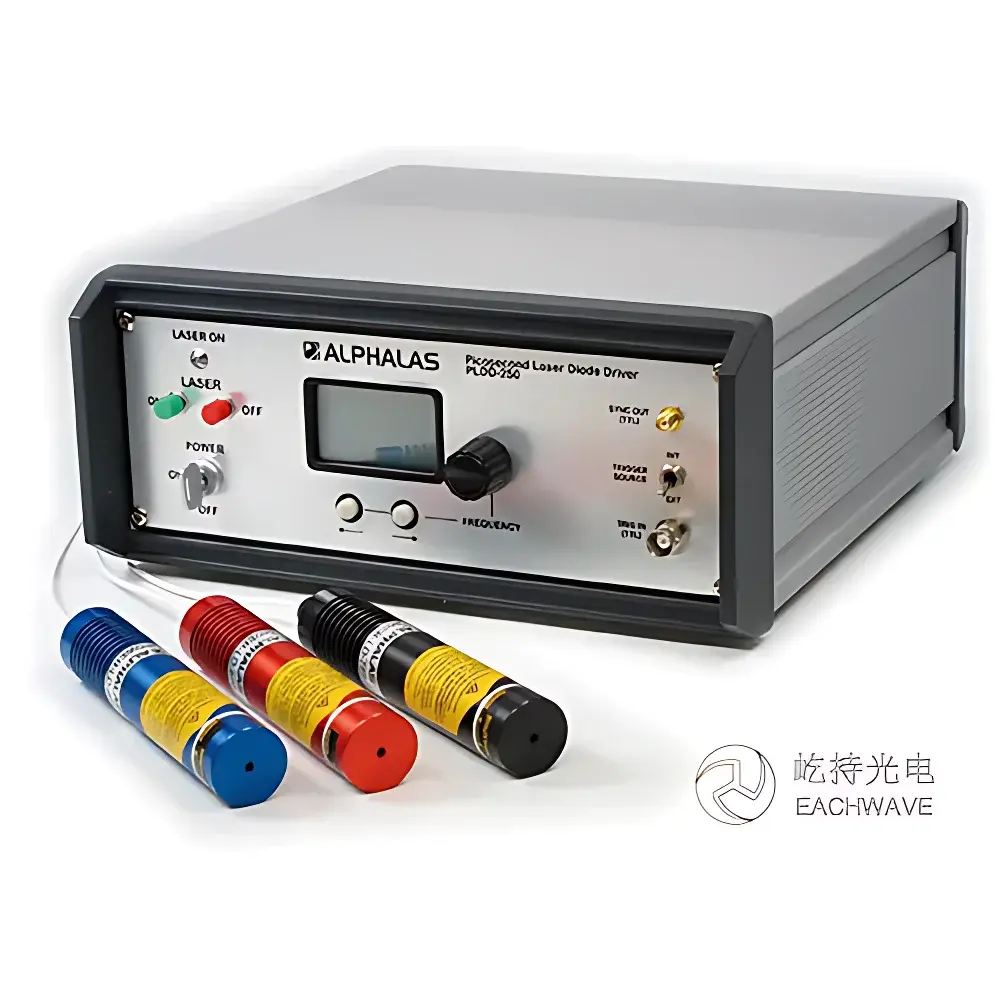
ALPHALAS PICOPOWER-LD Picosecond Pulsed Diode Laser System
| Brand | ALPHALAS |
|---|---|
| Origin | Germany |
| Type | Picosecond Pulsed Semiconductor Laser Source |
| Wavelength Range | 375–2300 nm |
| Pulse Width | Down to 12 ps (FWHM, convolved) |
| Peak Power | Up to 3 W |
| Repetition Rate | Single-shot to 100 MHz |
| Output Options | Free-space collimated or fiber-coupled (SM/PM) |
| Linewidth Options | Fabry–Pérot (FP) or DFB narrow-linewidth variants |
| Compliance | CE, RoHS, IEC 61000-6-3/6-4 |
Overview
The ALPHALAS PICOPOWER-LD is a modular, high-stability picosecond pulsed diode laser system engineered for time-resolved optical applications requiring precise temporal control, broad spectral coverage, and exceptional pulse-to-pulse reproducibility. Based on gain-switched semiconductor laser diodes, the system operates on the principle of direct current pulsing—delivering sub-40 ps optical pulses without external cavity compression or mode-locking. Its architecture integrates a low-jitter, high-current driver with thermally stabilized laser heads, enabling deterministic pulse generation synchronized to internal or external triggers with jitter < 4 ps (rms). Designed for integration into advanced photonic testbeds and OEM instrumentation, the PICOPOWER-LD serves as a compact, turnkey seed source for ultrafast amplifiers, time-correlated single-photon counting (TCSPC) systems, and time-of-flight measurement platforms.
Key Features
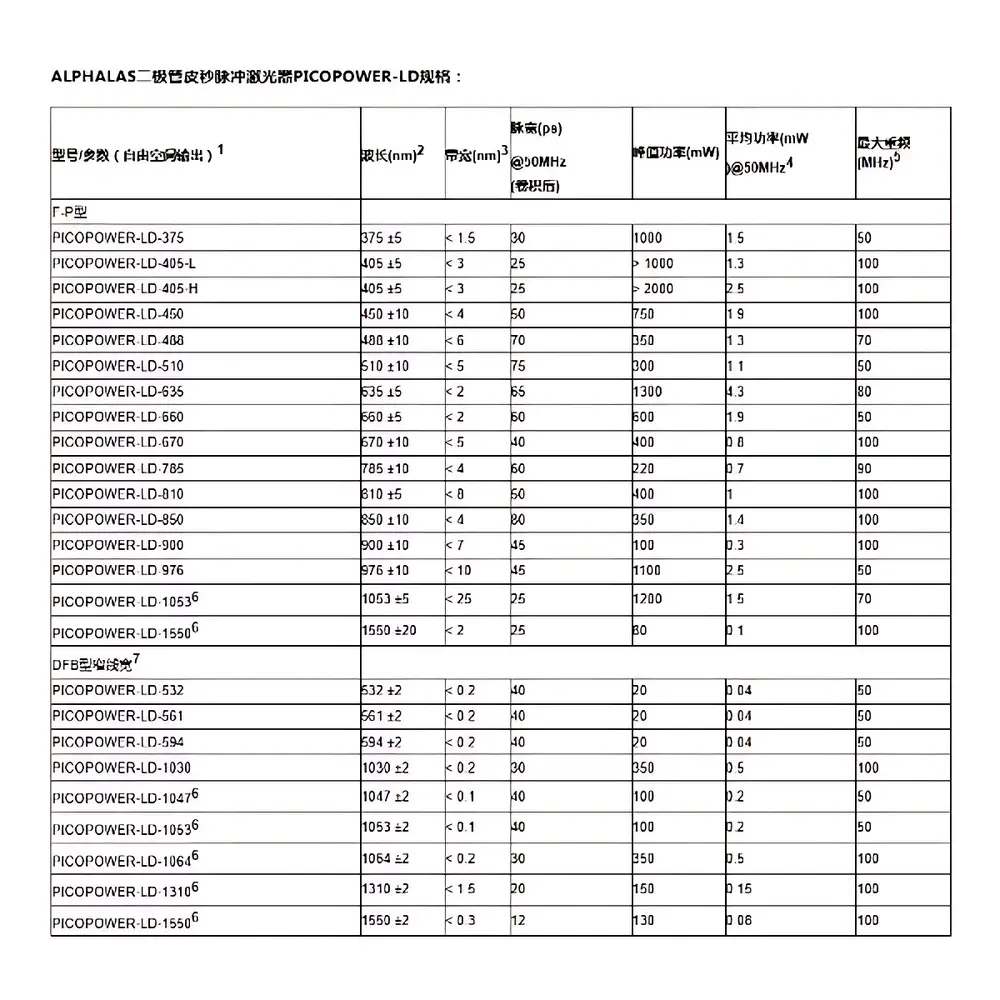
- Wavelength flexibility: Standard FP-configured heads available at 375, 405, 450, 488, 510, 635, 670, 785, 850, 976, 1030, 1047, 1053, 1064, 1310, and 1550 nm; DFB narrow-linewidth variants (< 0.3 nm FWHM) offered at select wavelengths including 532, 561, 594, 1030–1064 nm, and 1310–1550 nm.
- Pulse performance: Pulse widths as short as 12 ps (convolved), peak powers up to 3 W, average power up to 4.3 mW (at 50 MHz), and repetition rates programmable from 1 Hz to 100 MHz in discrete or continuous steps.
- Driver precision: PLDD-series picosecond drivers feature built-in high-stability frequency synthesizers (jitter < 10 ps), TTL/NIM synchronous outputs, < 43 ns fixed delay from trigger to laser output, and < 1% RMS amplitude stability over 8 hours.
- Modular scalability: Supports single-, dual-, or multi-channel configurations; one driver can sequentially or simultaneously operate multiple interchangeable laser heads via optional channel switching modules.
- Output versatility: Free-space collimated output (typical divergence < 1.5 mrad) or SMF-28/PM fiber coupling (25–30% coupling efficiency); TEC-controlled wavelength tuning available for red and IR heads (±0.1 nm/°C).
Sample Compatibility & Compliance
The PICOPOWER-LD is compatible with standard optical components used in ultrafast photonics—including TCSPC detectors (e.g., MCP-PMTs, SPAD arrays), streak cameras, fast photodiodes (rise time < 10 ps), and nonlinear crystals for SHG/OPO pumping. All laser heads meet IEC 60825-1:2014 Class 3B or Class 4 safety requirements depending on configuration, with integrated interlock circuits and key-switched operation. The system complies with EU electromagnetic compatibility directives (IEC 61000-6-3/6-4), RoHS 2011/65/EU, and carries CE marking for laboratory and industrial deployment. For regulated environments, full traceable calibration records, firmware revision logs, and audit-ready operational logs are supported through optional GLP/GMP-compliant software extensions.
Software & Data Management
Control is implemented via USB 2.0 or RS-232 interface using ALPHALAS’ cross-platform LabVIEW-compatible SDK and GUI application (Windows/Linux/macOS). The driver firmware supports SCPI command set for seamless integration into Python-, MATLAB-, or C++-based automation frameworks. Time-stamped pulse logging, real-time repetition rate monitoring, temperature tracking, and driver status telemetry are recorded with microsecond resolution. Optional FDA 21 CFR Part 11 compliance package includes electronic signatures, role-based access control, and immutable audit trails for all parameter changes—enabling use in pharmaceutical QC labs and ISO 17025-accredited testing facilities.
Applications
- Time-resolved microscopy: FLIM, PLIM, STED, FRAP, TIRF, and TRPL—leveraging sub-50 ps timing resolution for lifetime decay analysis with < 100 ps instrument response function (IRF).
- Ultrafast spectroscopy: FCS, FLCS, single-molecule fluorescence detection, and pump-probe experiments where tunable, low-noise seeding is critical.
- Laser seeding & amplification: MOPA systems, fiber amplifiers, and bulk solid-state amplifiers requiring high-fidelity, jitter-free injection seeding at variable repetition rates.
- Photonic device characterization: Jitter measurement of photodetectors, time-domain reflectometry (OTDR), diffusion optical tomography, and time-of-flight LiDAR validation.
FAQ
Can the PICOPOWER-LD be operated in continuous-wave (CW) mode?
Yes—optional CW modulation is available on select drivers (PLDD series), enabling adjustable average power control independent of pulse parameters.
What is the typical pulse-to-pulse timing jitter relative to the external trigger?
The system achieves < 4 ps rms jitter between TTL trigger input and optical pulse onset, verified with high-bandwidth oscilloscopes and time-interval analyzers.
Is fiber coupling available for all wavelengths?
All standard and custom wavelengths support SMF-28 or PM fiber coupling; coupling efficiency ranges from 25% to 30%, with polarization extinction ratio > 20 dB for PM variants.
How is wavelength stability maintained during extended operation?
Laser heads incorporate thermoelectric coolers (TECs) with ±0.05 °C regulation; DFB variants further reduce thermal drift via monolithic grating stabilization.
Are OEM integration kits and mechanical mounting options available?
Yes—19” rack-mount chassis, custom enclosure designs, DIN-rail adapters, and OEM driver PCB modules (with pin-compatible connectors) are offered under NDA.




