
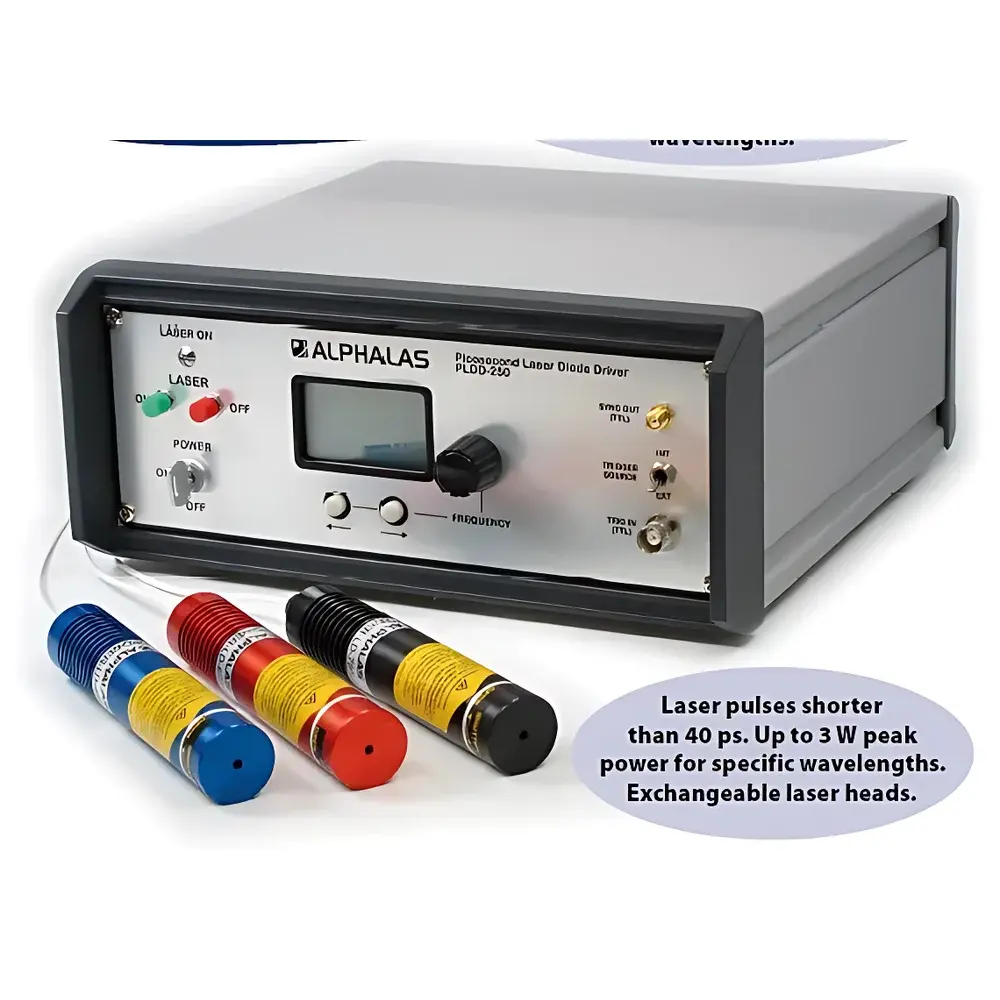
AlphaLas PICOPOWER-LD Picosecond Pulsed Solid-State Laser
| Brand | AlphaLas |
|---|---|
| Origin | Germany |
| Model | PICOPOWER-LD |
| Type | Diode-Pumped Solid-State (DPSS) Picosecond Laser Source |
| Wavelength Options | 375, 405, 450, 488, 520, 635, 670, 785, 976, 1030, 1064, 1300, 1550 nm (custom wavelengths available) |
| Pulse Width | <40 ps (typ. <50 ps across most wavelengths) |
| Repetition Rate | 0.1 Hz – 20 MHz (optional up to 80 MHz) |
| Peak Power | Up to 3 W (wavelength- and configuration-dependent) |
| Average Power | 0.2–1.0 mW @ 20 MHz (up to 2.0 mW @ 40 MHz, depending on wavelength) |
| Beam Quality | TEM₀₀ (slightly elliptical) |
| Beam Divergence | 0.5–1.5 mrad |
| Output | Collimated free-space (with integrated spatial filter) or optional fiber-coupled (SMF or PMF) |
| Triggering | External TTL input & synchronized TTL output |
| Control Interface | Built-in digital frequency generator with front-panel display |
| Compliance | CE-marked |
Overview
The AlphaLas PICOPOWER-LD is a compact, diode-pumped solid-state (DPSS) picosecond pulsed laser system engineered for high-temporal-resolution optical applications requiring sub-40 ps pulse widths, precise repetition rate control, and multi-wavelength flexibility. Unlike conventional Q-switched or mode-locked lasers, the PICOPOWER-LD employs a patented high-current laser diode driver architecture that directly generates short optical pulses without external modulation—enabling intrinsic jitter below 10 ps and exceptional timing stability. Its core design integrates a thermally stabilized solid-state gain medium with a monolithic cavity optimized for low-amplitude noise and high pulse-to-pulse reproducibility. The system operates across 13 standard wavelengths—from deep UV (375 nm) to mid-infrared (1550 nm)—each selected via interchangeable optical heads, allowing users to maintain identical temporal and electronic characteristics across spectral bands. This makes it particularly suitable for time-resolved spectroscopy, pump-probe dynamics, and calibration of ultrafast photodetectors where synchronization fidelity and pulse integrity are critical.
Key Features
- Sub-40 ps optical pulse width (typ. <50 ps), verified via autocorrelation and streak camera validation
- Peak power up to 3 W (wavelength- and head-dependent), enabling nonlinear excitation and efficient upconversion
- Digitally controlled repetition rate from 0.1 Hz to 20 MHz (optional 40/80 MHz versions), with front-panel LCD frequency display and internal programmable divider
- Integrated spatial filter ensuring collimated, diffraction-limited TEM₀₀ output (M² < 1.3, slightly elliptical polarization)
- Modular optical head design supporting rapid wavelength interchange without realignment or recalibration
- External TTL trigger input with <1 ns edge jitter and synchronous TTL output for multi-instrument synchronization
- Optional single-mode or polarization-maintaining fiber coupling (FC/APC interface), compatible with amplification stages and integrated photonics platforms
- Compliance with IEC 61000-6-3 (EMC emission) and IEC 60825-1:2014 (laser safety Class 4, interlock-ready)
Sample Compatibility & Compliance
The PICOPOWER-LD is designed for integration into regulated analytical workflows. Its stable pulse parameters and low timing jitter support GLP-compliant fluorescence lifetime imaging (FLIM) and time-correlated single-photon counting (TCSPC) systems. When configured with fiber-coupled outputs at 785 nm or 1550 nm, it meets ITU-T G.694.1 channel spacing requirements for telecom-grade OTDR validation. All units ship with CE marking, full traceable calibration certificates (NIST-traceable pulse width and wavelength verification), and documentation aligned with ISO/IEC 17025 clause 5.5.2 (equipment verification). Optional 21 CFR Part 11–compliant software logging packages are available for audit-ready timestamped operation records.
Software & Data Management
While the PICOPOWER-LD operates autonomously via its built-in digital frequency generator, AlphaLas provides the optional LaserControl Suite—a Windows-based application supporting remote configuration via USB or RS-232. The suite enables automated sequence programming (e.g., burst mode, gated repetition), real-time monitoring of driver temperature and diode current, and export of pulse statistics (jitter, amplitude drift) in CSV format. All firmware updates preserve factory calibration tables and support version-controlled rollback. Audit trails include user ID, timestamp, parameter changes, and checksum-verified configuration files—fully compliant with data integrity requirements under ALCOA+ principles.
Applications
- Fluorescence lifetime decay analysis (FLIM, TCSPC) using time-gated detection
- Pump-probe spectroscopy for carrier dynamics in semiconductors and 2D materials
- Characterization of photodetector rise/fall times and impulse response functions
- Calibration source for optical time-domain reflectometers (OTDRs) in fiber network certification
- Seed source for fiber amplifiers and optical parametric oscillators (OPOs)
- Time-of-flight (ToF) measurements in optical coherence tomography (OCT) and LIDAR development
- Ultrafast optoelectronic sampling in high-speed circuit testing
FAQ
What is the typical pulse-to-pulse energy stability over 8 hours?
RMS fluctuation is ≤1.2% (measured with calibrated photodiode and oscilloscope averaging over 10⁴ pulses at 10 MHz).
Can the PICOPOWER-LD be synchronized with femtosecond Ti:sapphire lasers?
Yes—via its low-jitter TTL output (<500 ps RMS jitter relative to pulse peak) and external trigger input with adjustable delay (0–100 ns, 10 ps resolution).
Is wavelength calibration traceable to NIST standards?
Each unit includes a certificate of conformance referencing NIST SRM 2034 (for visible/NIR) or SRM 2035 (for IR), with uncertainty ±0.5 nm (k=2) at 23 °C.
What cooling method is required?
Passive convection cooling suffices for continuous operation at ≤10 MHz; forced-air cooling is recommended above 20 MHz or in ambient temperatures >30 °C.
Are OEM integration kits available?
Yes—AlphaLas offers DIN-rail mounting brackets, 24 V DC power modules, and API libraries (C/C++, Python, LabVIEW) for embedded control in automated test equipment (ATE) platforms.




