
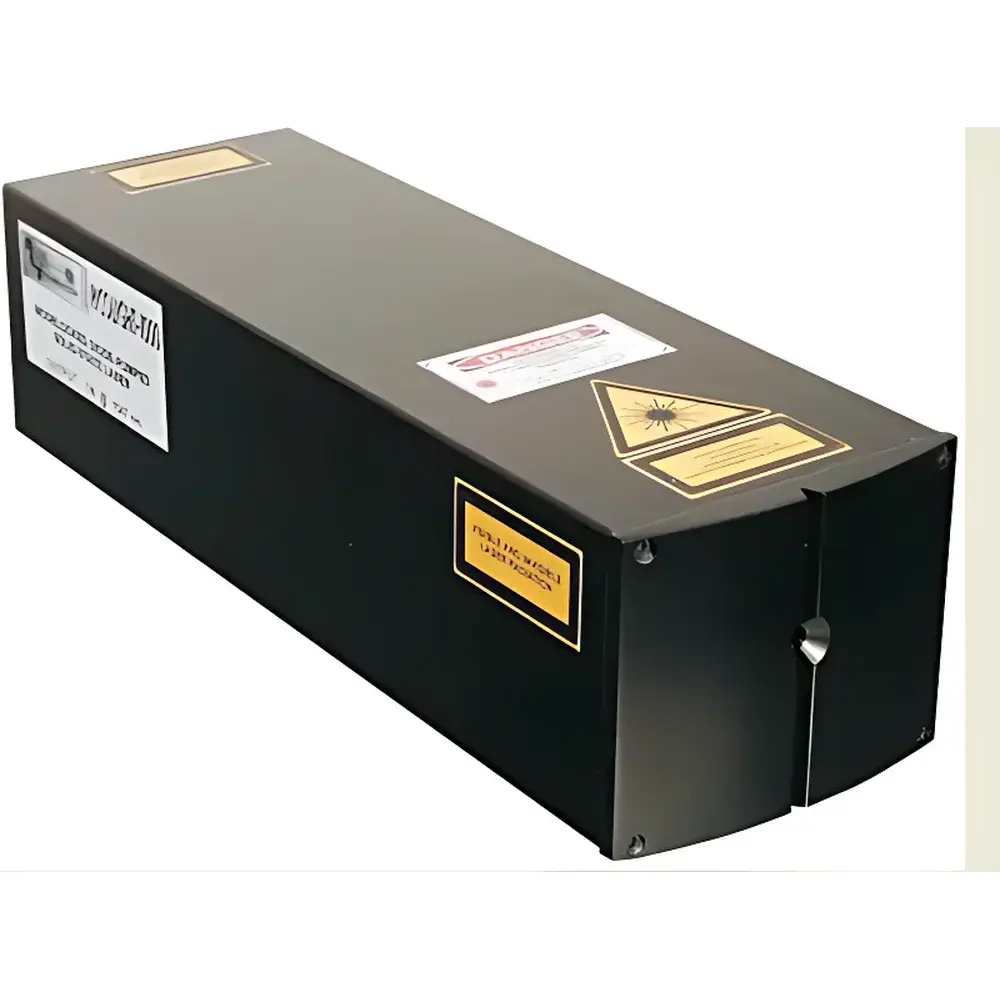
AlphaLas PICOPOWER Series Diode-Pumped Passively Mode-Locked Solid-State Picosecond Laser
| Brand | AlphaLas |
|---|---|
| Origin | Germany |
| Model | PICOPOWER 10 IR / PICOPOWER 5 G |
| Wavelength | 1064 nm (IR) / 532 nm (Green) |
| Pulse Width | <10 ps |
| Repetition Rate | 100 MHz |
| Average Output Power | ≥10 W @ 1064 nm, ≥5 W @ 532 nm |
| Beam Quality | TEM₀₀ |
| Beam Diameter (1/e²) | 1 mm at output |
| Beam Divergence | 1 mrad |
| Power Stability (24 h, peak-to-peak) | <1% |
| Polarization Ratio | >300:1, linear |
| Intensity Noise (30 Hz–2 MHz) | <0.5% RMS |
| Pump Diode Lifetime | >10,000 h |
| Operating Voltage | 85–240 V AC, single-phase |
| Max. Power Consumption | <800 W |
| Laser Head Dimensions | 150 × 150 × 800 mm³ |
| PSU & Cooling Unit Dimensions | 450 × 300 × 600 mm³ |
| Operating Temperature | 10–35 °C |
Overview
The AlphaLas PICOPOWER Series represents a class of diode-pumped, passively mode-locked solid-state picosecond lasers engineered for high-repetition-rate, ultrafast pulse generation with exceptional amplitude stability and beam fidelity. Based on Nd:YVO₄ gain media and nonlinear semiconductor saturable absorber mirror (SESAM) technology, these lasers operate in fundamental infrared (1064 nm) and frequency-doubled green (532 nm) configurations. The PICOPOWER 10 IR delivers ≥10 W average power at 1064 nm, while the PICOPOWER 5 G provides ≥5 W at 532 nm — both with sub-10 ps pulse durations and 100 MHz repetition rate. Designed around a monolithic cavity architecture incorporating intracavity harmonic generation and passive mode-locking, the system eliminates active RF modulation or mechanical components in the pulse formation path, thereby ensuring long-term temporal stability and low timing jitter (<100 fs RMS, typical). Its all-solid-state construction — combining high-brightness laser diodes, diffusion-bonded crystal mounts, and hermetically sealed optical paths — ensures robustness under continuous laboratory operation and compatibility with demanding environments such as cleanroom-based microfabrication or vacuum-coupled ultrafast spectroscopy setups.
Key Features
- Passively mode-locked architecture using SESAM for self-starting, stable pulse generation without external RF drivers
- TEM₀₀ spatial mode with M² < 1.1, beam pointing stability < 40 μrad over 24 h
- Integrated third- and fourth-harmonic generation capability via optional external crystals (e.g., BBO, LBO)
- Low-intensity noise (<0.5% RMS, 30 Hz–2 MHz), critical for pump-probe experiments and nonlinear frequency conversion
- Full diode-pumping design enabling >10,000 h mean time between failures (MTBF) for pump sources
- Industrial-grade thermal management with closed-loop water cooling and real-time temperature monitoring
- Compliance with IEC 60825-1:2014 Class 4 laser safety requirements; interlock-ready for integration into OEM systems
Sample Compatibility & Compliance
The PICOPOWER laser is routinely deployed in applications requiring precise spatiotemporal excitation of materials with minimal thermal load — including wide-bandgap semiconductors (GaN, SiC), transparent dielectrics (fused silica, CaF₂), and organic thin films. Its ultrashort pulses enable multiphoton absorption, ablation threshold control, and carrier dynamics probing with sub-picosecond resolution. The system meets ISO 13406-2 for beam safety classification and supports GLP/GMP-aligned operation through optional analog/digital TTL synchronization outputs and RS-232/USB 2.0 interfaces for remote parameter logging. All optical coatings and crystal mounts conform to MIL-C-48497A standards for environmental durability. No hazardous substances are used per RoHS Directive 2011/65/EU.
Software & Data Management
AlphaLas provides the PICOCONTROL suite — a Windows-based application supporting real-time monitoring of output power, internal cavity temperature, coolant flow rate, and diode current. Data export is available in CSV and HDF5 formats for post-acquisition analysis in MATLAB, Python (NumPy/H5Py), or LabVIEW. Audit trails comply with FDA 21 CFR Part 11 when operated in validated mode (user-configurable electronic signatures and change logs). Remote control via SCPI commands enables integration into automated test benches or multi-instrument ultrafast labs adhering to IEEE 1588 precision time protocol.
Applications
- Time-resolved photoluminescence and transient absorption spectroscopy
- Precision micromachining of transparent and reflective materials (e.g., display glass cutting, solar cell scribing)
- Optical parametric amplifier (OPA) pumping and supercontinuum generation in photonic crystal fibers
- Two-photon polymerization for micro-optics and biomedical scaffold fabrication
- Seed source for chirped-pulse amplification (CPA) systems operating at kHz–MHz repetition rates
- Calibration of streak cameras and single-photon avalanche diodes (SPADs)
FAQ
Can pulse duration be customized below 10 ps?
Yes — optional cavity dispersion compensation modules (e.g., prism pairs or chirped mirrors) allow tuning down to ~5 ps FWHM while maintaining spectral bandwidth and temporal profile integrity.
Is harmonic generation included by default?
The base configuration operates at 1064 nm (IR) or 532 nm (green). External harmonic modules (355 nm, 266 nm) are available as add-on options with integrated beam routing and collimation.
What cooling method is required?
A closed-loop chiller delivering 18–22 °C water at ≥2 L/min flow rate is mandatory; air-cooled variants are not offered due to thermal lensing constraints at >5 W average power.
Does the system support external triggering or synchronization?
Yes — TTL-compatible sync outputs (100 MHz clock, pulse pick-off, and Q-switch trigger) are standard; optional fiber-coupled sync distribution kits enable multi-laser timing alignment within ±200 fs.
How is beam pointing stability maintained over extended runs?
Thermal drift is mitigated via invar-based optomechanical mounts, active cavity length stabilization using piezoelectric transducers, and real-time beam centroid feedback via quadrant photodiode monitoring (optional upgrade).




