
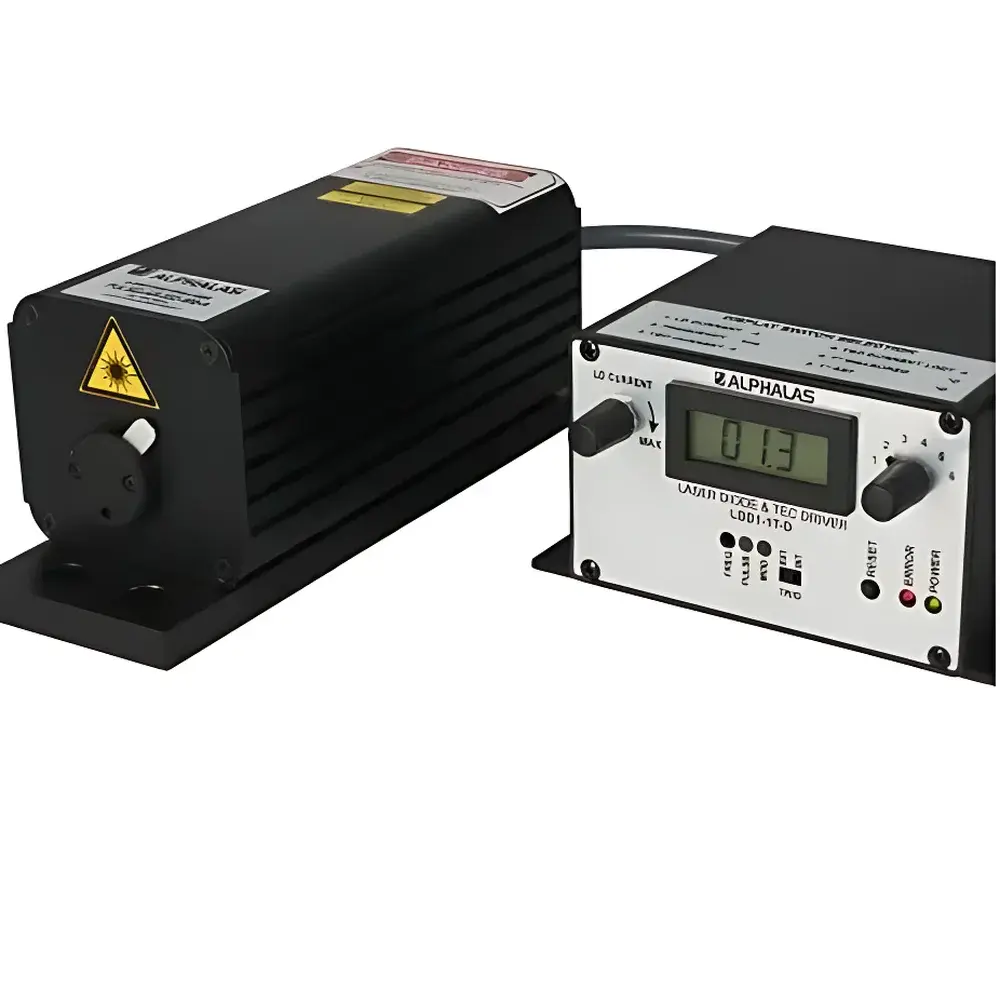
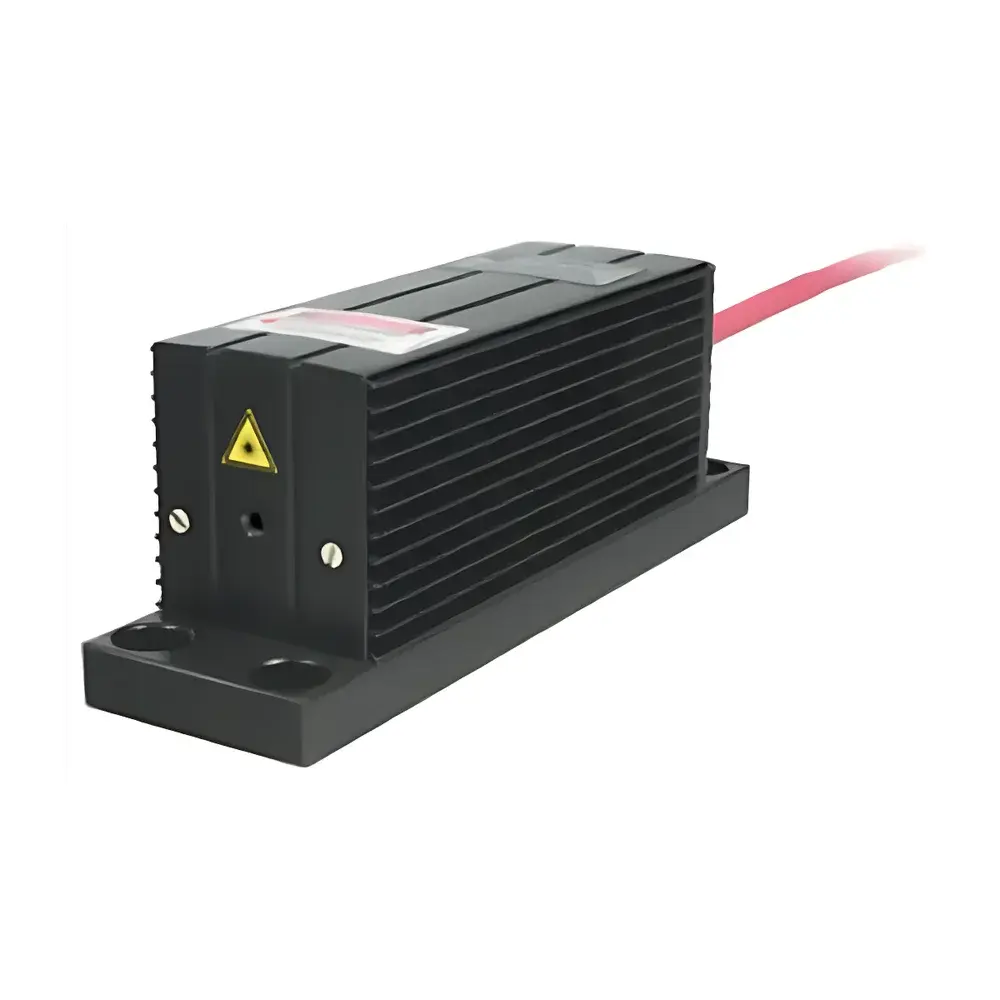
AlphaLas PULSELAS-P Passive Q-Switched Microchip Sub-Nanosecond Laser
| Brand | AlphaLas |
|---|---|
| Origin | Germany |
| Model | PULSELAS-P |
| Wavelength | 1064 nm |
| Pulse Width | < 1 ns (typ. 800 ps) |
| Pulse Energy | up to 1500 µJ @ 100 Hz |
| Peak Power | > 1.5 MW |
| Average Power | up to 1 W |
| Repetition Rate | up to 100 kHz |
| Beam Quality | TEM₀₀ |
| Polarization Ratio | > 100:1 |
| Power Stability | < 2% RMS (1 h) |
| Output Beam Diameter | 0.3–0.4 mm |
| Beam Divergence | ~6 mrad |
| Laser Head Dimensions | 40 × 52 × 90 mm or 40 × 52 × 140 mm (HP/HE variants) |
| Harmonic Options | 532 nm, 355 nm, 266 nm (optional) |
| Triggering | Internal frequency generator (up to 5 kHz) and external TTL trigger standard |
| Pump Configuration | Free-space or fiber-coupled laser diode (LDF-30-P) |
Overview
The AlphaLas PULSELAS-P is a passively Q-switched microchip laser engineered for high-repetition-rate, sub-nanosecond pulsed operation at 1064 nm. Based on monolithic Nd:YAG or Nd:YVO₄ gain media with saturable absorber integration, it delivers transform-limited, diffraction-limited TEM₀₀ output pulses with intrinsic alignment stability—eliminating the need for periodic optical realignment. Its solid-state microchip architecture ensures robustness against mechanical drift, thermal fluctuation, and environmental vibration—critical for integration into OEM instrumentation, industrial processing platforms, and field-deployable analytical systems. The laser operates via passive Q-switching using semiconductor saturable absorber mirrors (SESAMs) or Cr⁴⁺:YAG, enabling self-starting, jitter-free pulse generation without active electronics in the cavity. Pulse durations are consistently maintained below 1 ns (typically 800 ps), supporting time-resolved measurements requiring picosecond-scale temporal resolution while retaining nanosecond-class energy scalability.
Key Features
- Passive Q-switching architecture for low-jitter, self-starting pulse generation without RF drivers or active modulators
- Monolithic microchip design with permanently aligned resonator—no user-accessible optics or alignment screws
- TEM₀₀ spatial mode with M² < 1.1 and polarization extinction ratio > 100:1 for consistent beam delivery and nonlinear conversion efficiency
- Scalable performance across seven standard variants: from 100 mW / 10 kHz (PULSELAS-P-1064-100) to 150 mW / 100 Hz / 1.5 mJ (PULSELAS-P-1064-150-HE)
- Standard internal frequency generator (up to 5 kHz) and TTL-compatible external triggering interface for precise synchronization with detectors, scanners, or data acquisition systems
- Optional fiber-coupled pump configuration (LDF-30-P diode + driver) enabling compact integration into space-constrained subsystems
- Harmonic generation-ready: integrated harmonic separation optics support efficient second-, third-, and fourth-harmonic generation to 532 nm, 355 nm, and 266 nm with minimal realignment
- Power stability < 2% RMS over 1 hour—validated under continuous operation at rated repetition rate and ambient temperature (20–25 °C)
Sample Compatibility & Compliance
The PULSELAS-P series is designed for compatibility with standard optomechanical interfaces (e.g., SM1-threaded mounts, Ø25 mm kinematic bases) and integrates seamlessly with commercial optical parametric amplifiers (OPAs), time-correlated single-photon counting (TCSPC) modules, streak cameras, and LIBS sample chambers. All models comply with IEC 60825-1:2014 Class 4 laser safety requirements when operated with appropriate interlocks and beam enclosures. Emission profiles meet EN 61326-1:2013 for electromagnetic compatibility in laboratory and light-industrial environments. For regulated applications—including pharmaceutical process analytical technology (PAT) or environmental monitoring—the system supports traceable calibration documentation and optional audit-trail-enabled control firmware compatible with FDA 21 CFR Part 11 workflows when paired with AlphaLas’ LASCAL software suite.
Software & Data Management
AlphaLas provides the LASCAL Control Suite—a Windows-based application offering full remote parameter control (repetition rate, trigger mode, pulse selection), real-time power monitoring, and automated logging of operational parameters (pulse energy, temperature, diode current). The software exports timestamped datasets in CSV and HDF5 formats, ensuring interoperability with MATLAB, Python (NumPy/Pandas), and LabVIEW. API support (DLL and .NET libraries) enables custom integration into larger automation frameworks such as PLC-controlled laser machining cells or synchrotron timing systems. Firmware updates preserve backward compatibility and include enhanced thermal management algorithms for extended duty-cycle stability. Optional Ethernet or USB-C communication interfaces support deterministic latency (< 100 µs) for closed-loop feedback applications.
Applications
- Laser-induced breakdown spectroscopy (LIBS): High peak power and sub-ns pulse width enable efficient plasma initiation on conductive and dielectric surfaces with minimal thermal diffusion
- Time-resolved fluorescence lifetime imaging (FLIM) and TCSPC: Low timing jitter (< 30 ps RMS) and stable pulse-to-pulse amplitude ensure high-fidelity decay curve reconstruction
- Nonlinear optical pumping: Fundamental 1064 nm output serves as reliable pump source for optical parametric oscillators (OPOs) and supercontinuum generation in photonic crystal fibers
- Precision micromachining: TEM₀₀ beam profile and < 1 ns pulse duration minimize heat-affected zones in ceramics, sapphire, and polycrystalline diamond
- LIDAR and time-of-flight ranging: High repetition rate and narrow pulse width enable centimeter-level distance resolution in atmospheric and combustion diagnostics
- Combustion ignition research: Standoff laser spark generation in high-pressure engine cylinders with controllable energy deposition
- DNA sequencing and flow cytometry: UV harmonics (266 nm, 355 nm) provide high-photon-energy excitation for fluorophore activation and nucleic acid ablation
FAQ
What is the typical pulse-to-pulse timing jitter?
Timing jitter is < 30 ps RMS (measured with 10 GHz photodetector and high-bandwidth oscilloscope), independent of repetition rate up to 50 kHz.
Can the laser be synchronized to an external clock signal?
Yes—TTL-compatible external trigger input accepts signals from 0.1 Hz to 100 kHz with adjustable delay (0–100 ms) and polarity inversion.
Is harmonic generation included as standard equipment?
No—harmonic modules (SHG, THG, FHG) are optional accessories; each includes wavelength-separation optics, temperature-stabilized nonlinear crystals, and collimation optics optimized for the fundamental beam profile.
What cooling method is required?
Conductive cooling only—no forced air or water cooling is needed. Operating temperature range is 15–35 °C; baseplate must be mounted to a thermally stable surface with thermal resistance < 0.5 K/W.
Are OEM volume discounts and custom firmware features available?
Yes—AlphaLas offers tailored mechanical interfaces, embedded control logic (e.g., analog modulation input, safety interlock mapping), and volume pricing for orders ≥5 units.




