
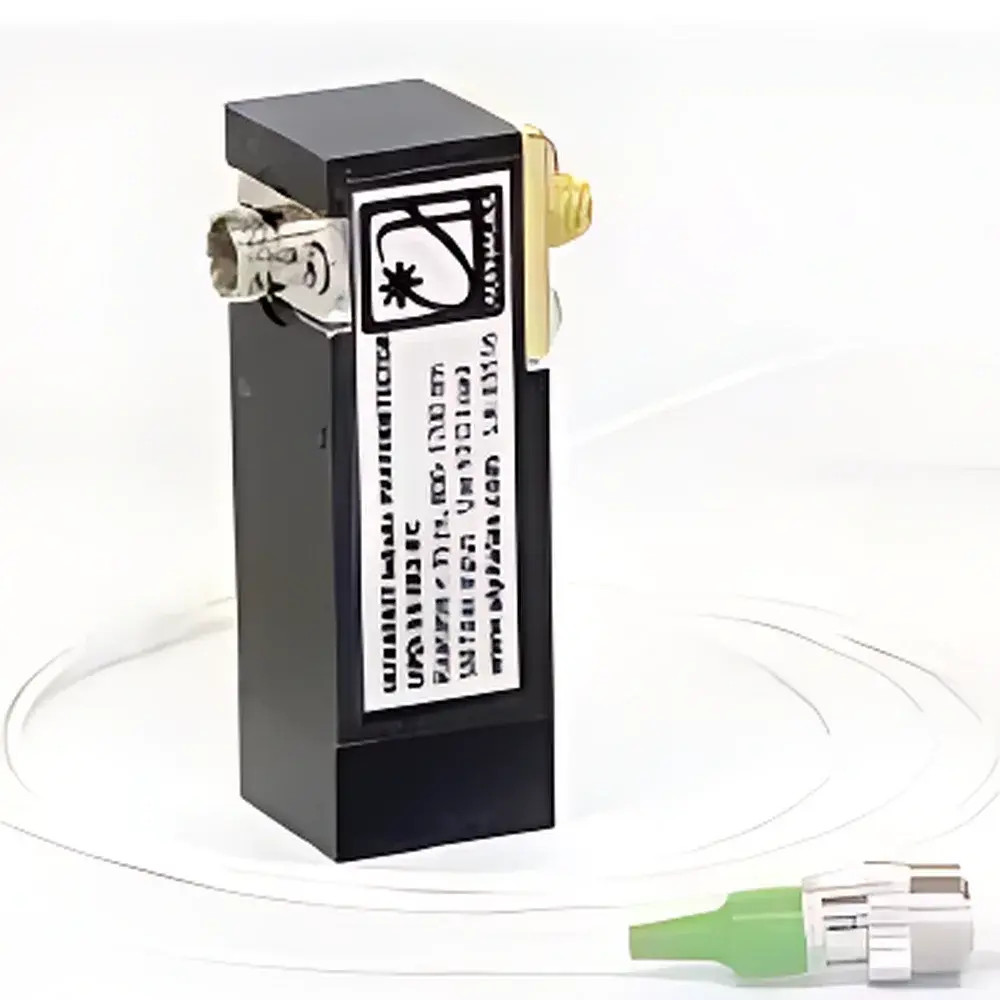
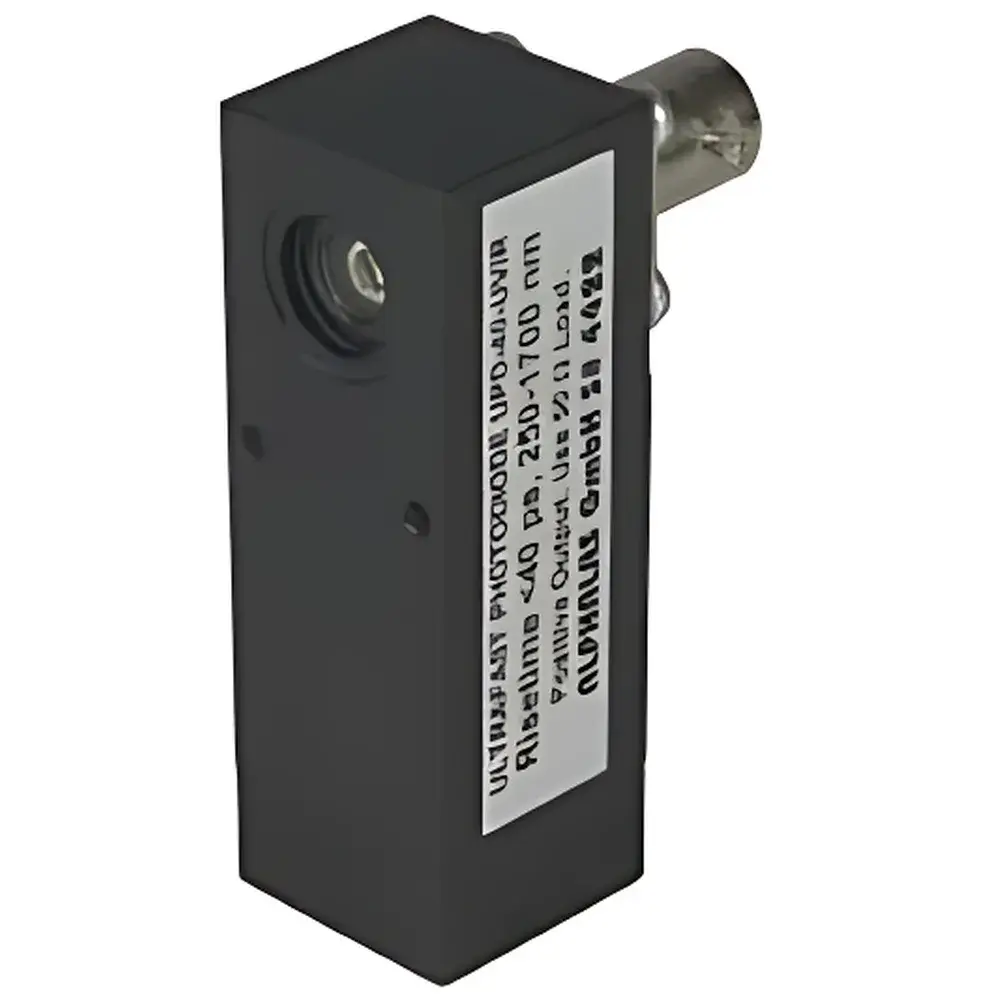
Alphalas UPD Series Ultrafast Photodetectors
| Brand | Alphalas |
|---|---|
| Origin | Germany |
| Model | UPD Series |
| Spectral Range | 170–2600 nm |
| Rise Time | as low as 15 ps |
| Bandwidth | up to 25 GHz |
| Detector Materials | Si, GaAs, InGaAs, Ge |
| Output Interface | SMA or BNC |
| Housing | rugged anodized aluminum |
| Bias Options | battery or external DC supply |
| Input Options | free-space (polished/diffuse MgF₂/quartz/glass), FC/PC, FC/APC fiber-coupled |
Overview
The Alphalas UPD Series Ultrafast Photodetectors are engineered for high-fidelity time-domain optical signal acquisition in demanding photonics research and industrial metrology environments. Based on optimized PIN photodiode architectures with minimized carrier transit time and parasitic capacitance, these detectors operate on the principle of ultrafast photocurrent generation under transient illumination—enabling direct, linear, and distortion-free conversion of optical pulses into electrical waveforms without internal amplification stages. With rise times down to 15 ps and bandwidths extending to 25 GHz, the UPD series supports accurate characterization of femtosecond-to-nanosecond laser pulses, mode-locked oscillators, optical timing jitter, and high-speed modulation formats. The devices maintain flat frequency response across their specified bandwidth, ensuring minimal overshoot, ringing, or phase distortion—critical for applications requiring faithful pulse shape reconstruction and precise temporal synchronization.
Key Features
- Sub-15 ps rise time (UPD-15-IR2-FC) and DC–25 GHz analog bandwidth for true ultrafast waveform fidelity
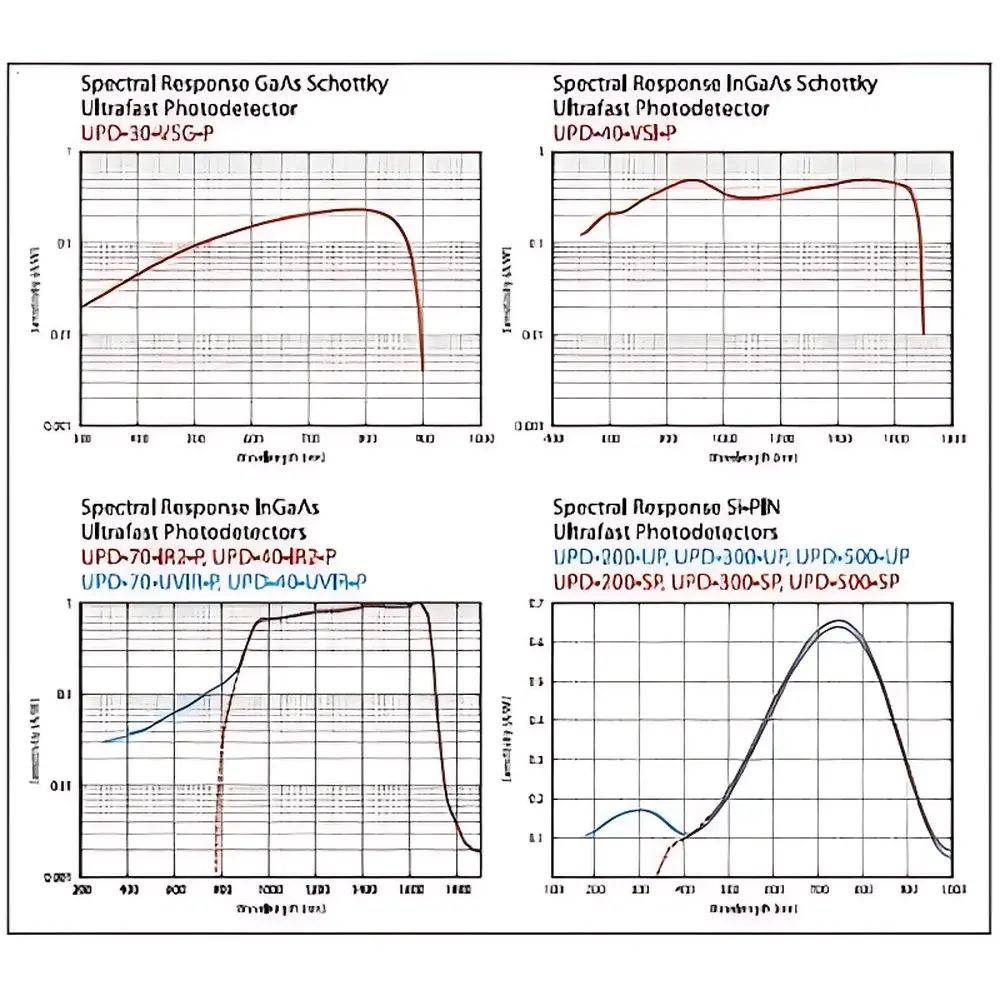
- Multi-material detector options: UV-enhanced silicon (170–1100 nm), GaAs (320–900 nm), extended-InGaAs (350–1700 nm, 800–2600 nm), and germanium (400–2000 nm)
- Rugged, compact anodized aluminum housing with thermal stability and EMI shielding—designed for benchtop, OEM integration, and vacuum-compatible setups
- Flexible biasing: dual-mode operation via internal 9 V battery or external 0–15 V DC supply; no warm-up delay or drift
- Impedance-matched 50 Ω RF output (SMA or BNC) ensures minimal reflection and preserves signal integrity into oscilloscopes, spectrum analyzers, or digitizers
- Multiple optical input configurations: free-space (with polished MgF₂, quartz, or BK7 windows), FC/PC receptacle, and single-mode fiber coupling (9 µm core, FC/APC)
- Low dark current (as low as 0.001 nA for Si variants) and noise-equivalent power (NEP) down to 1.0 × 10⁻¹⁴ W/√Hz enable high signal-to-noise ratio detection at low optical power levels
- Configurable output polarity (standard positive; negative output available on request) and optional thermoelectric cooling (TEC) for ultra-low-noise InGaAs variants
Sample Compatibility & Compliance
The UPD series accommodates a broad range of optical sources—including Ti:sapphire, Yb:fiber, Er:fiber, and quantum cascade lasers—as well as pulsed LEDs, supercontinuum sources, and electro-optic modulators. Detector window options (MgF₂ for deep-UV, quartz for high-damage-threshold IR, diffuse quartz for peak-power handling) ensure compatibility with ultrashort pulses (≥100 fs), high-repetition-rate systems (up to GHz), and high-peak-power regimes (>1 MW/cm²). All models comply with IEC 61340-5-1 (ESD control), RoHS Directive 2011/65/EU, and CE marking requirements. For regulated environments, traceable calibration certificates (NIST-traceable responsivity vs. wavelength and rise time verification) are available upon request. While not intrinsically FDA 21 CFR Part 11 compliant (as a hardware-only detector), UPD outputs integrate seamlessly with validated data acquisition platforms supporting audit trails, electronic signatures, and ALCOA+ principles in GLP/GMP laboratories.
Software & Data Management
As a passive, analog front-end device, the UPD series requires no embedded firmware or driver software. It delivers raw, unprocessed photocurrent signals compatible with industry-standard test equipment—including Keysight, Tektronix, and Rohde & Schwarz real-time oscilloscopes (≥20 GHz bandwidth recommended), lock-in amplifiers, RF spectrum analyzers, and PCIe-based high-speed digitizers. Signal integrity is preserved through 50 Ω impedance matching and minimal group delay variation (<1 ps over 20 GHz). When integrated into automated measurement systems, UPDs support time-stamped waveform capture, trigger synchronization (via auxiliary TTL outputs on select OEM variants), and post-processing using MATLAB, Python (NumPy/SciPy), or LabVIEW. For traceability, users may log detector serial number, calibration date, spectral responsivity curve, and rise time certificate alongside experimental metadata—aligning with ISO/IEC 17025 documentation practices.
Applications
- Pulse width and chirp characterization of ultrafast lasers (fs–ps regime)
- Optical timing jitter and synchronization measurements in pump-probe and attosecond science
- High-speed optical communications testing (NRZ, PAM4, OOK up to 50 Gbaud)
- Photonic integrated circuit (PIC) output monitoring and de-embedding
- Heterodyne and beat-note detection in optical frequency comb stabilization
- Laser-induced breakdown spectroscopy (LIBS) and time-resolved fluorescence lifetime imaging (FLIM)
- THz generation and electro-optic sampling (when used as gating detector)
- Calibration reference for streak cameras, autocorrelators, and FROG systems
FAQ
What is the difference between “polished” and “diffuse” input windows?
Polished windows maximize quantum efficiency and spatial resolution for low-to-medium peak power beams. Diffuse quartz windows reduce interference fringes and increase damage threshold by ~3–5× but lower responsivity and blur spatial mode definition—recommended only for high-peak-power pulsed lasers.
Can I use a 1 MΩ oscilloscope input with UPD detectors?
Yes—but with trade-offs: high-impedance termination yields larger voltage swing (V = Iph × RL) yet introduces bandwidth limitation (~3 dB roll-off above 1/(2πRC)), increased ringing, and susceptibility to EMI. For full bandwidth, 50 Ω termination is mandatory.
Are UPD detectors calibrated for absolute responsivity?
Each unit ships with a factory-measured spectral responsivity curve (A/W vs. λ) and rise time report. NIST-traceable calibration is available as an optional service, including uncertainty budgets per ISO/IEC 17025.
Do UPD models support AC coupling or DC coupling?
All UPD detectors provide true DC-coupled output—essential for measuring pulse pedestals, CW background, and slow envelope dynamics. No internal capacitors block low-frequency content.
Is fiber coupling limited to single-mode operation?
Yes—fiber-coupled variants (e.g., UPD-15-IR2-FC) are optimized for SMF-28 or similar 9/125 µm fibers. Multimode coupling degrades bandwidth and introduces modal dispersion; free-space alignment is advised for multimode or high-NA sources.





