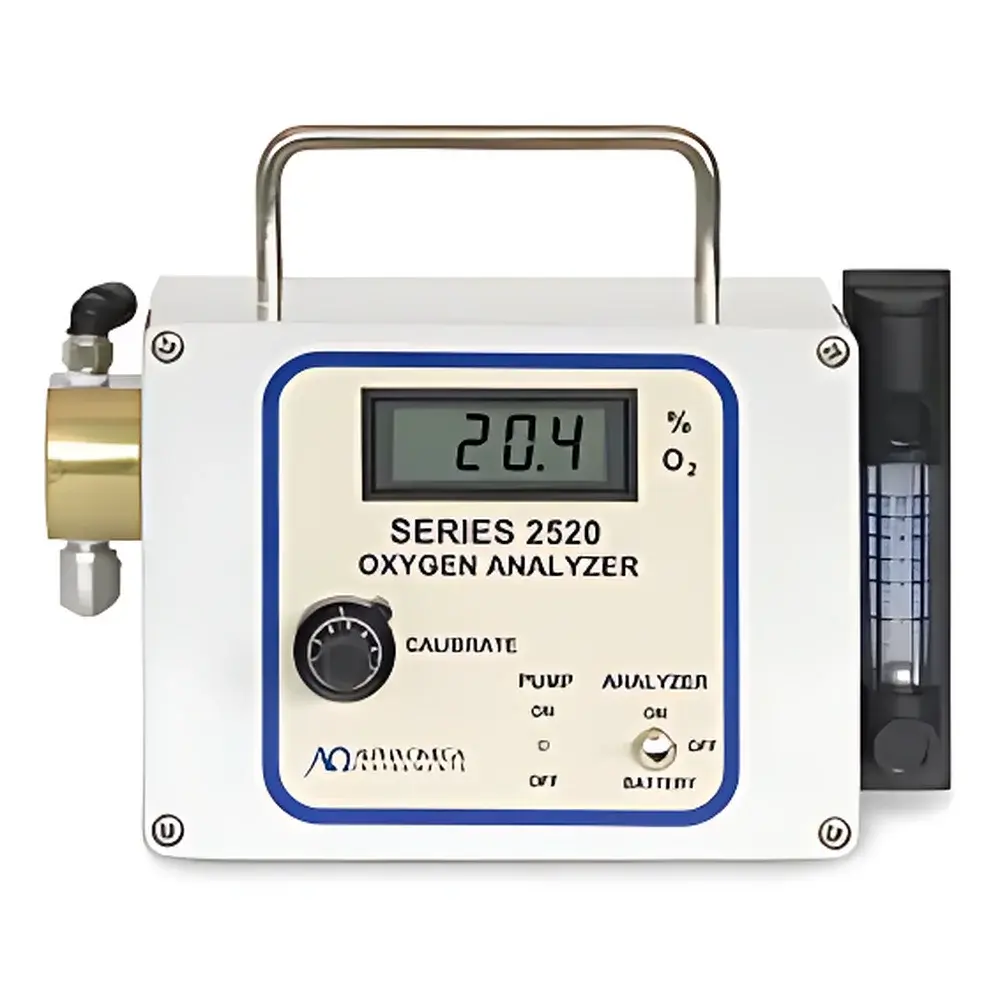
AlphaOmega AOI Model 2520 Portable Oxygen Analyzer
| Brand | AlphaOmega |
|---|---|
| Origin | USA |
| Model | 2520 |
| Measurement Ranges | 0–1%, 0–5%, 0–10%, 0–25%, 0–50%, 0–100% O₂ |
| Accuracy | ±0.1% FS |
| Linearity | ±0.1% FS |
| Response Time (t₉₀) | <10 s |
| Sensor Type | Electrochemical (O₂-specific) |
| Sample Temperature | 0–50 °C |
| Sample Pressure | 0.1–1 kg/cm² |
| Sample Flow Rate | 0.5–1.0 L/min |
| Temperature Compensation | Built-in |
| Display | 3½-digit LCD |
| Power | Rechargeable NiCd battery + universal AC adapter (battery charges during AC operation) |
| Enclosure | NEMA 1-rated polycarbonate |
| Dimensions | 5.8" H × 6.7" W × 3.4" D |
| Weight | <1 kg |
| Inlet/Outlet | Quick-connect fittings |
| Integrated Components | 12 VDC sampling pump, flowmeter with control valve at outlet |
| Analog Output | None |
Overview
The AlphaOmega AOI Model 2520 Portable Oxygen Analyzer is a field-deployable, electrochemical-based gas analysis instrument engineered for precise, real-time quantification of oxygen concentration across a broad range of industrial process and environmental applications. Utilizing a temperature-compensated, galvanic-type electrochemical sensor, the 2520 operates on the principle of oxygen diffusion through a selective membrane into an electrolyte cell, generating a current proportional to partial pressure—converted linearly to % O₂ by calibrated signal conditioning circuitry. Its design prioritizes operational robustness in non-laboratory settings: the NEMA 1-rated polycarbonate housing provides mechanical durability and ingress protection against dust and incidental splashes, while the integrated 12 VDC sampling pump ensures consistent sample draw under variable line conditions. Unlike fixed-installation analyzers requiring external power infrastructure or data acquisition systems, the 2520 functions autonomously via its internal NiCd battery—rechargeable even during AC-powered operation—enabling uninterrupted use during extended field surveys, commissioning checks, or emergency leak verification.
Key Features
- Multi-range measurement capability: User-selectable full-scale ranges (0–1%, 0–5%, 0–10%, 0–25%, 0–50%, 0–100% O₂) accommodate both trace-level monitoring (e.g., inert gas blanketing) and ambient air verification.
- High metrological fidelity: ±0.1% full-scale accuracy and ±0.1% linearity ensure repeatability suitable for compliance-related spot-checks and QA/QC documentation.
- Rapid response dynamics: t₉₀ <10 seconds enables dynamic assessment of purge cycles, glovebox integrity tests, or combustion air adjustments without analytical lag.
- Self-contained sampling system: Integrated 12 VDC pump, calibrated flowmeter with needle-valve control, and quick-connect inlet/outlet fittings eliminate dependency on external vacuum sources or flow regulators.
- Field-optimized human interface: 3½-digit LCD display with backlight-independent readability; intuitive range selection and zero/span calibration accessible via front-panel controls.
- Regulatory-ready construction: NEMA 1 enclosure meets minimum industrial enclosure standards for indoor use; no hazardous location rating (Class I Div 2 not claimed).
Sample Compatibility & Compliance
The Model 2520 is validated for use with dry, non-corrosive, non-condensing gas streams—including compressed air, nitrogen, argon, helium, CO₂, and natural gas—within specified thermal (0–50 °C) and pressure (0.1–1 kg/cm²) limits. Condensate formation, particulate loading >1 µm, or exposure to halogenated hydrocarbons, sulfur oxides, or hydrogen sulfide may degrade sensor life or induce drift; inline particulate filtration and moisture traps are recommended upstream of the analyzer when sampling from unconditioned lines. While the device itself does not carry CE, ATEX, or IECEx certification, its measurement methodology aligns with ASTM D6299 (Standard Practice for Applying Statistical Quality Assurance) for portable gas analyzers used in process validation. Data generated supports GLP-aligned field logs but lacks 21 CFR Part 11-compliant audit trails due to absence of digital data storage or user authentication.
Software & Data Management
The Model 2520 operates as a standalone hardware instrument with no embedded firmware-based data logging, Bluetooth/Wi-Fi connectivity, or PC interface. All measurements are displayed in real time only; no analog output (4–20 mA or 0–10 V) is provided, precluding integration into DCS or SCADA architectures. Users must manually record readings using external logbooks or mobile devices. Calibration history, sensor expiration dates, and range selections are not stored internally. For regulated environments requiring electronic records, third-party USB data loggers with voltage-input capability may be interfaced via the internal signal test points (accessible upon request of technical documentation), though such configurations fall outside factory validation scope.
Applications
- Verification of inert gas purging efficacy in pharmaceutical reactors, semiconductor fabrication chambers, and food packaging lines.
- Monitoring residual O₂ in nitrogen-blanketed storage tanks and pipeline pigging operations.
- Field validation of air separation unit (ASU) product purity prior to distribution.
- Leak detection in vacuum furnaces, gloveboxes, and controlled-atmosphere heat treatment systems.
- QA spot-checking of medical gas supply lines (e.g., O₂ concentrators, bulk liquid vaporizers) per ISO 8573-1 purity classes.
- Educational and maintenance technician training on gas sensing fundamentals and process safety protocols.
FAQ
What is the expected service life of the electrochemical sensor?
Typical functional lifespan is 18–24 months under continuous operation at ambient conditions; shelf life (uninstalled, sealed) is 12 months from date of manufacture.
Can the Model 2520 measure oxygen in high-humidity or corrosive gas streams?
No—exposure to condensate, SO₂, Cl₂, or H₂S accelerates sensor degradation; always condition samples to dew point <5 °C and filter particulates <1 µm before introduction.
Is calibration traceable to NIST standards?
Yes—factory calibration uses NIST-traceable certified gas mixtures; users receive a calibration certificate with each unit shipment.
Does the analyzer support automatic temperature compensation?
Yes—integrated thermistor continuously monitors sample gas temperature and applies algorithmic correction to maintain accuracy across 0–50 °C.
What maintenance is required between calibrations?
Visual inspection of inlet filters, verification of pump operation and flowmeter accuracy, and periodic zero check using certified zero-air cylinder (e.g., <1 ppm O₂) every 30 days in critical applications.
Related Products