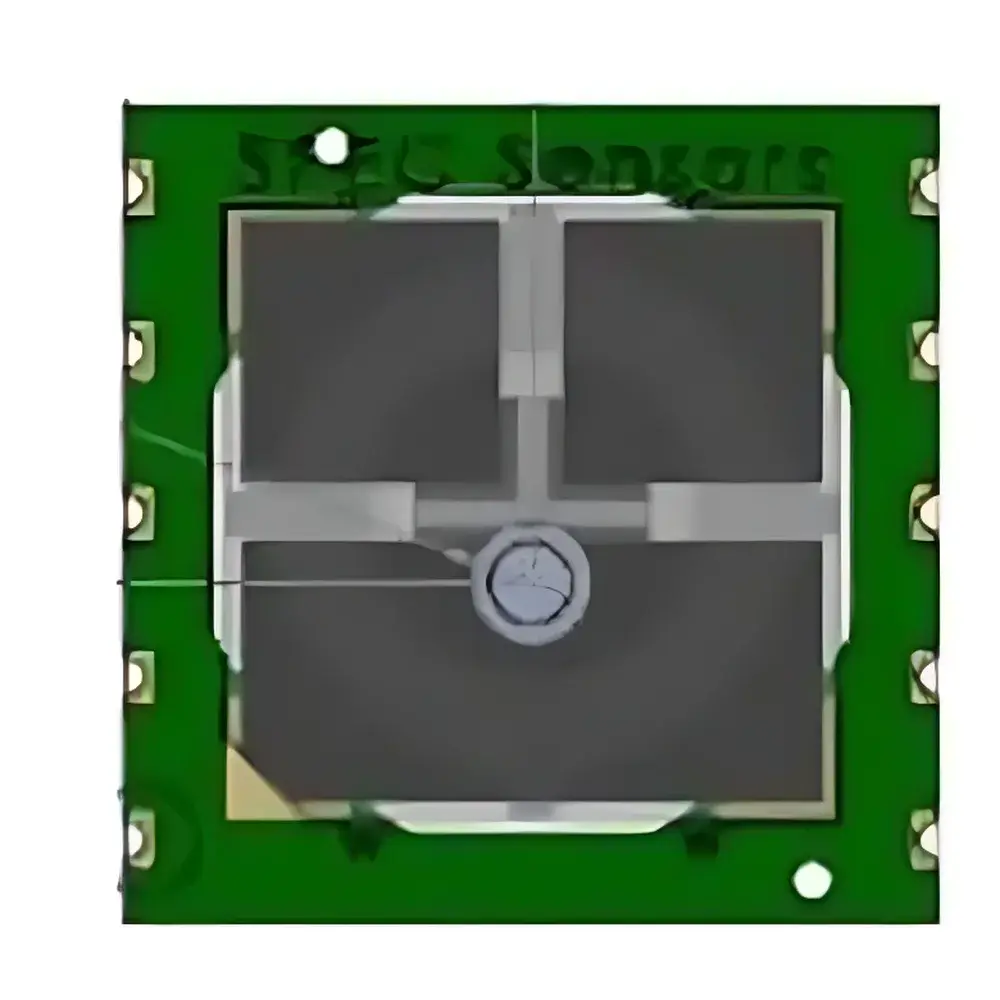
Alphasense 3SP_NO2_20 Electrochemical Nitrogen Dioxide (NO₂) Sensor
| Brand | Alphasense (UK) |
|---|---|
| Origin | United Kingdom |
| Model | 3SP_NO2_20 |
| Detection Range | 0–20 ppm |
| Overload Limit | 50 ppm |
| Response Time (t₉₀) | <30 s |
| Sensitivity | 30 ± 5 nA/ppm |
| Dimensions | 15 × 15 × 3.8 mm |
Overview
The Alphasense 3SP_NO2_20 is a high-stability, miniature electrochemical sensor engineered for selective and reliable detection of nitrogen dioxide (NO₂) in ambient air and industrial environments. Based on a three-electrode amperometric cell architecture, it operates via controlled potential electrolysis: NO₂ diffuses through a hydrophobic membrane into the electrolyte, where it undergoes a quantifiable redox reaction at the working electrode, generating a current proportional to gas concentration. This principle ensures linear output, low cross-sensitivity to common interferents (e.g., CO, SO₂, O₃), and stable baseline performance over extended deployment periods. Designed for integration into fixed-site air quality monitoring stations, portable safety instruments, and indoor air quality (IAQ) systems, the 3SP_NO2_20 delivers consistent performance under variable temperature (−20 °C to +50 °C) and humidity (15–90% RH non-condensing) conditions—making it suitable for both urban roadside networks and confined-space occupational health applications.
Key Features
- Compact footprint (15 × 15 × 3.8 mm) enabling space-constrained OEM integrations and multi-gas module designs
- Low-profile construction with integrated filter and diffusion barrier optimized for long-term drift stability
- Electrochemical selectivity enhanced by proprietary catalyst formulation and membrane tuning, minimizing interference from ozone and nitric oxide
- Typical operational lifetime exceeding 24 months when operated within specified environmental limits and storage conditions
- Factory-calibrated with traceable reference gases; supports two-point field calibration using certified NO₂ standards (e.g., ISO 12039, EN 14625)
- RoHS-compliant materials and lead-free soldering compatible with modern electronics assembly processes
Sample Compatibility & Compliance
The 3SP_NO2_20 is validated for continuous measurement of NO₂ in ambient air, workplace atmospheres, and ventilation duct streams. It complies with key regulatory frameworks governing air quality instrumentation, including EU Directive 2008/50/EC (Ambient Air Quality Directive) and US EPA equivalency criteria for NO₂ monitoring (40 CFR Part 53). While not a certified reference method instrument per se, its performance characteristics align with requirements for indicative measurements under ISO 13127 (electrochemical sensors for toxic gases) and EN 45544-2 (safety-related gas detection systems). The sensor requires no external power supply beyond standard bias voltage (typically −200 mV vs. reference electrode) and outputs a linear analog current signal (nA range), facilitating direct interface with 16-bit ADC circuits or industrial I/O modules compliant with IEC 61000-6-2/6-4 EMC standards.
Software & Data Management
As a transducer-level component, the 3SP_NO2_20 does not include embedded firmware or onboard data logging. Its analog output is intended for integration into host systems supporting configurable signal conditioning (e.g., transimpedance amplification, temperature compensation algorithms). When deployed in networked monitoring platforms, raw sensor data is typically processed using calibration polynomials stored in device EEPROM or cloud-based configuration profiles. For regulatory reporting, systems incorporating this sensor may implement audit-trail functionality in accordance with ISO/IEC 17025 requirements for measurement traceability and GLP-compliant data integrity. Optional digital interface boards (e.g., Alphasense B4 series adaptors) provide UART output, automatic temperature compensation, and diagnostic flags—including end-of-life alerts based on baseline drift thresholds.
Applications
- Ambient air quality monitoring networks (urban, roadside, background stations)
- Indoor air quality (IAQ) systems in schools, offices, and public transport hubs
- Occupational exposure assessment in manufacturing, wastewater treatment, and chemical handling facilities
- Smart building HVAC control loops responsive to NO₂-driven ventilation demand
- OEM integration into handheld personal exposure monitors and drone-based atmospheric mapping platforms
- Research-grade studies on traffic-related air pollution dispersion and health impact modeling
FAQ
What is the recommended operating temperature range for the 3SP_NO2_20?
The sensor is rated for continuous operation between −20 °C and +50 °C, with optimal accuracy maintained between 20 °C and 30 °C. Temperature compensation must be applied in host firmware using the integrated thermistor (NTC 10 kΩ at 25 °C).
Does the sensor require periodic recalibration?
Yes. While factory-calibrated, field recalibration is recommended every 3–6 months depending on exposure history and required measurement uncertainty. Two-point calibration (zero and span) using certified NO₂ gas standards is advised per ISO 12039 guidelines.
Can the 3SP_NO2_20 be used in high-humidity environments?
It is qualified for operation up to 90% RH non-condensing. Prolonged exposure to condensation or aerosol-laden air may affect membrane permeability; use of hydrophobic particulate filters is strongly recommended.
Is the sensor compatible with Part 11-compliant data systems?
The sensor itself has no digital identity or audit trail capability. However, when integrated into a validated system architecture—including secure data acquisition, electronic signatures, and change control logs—it can support compliance with FDA 21 CFR Part 11 for regulated environmental monitoring applications.
What is the typical shelf life before installation?
Unopened units stored at 5–25 °C and <60% RH retain full specification for 12 months from date of manufacture. Post-installation lifespan depends on cumulative exposure dose and environmental stress factors.