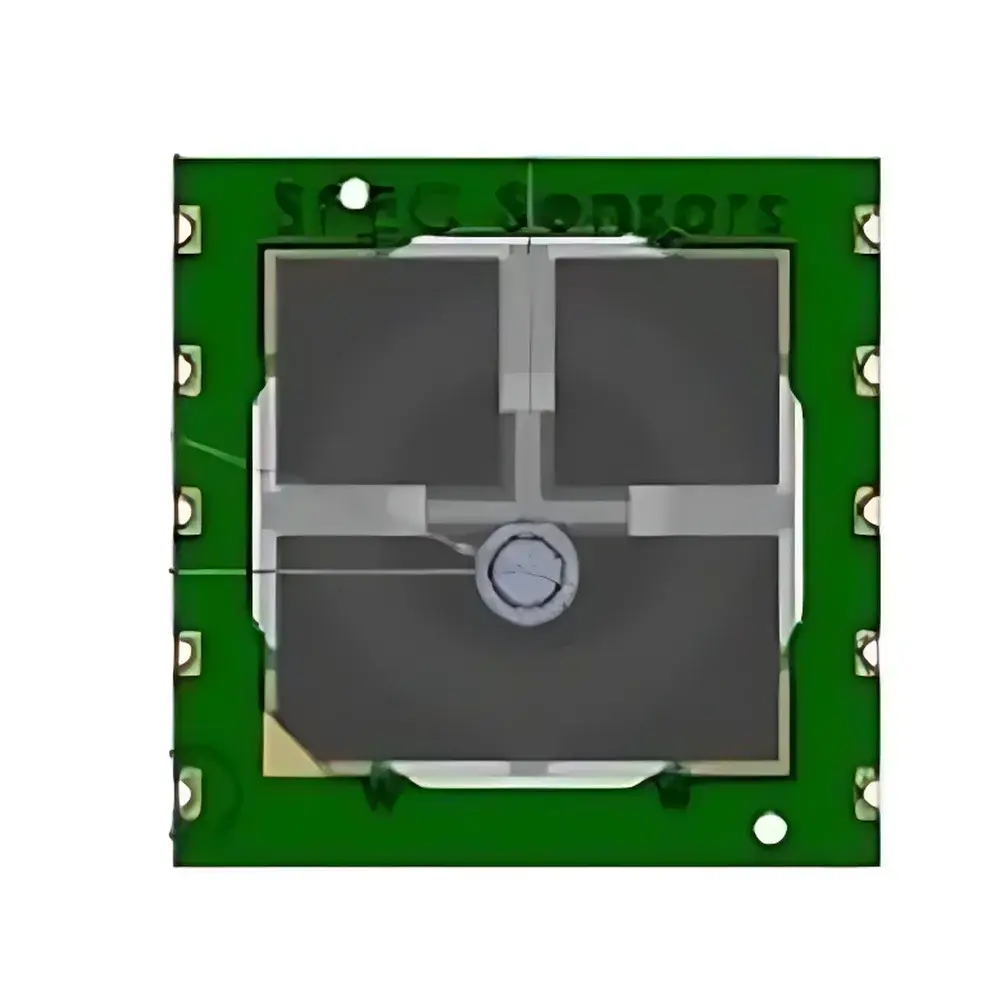
Alphasense 3SP_O3_20 Electrochemical Ozone Sensor
| Brand | Alphasense (UK) |
|---|---|
| Origin | United Kingdom |
| Model | 3SP_O3_20 |
| Detection Range | 0–20 ppm |
| Overload Limit | 50 ppm |
| Response Time (t₉₀) | <30 s |
| Sensitivity | −30 ±5 nA/ppm |
| Dimensions | 15 × 15 × 3.8 mm |
| Operating Temperature | −30 to +50 °C |
| Storage Life | ≥12 months (unmounted, sealed) |
| Compliance | RoHS, REACH, CE-marked per EN 61000-6-3/6-4 |
Overview
The Alphasense 3SP_O3_20 is a compact, high-stability electrochemical gas sensor engineered for continuous, low-power detection of ozone (O₃) in ambient air and industrial environments. Based on a three-electrode amperometric cell architecture, it operates via controlled potential electrolysis: ozone diffuses through a hydrophobic PTFE membrane into an aqueous electrolyte, where it undergoes a selective redox reaction at the working electrode, generating a current linearly proportional to gas concentration. This principle ensures high specificity to ozone with minimal cross-sensitivity to common interferents such as NO₂, Cl₂, and SO₂—critical for reliable deployment in multi-pollutant monitoring networks. Designed for integration into portable analyzers, fixed-site air quality stations, and OEM safety instrumentation, the 3SP_O3_20 delivers metrological consistency across temperature and humidity gradients typical of outdoor and indoor operational settings.
Key Features
- Ultra-compact footprint (15 × 15 × 3.8 mm) enabling space-constrained PCB-level integration
- Low power consumption (<80 µW average at 1 Hz readout), suitable for battery-powered or solar-harvested systems
- Fast t₉₀ response time of <30 seconds, supporting dynamic ozone event capture (e.g., photochemical smog episodes)
- Stable baseline and calibrated sensitivity (−30 ±5 nA/ppm) verified per Alphasense’s ISO/IEC 17025-accredited calibration protocol
- Extended operational lifetime (>24 months typical in clean air; >18 months at 20 ppb average exposure)
- Integrated thermal compensation circuitry minimizing drift across −30 to +50 °C operating range
- RoHS-compliant construction with lead-free solder compatibility and halogen-free encapsulation
Sample Compatibility & Compliance
The 3SP_O3_20 is validated for use in ambient air, workplace atmospheres, and recirculated HVAC streams where ozone concentrations remain within its 0–20 ppm measurement span. It is not intended for direct exposure to condensing moisture, organic solvents, or high particulate loads without upstream filtration (e.g., 0.2 µm PTFE particulate filter recommended). The sensor meets electromagnetic compatibility requirements under EN 61000-6-3 (emissions) and EN 61000-6-4 (immunity), and carries CE marking under the EU Low Voltage Directive (2014/35/EU) and EMC Directive (2014/30/EU). While not certified to IEC 60079 for explosive atmospheres, it may be deployed in Zone 2 classified areas when housed in appropriate enclosures per ATEX guidelines. Its design supports alignment with EPA Method TO-11A (ozone monitoring for regulatory compliance) and ISO 16000-25 (indoor air quality assessment).
Software & Data Management
The 3SP_O3_20 outputs a linear analog current signal (nA range) requiring external transimpedance amplification and ADC conversion. Alphasense provides comprehensive integration documentation—including pinout schematics, recommended biasing circuits, temperature compensation coefficients, and digital filtering guidance—for seamless incorporation into custom firmware stacks. When paired with Alphasense’s B4 or B5 series interface boards, the sensor supports UART-based digital output with built-in linearization, zero/span adjustment, and diagnostic flags (e.g., low battery warning, sensor timeout). All calibration data are traceable to NPL (National Physical Laboratory, UK) reference standards, and raw sensor logs can be exported in CSV format for GLP-compliant audit trails. Firmware versions compliant with FDA 21 CFR Part 11 are available upon request for regulated environmental health applications.
Applications
- Ambient air quality monitoring networks (urban, rural, roadside) adhering to EU Directive 2008/50/EC and US EPA NAAQS
- Indoor air quality (IAQ) systems in hospitals, schools, and commercial buildings to verify ozone levels below WHO guideline values (100 µg/m³, ~50 ppb, 8-h mean)
- Ozone generator output verification and leak detection in water treatment, food processing, and sterilization facilities
- Portable personal exposure monitors for occupational health surveillance under OSHA PEL (0.1 ppm TWA) and ACGIH TLV® (0.05 ppm TWA)
- Research-grade atmospheric chemistry instrumentation requiring stable, low-drift ozone baselines over extended field campaigns
FAQ
What is the recommended warm-up time before stable readings?
Allow 120 seconds after power-on for internal electrochemical equilibrium; full accuracy is achieved after 5 minutes of continuous operation.
Does the sensor require periodic zero calibration in the field?
No routine zeroing is required under normal conditions; however, a zero-point verification using certified zero air is advised every 3 months for regulatory-grade deployments.
Can the 3SP_O3_20 be used in high-humidity environments?
Yes—its hydrophobic membrane prevents electrolyte dilution up to 95% RH non-condensing; optional desiccant cap available for sustained >90% RH exposure.
Is cross-sensitivity to nitrogen dioxide (NO₂) compensated in firmware?
The sensor exhibits <5% signal interference from 1 ppm NO₂; Alphasense-supplied compensation algorithms reduce this to <1.5% when implemented with concurrent NO₂ sensing.
What is the shelf life of an unmounted sensor?
12 months from date of manufacture when stored in original sealed packaging at 20–25 °C and <60% RH.