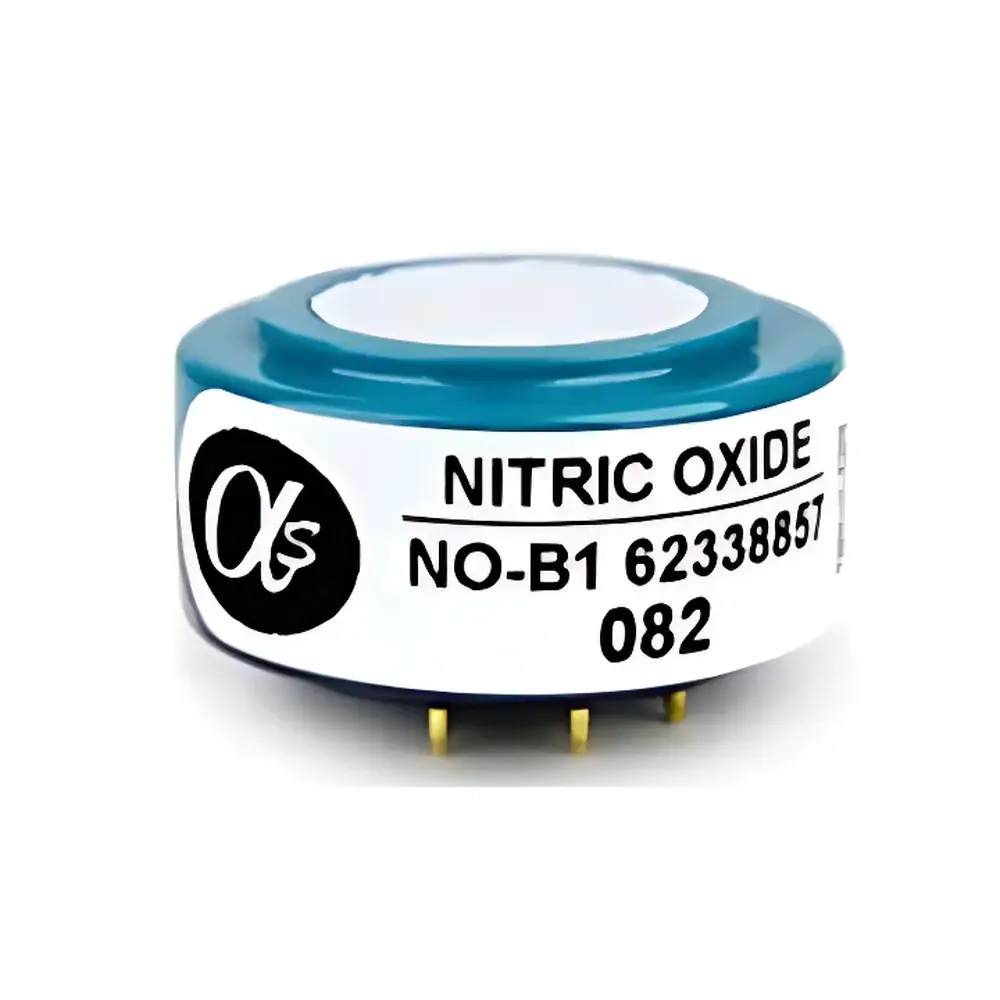
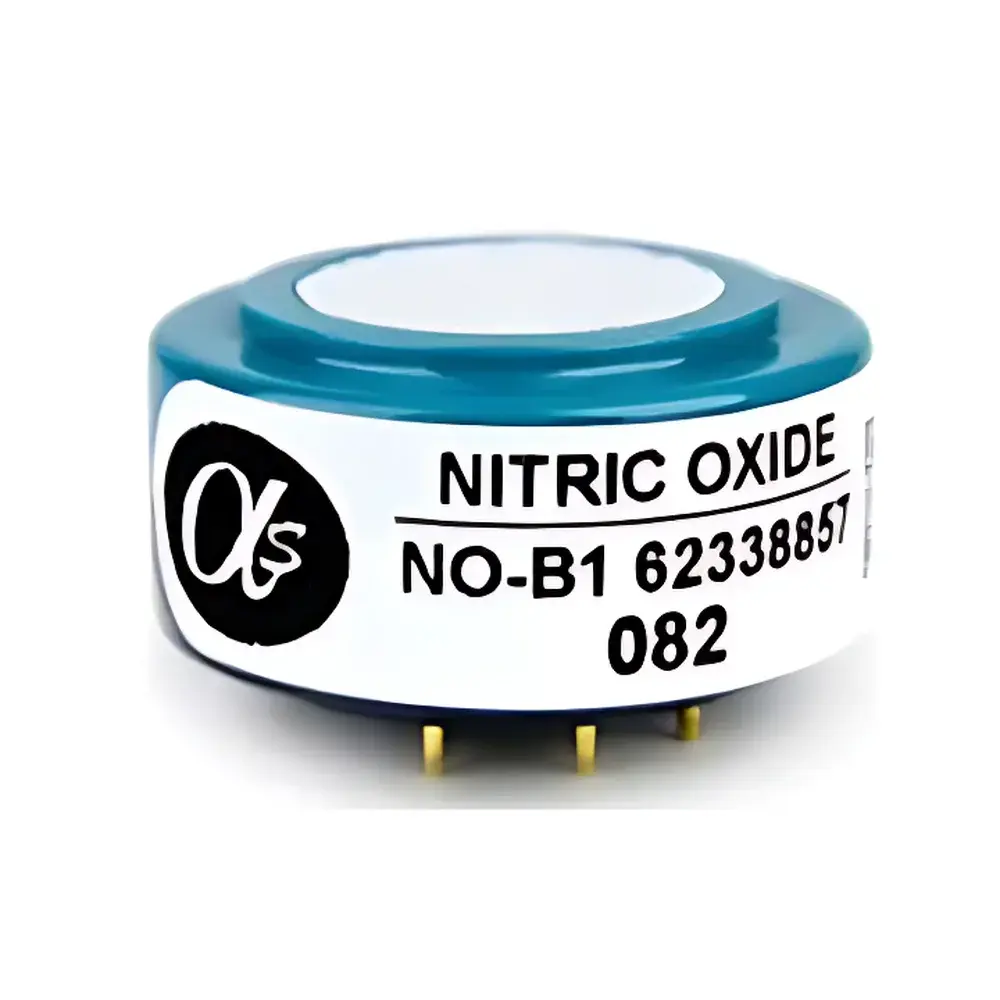
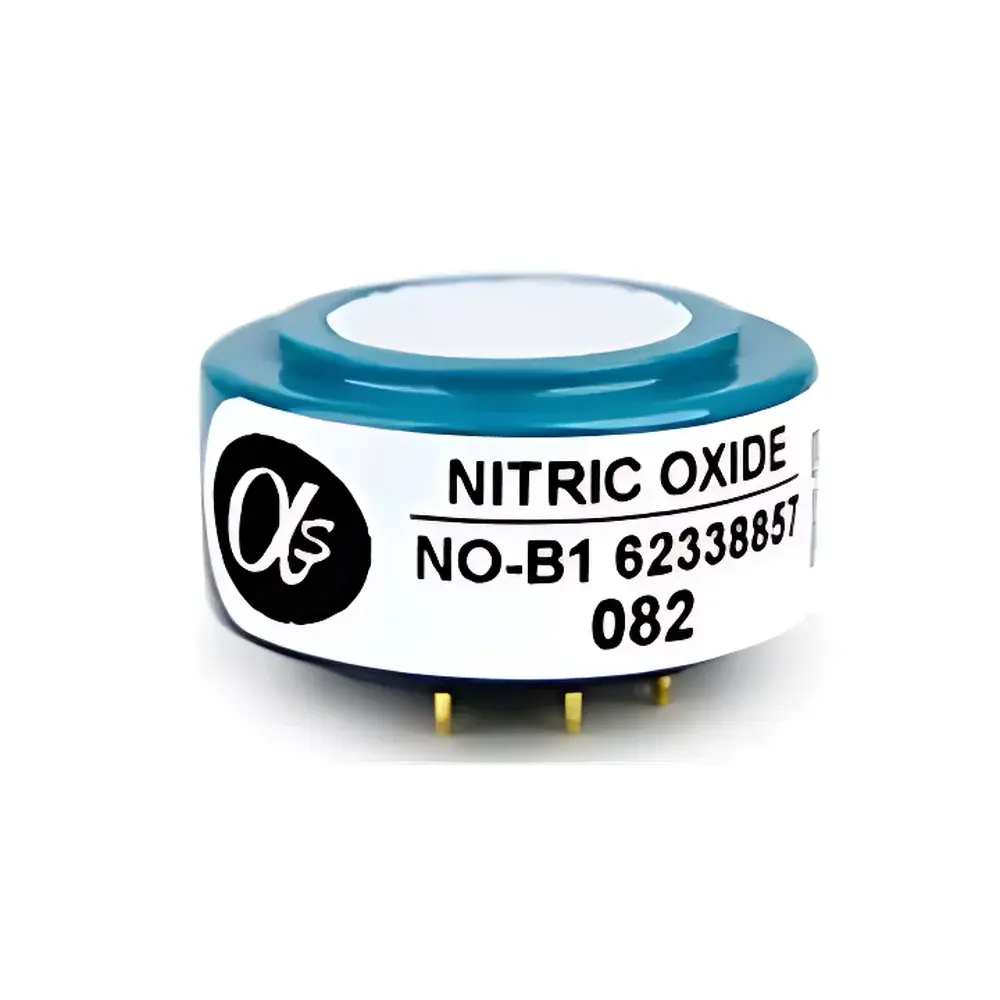
Alphasense NO-B1 Electrochemical Nitric Oxide (NO) Gas Sensor
| Brand | Alphasense (UK) |
|---|---|
| Origin | United Kingdom |
| Model | NO-B1 |
| Measurement Range | 0–250 ppm |
| Sensitivity | 400–620 nA/ppm |
| Response Time (t₉₀) | <30 s |
| Linear Range | –20 to –25 ppm (zero-current baseline offset) |
| Overload Capacity | 1200 ppm |
| Resolution | <0.15 ppm |
| Dimensions | Ø32.3 × 16.5 mm |
| Operating Temperature | –30 to +50 °C |
| Operating Humidity | 15–90 %RH (non-condensing) |
| Load Resistance | 10–47 Ω |
| Expected Service Life | 24 months (typical, under recommended operating conditions) |
| Storage Shelf Life | 6 months (at 20 °C, sealed in original packaging) |
Overview
The Alphasense NO-B1 is a precision-engineered electrochemical gas sensor designed for reliable, low-power detection of nitric oxide (NO) in ambient air and industrial process streams. Based on three-electrode amperometric technology, the sensor operates via controlled potential electrolysis at the working electrode, where NO undergoes oxidation to generate a proportional current signal. This principle ensures high selectivity against common interferents—including CO, SO₂, H₂S, and NO₂—when used with appropriate filter layers and circuit compensation. The NO-B1 is optimized for continuous monitoring applications requiring stable zero baseline, minimal drift, and fast dynamic response—critical attributes for real-time emission compliance tracking and occupational health surveillance.
Key Features
- Three-electrode electrochemical architecture with integrated reference and counter electrodes for enhanced stability and reduced cross-sensitivity
- Factory-calibrated sensitivity range of 400–620 nA/ppm enables accurate quantification across regulatory thresholds (e.g., OSHA PEL = 25 ppm; NIOSH REL = 25 ppm; WHO air quality guideline = 200 µg/m³ ≈ 100 ppb)
- Sub-30-second t₉₀ response time supports rapid transient detection in dynamic environments such as diesel exhaust sampling or fume hood monitoring
- Robust mechanical design (Ø32.3 × 16.5 mm stainless-steel housing with hydrophobic PTFE membrane) ensures long-term performance under variable humidity (15–90 %RH) and wide thermal gradients (–30 to +50 °C)
- Low-power operation compatible with battery-powered data loggers and portable analyzers (typical operating current <100 µA)
- Defined linear range extending to –20 to –25 ppm facilitates accurate zero-point verification and baseline correction during calibration routines
- Rated overload tolerance up to 1200 ppm provides operational safety margin during unexpected exposure events
Sample Compatibility & Compliance
The NO-B1 is validated for use in gaseous matrices containing oxygen (≥10 % v/v), nitrogen, carbon dioxide, and trace hydrocarbons typical of urban air, combustion flue gas, and indoor workplace atmospheres. It is not intended for direct immersion in liquids or exposure to condensate, silicone vapors, or halogenated solvents, which may irreversibly poison the catalyst layer. The sensor complies with IEC 60079-29-1:2016 for performance classification of electrochemical gas detectors and meets essential requirements outlined in EN 45544-1:2019 (electrical safety) and EN 45544-2:2019 (performance testing for toxic gas sensors). When integrated into certified instrumentation, it supports adherence to ISO 16000-23 (indoor air quality), ASTM D6782 (ambient NO measurement), and EU Directive 2008/50/EC (ambient air quality assessment).
Software & Data Management
Raw output from the NO-B1 is a low-level analog current signal (nA), requiring external transimpedance amplification and temperature-compensated linearization. Alphasense provides comprehensive technical documentation—including sensitivity temperature coefficients, humidity correction curves, and aging profiles—for integration into OEM data acquisition systems. When deployed in compliant analytical platforms, the sensor supports audit-ready data integrity through timestamped readings, configurable alarm thresholds, and optional GLP/GMP-compliant firmware logging (e.g., FDA 21 CFR Part 11–enabled instruments with electronic signatures and change history). Calibration records—including span gas concentration, date, operator ID, and post-calibration deviation—can be archived alongside raw sensor output for full traceability.
Applications
- Automotive emissions testing: Real-time NO monitoring in chassis dynamometer exhaust lines and portable emissions measurement systems (PEMS)
- Industrial hygiene: Fixed and personal sampling for occupational exposure limit (OEL) verification in chemical manufacturing, metal heat treatment, and semiconductor fabrication facilities
- Environmental air quality networks: Urban and roadside monitoring stations measuring NO as a key precursor to ground-level ozone and secondary particulate formation
- Indoor air quality (IAQ) management: Integration into HVAC controllers and smart building systems for ventilation optimization based on occupant-generated NO levels
- Research-grade instrumentation: Benchtop gas analyzers, microfluidic lab-on-chip platforms, and atmospheric chemistry simulation chambers
FAQ
What is the recommended calibration frequency for the NO-B1 sensor?
Calibration should be performed before each deployment cycle and after any exposure exceeding 500 ppm or lasting >1 hour. Field recalibration using certified 50 ppm NO in N₂ is advised every 30–90 days depending on environmental severity and required measurement uncertainty.
Can the NO-B1 be used in oxygen-deficient environments?
No. The sensor requires ≥10 % v/v ambient oxygen to sustain the electrochemical reaction at the counter electrode. Operation below this threshold results in unstable baseline and non-linear output.
Does the NO-B1 require a zero-gas purge for baseline stabilization?
Not routinely—its inherent zero-current offset falls within –20 to –25 ppm, enabling electronic zero compensation. However, periodic zeroing with certified zero air (NO < 5 ppb) is recommended for applications demanding sub-ppm accuracy.
How does humidity affect NO-B1 performance?
Relative humidity between 15–90 %RH has negligible impact on sensitivity when the PTFE membrane remains intact. Condensation or prolonged exposure >95 %RH may cause temporary signal attenuation due to electrolyte dilution.
Is the NO-B1 compatible with wireless IoT sensor nodes?
Yes—its low power draw (<100 µA), analog output, and compact form factor make it suitable for integration with LoRaWAN, NB-IoT, or Bluetooth Low Energy (BLE) edge devices, provided appropriate signal conditioning and temperature compensation are implemented.