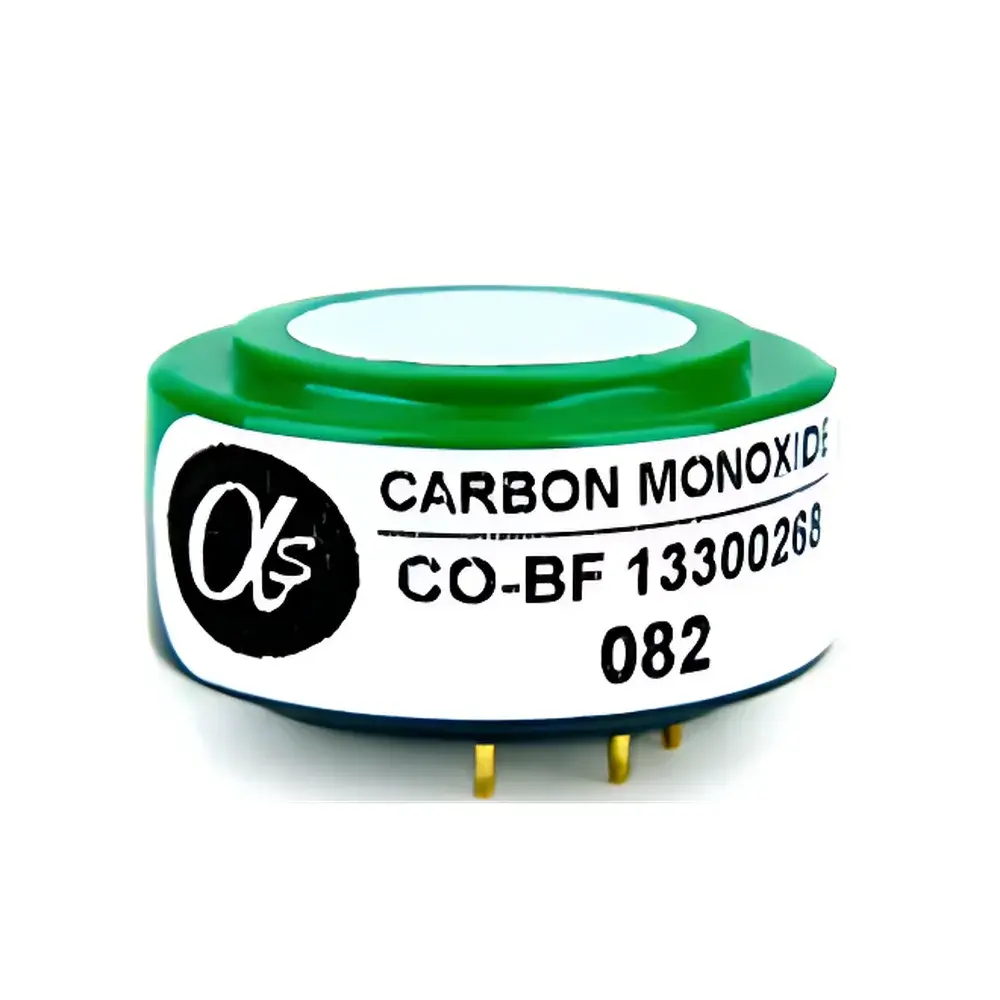
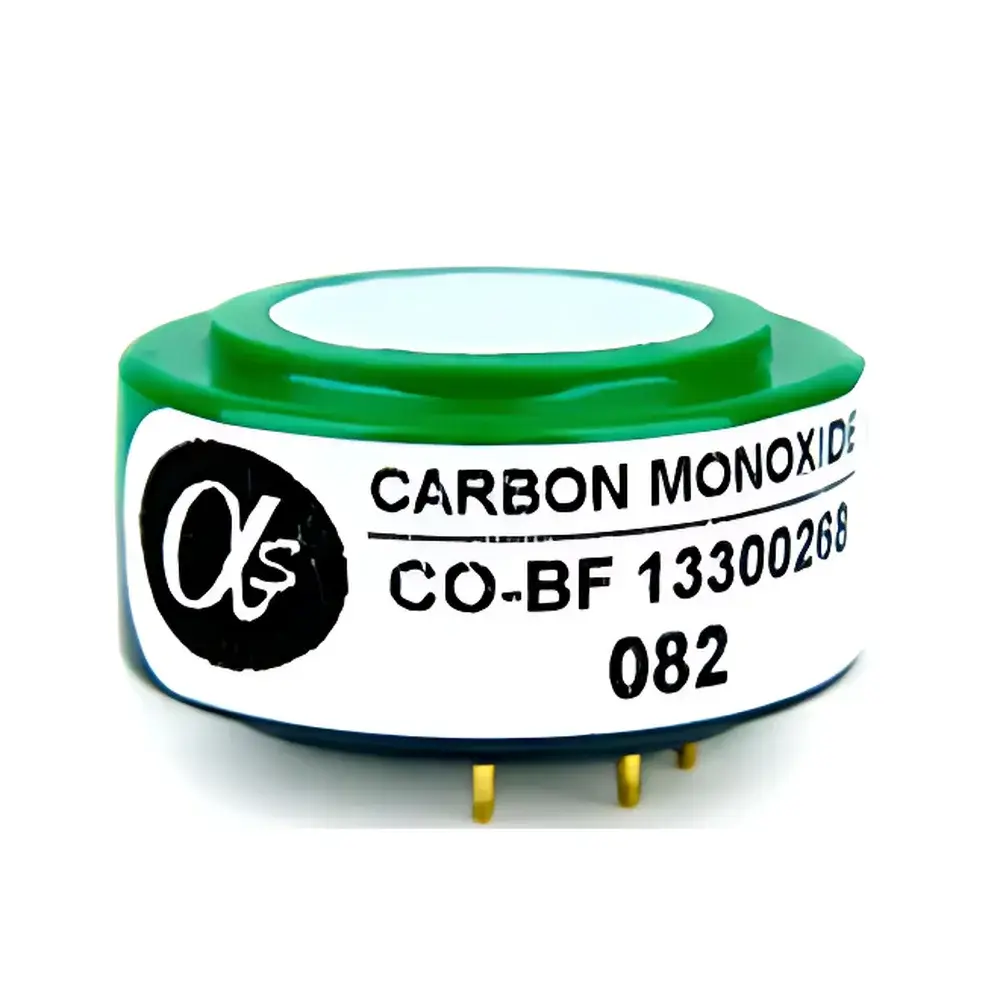
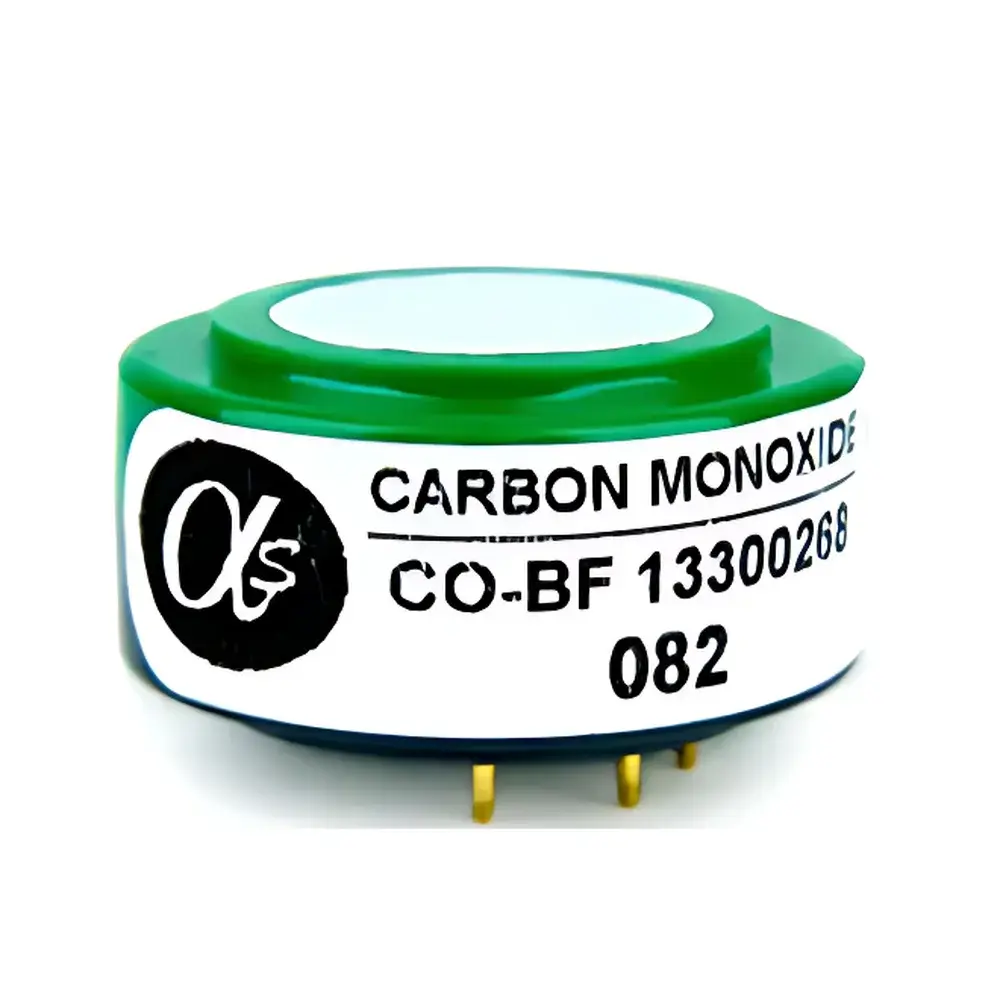
Alphasense CO-BF Compact Electrochemical Carbon Monoxide Sensor with Integrated Hydrophobic Filter
| Brand | Alphasense |
|---|---|
| Origin | United Kingdom |
| Model | CO-BF |
| Measurement Principle | Amperometric Electrochemistry |
| Range | 0–5000 ppm CO |
| Sensitivity | 80–130 nA/ppm |
| Response Time (t₉₀) | <25 s |
| Zero Current | ±30 ppm |
| Overload Capacity | 10,000 ppm |
| Resolution | 0.5 ppm |
| Dimensions | Ø32.3 × 16.5 mm |
| Filter | Integrated hydrophobic PTFE membrane |
| Operating Temperature | −30 to +50 °C |
| Operating Humidity | 15–90 % RH (non-condensing) |
| Load Resistance | 10–47 Ω |
| Expected Operational Life | 24 months |
| Storage Stability | 6 months (unpowered, sealed) |
Overview
The Alphasense CO-BF is a compact, high-stability electrochemical sensor engineered for continuous, low-power detection of carbon monoxide (CO) in ambient air and industrial process environments. Based on three-electrode amperometric electrochemistry, the sensor operates by catalyzing the oxidation of CO at the working electrode in the presence of an aqueous electrolyte, generating a current linearly proportional to gas concentration. Its integrated hydrophobic polytetrafluoroethylene (PTFE) filter provides selective permeability—blocking liquid water, particulates, and high-molecular-weight interferents while enabling rapid diffusion of CO molecules. This architecture ensures robust performance under variable humidity and dusty conditions without requiring external filtration or conditioning hardware. Designed for integration into fixed gas monitoring systems, portable safety instruments, and indoor air quality (IAQ) analyzers, the CO-BF complies with fundamental design principles outlined in IEC 60079-29-1 (explosive atmospheres) and meets functional safety considerations aligned with SIL-2 capable system architectures when deployed within certified host electronics.
Key Features
- Compact cylindrical form factor (Ø32.3 × 16.5 mm) optimized for space-constrained OEM designs
- Integrated hydrophobic PTFE membrane offering >99.9% particulate rejection and condensation resistance up to 90% RH
- Stable baseline output with zero-current drift ≤±30 ppm over 30 days (typical, at 23°C/50% RH)
- Fast electrochemical response: t₉₀ <25 seconds across full 0–5000 ppm range
- High signal-to-noise ratio enabled by low-noise electrode geometry and optimized electrolyte formulation
- Temperature-compensated output compatible with standard analog (current loop) or digital (I²C/UART) interface modules
- Rated operational life of 24 months under continuous operation at 23°C and 50% RH; extended shelf life of 6 months in factory-sealed packaging
Sample Compatibility & Compliance
The CO-BF sensor is calibrated and validated for use in clean, non-corrosive air matrices containing CO as the primary target analyte. It exhibits minimal cross-sensitivity to hydrogen (<3% response at 1000 ppm H₂), nitrogen dioxide (<2% at 1 ppm NO₂), and sulfur dioxide (<1% at 1 ppm SO₂), making it suitable for urban air monitoring and occupational hygiene applications where such interferents are present at sub-ppm levels. The device conforms to RoHS 2011/65/EU and REACH SVHC compliance requirements. While the sensor itself is not CE-marked as a standalone product, it is widely integrated into CE- and UKCA-certified gas detection systems meeting EN 45544-1 (workplace exposure monitoring) and EN 50194-1 (residential CO alarms). For regulatory deployments in pharmaceutical cleanrooms or HVAC control, users must validate sensor performance per ISO 16000-23 (indoor air—CO measurement) and ensure traceable calibration against NIST-traceable standards.
Software & Data Management
As a transducer-level component, the CO-BF does not include embedded firmware or onboard data logging. Its analog current output (typically 0–200 nA per ppm) is conditioned and digitized by host instrumentation. When integrated into systems supporting FDA 21 CFR Part 11 compliance—such as environmental monitoring platforms used in GMP manufacturing—the sensor’s raw output must be captured with audit-trail-enabled acquisition software. Alphasense provides detailed calibration protocols, temperature compensation coefficients, and long-term stability datasets to support IQ/OQ/PQ validation documentation. Host systems utilizing the CO-BF are expected to implement linearization algorithms based on manufacturer-supplied sensitivity curves and apply humidity correction factors derived from co-located RH sensors.
Applications
- Fixed-site ambient air quality monitoring networks (e.g., EPA reference method adjuncts)
- OEM integration into portable personal safety monitors for fire service and confined-space entry
- Indoor air quality (IAQ) controllers in commercial HVAC systems
- Process gas stream monitoring in combustion optimization and flue gas analysis
- Automotive cabin air quality feedback loops and battery thermal management systems
- Research-grade exposure chambers requiring stable, low-drift CO quantification
FAQ
What is the recommended calibration frequency for the CO-BF sensor?
For critical safety applications, bump testing is advised before each use; full two-point calibration (zero and span) is recommended every 30–90 days depending on operating environment and regulatory requirements.
Can the CO-BF operate continuously at 90% RH?
Yes—its integrated hydrophobic filter maintains diffusion-limited response stability up to 90% RH non-condensing; prolonged exposure to condensing humidity may degrade long-term baseline stability.
Is the CO-BF compatible with 3.3 V microcontroller ADC inputs?
Direct connection requires a precision transimpedance amplifier; Alphasense recommends using their AS-MP series interface modules or equivalent low-bias-current op-amp circuits for optimal signal integrity.
Does the sensor require a warm-up period before stable readings?
A 24-hour stabilization period is recommended after initial power-on or long-term storage to achieve specified sensitivity and zero-current specifications.
How should expired CO-BF units be disposed of?
Units contain small quantities of lead and potassium hydroxide electrolyte; disposal must follow local hazardous waste regulations and WEEE Directive guidelines for electronic components.