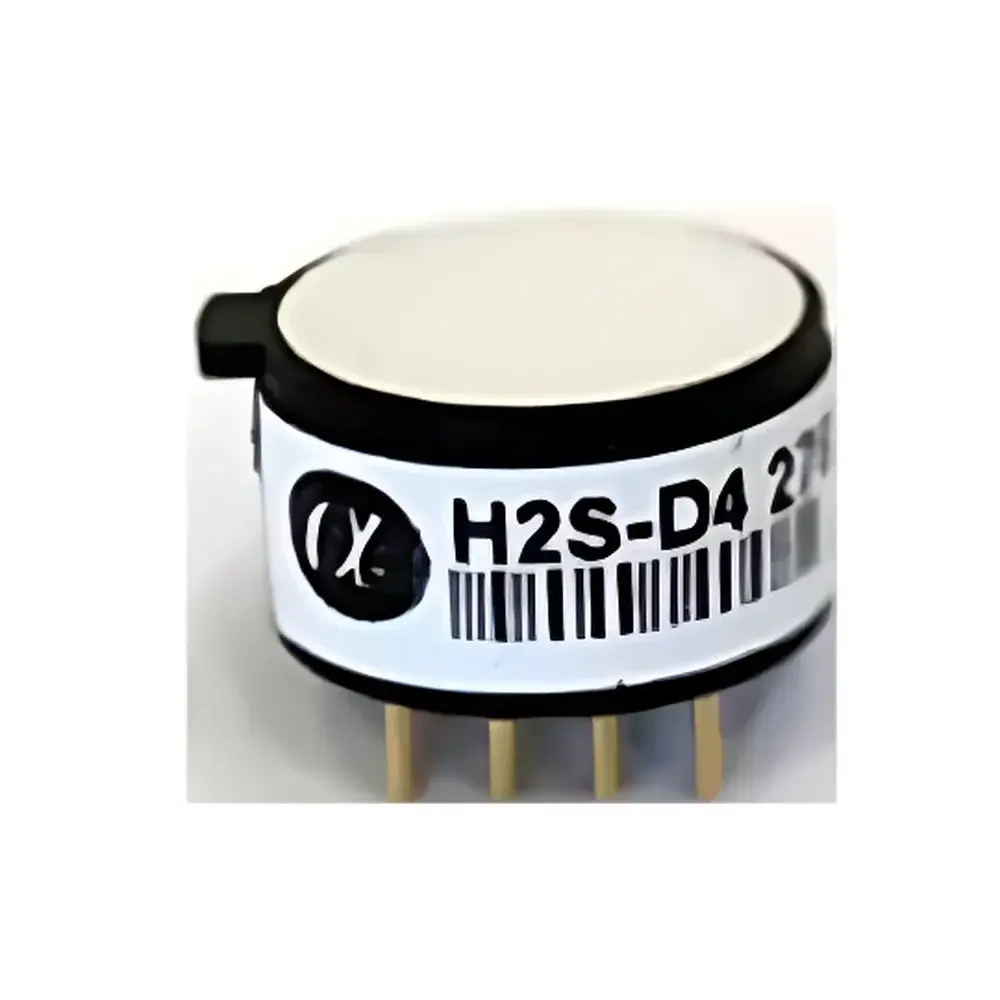
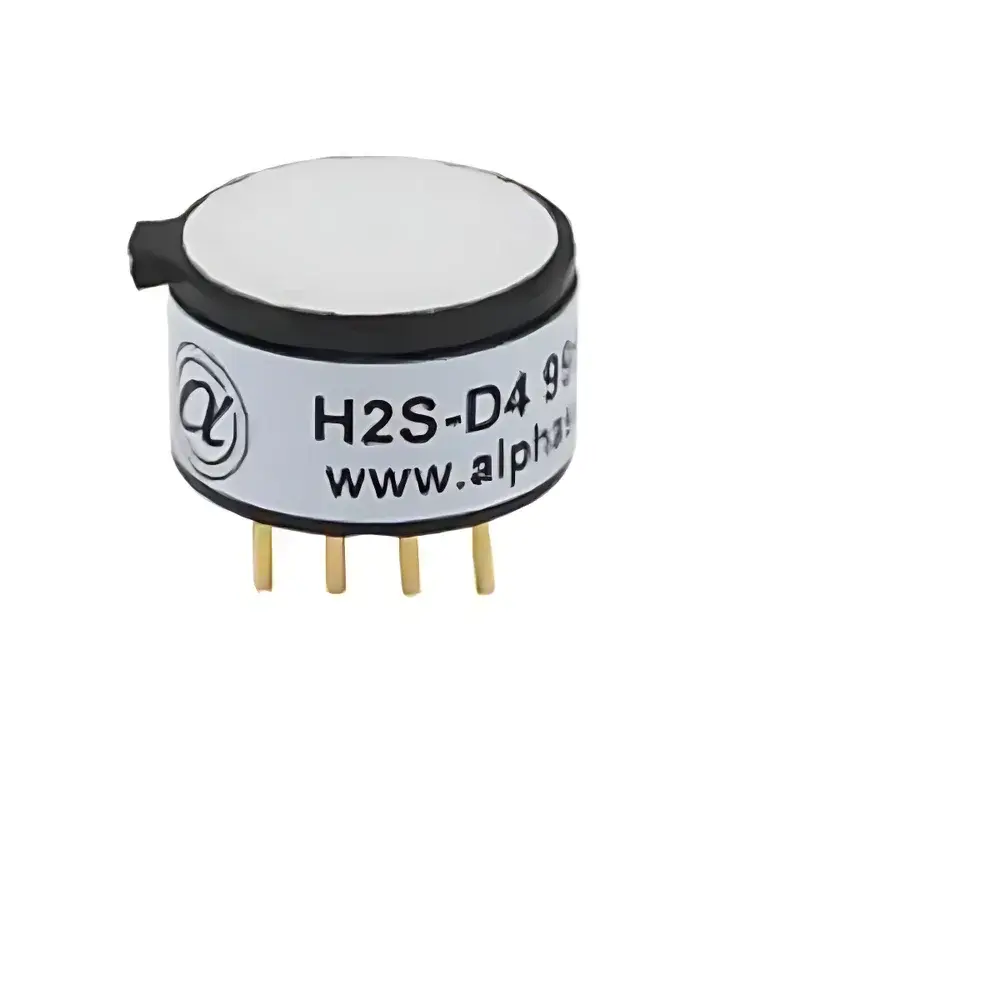
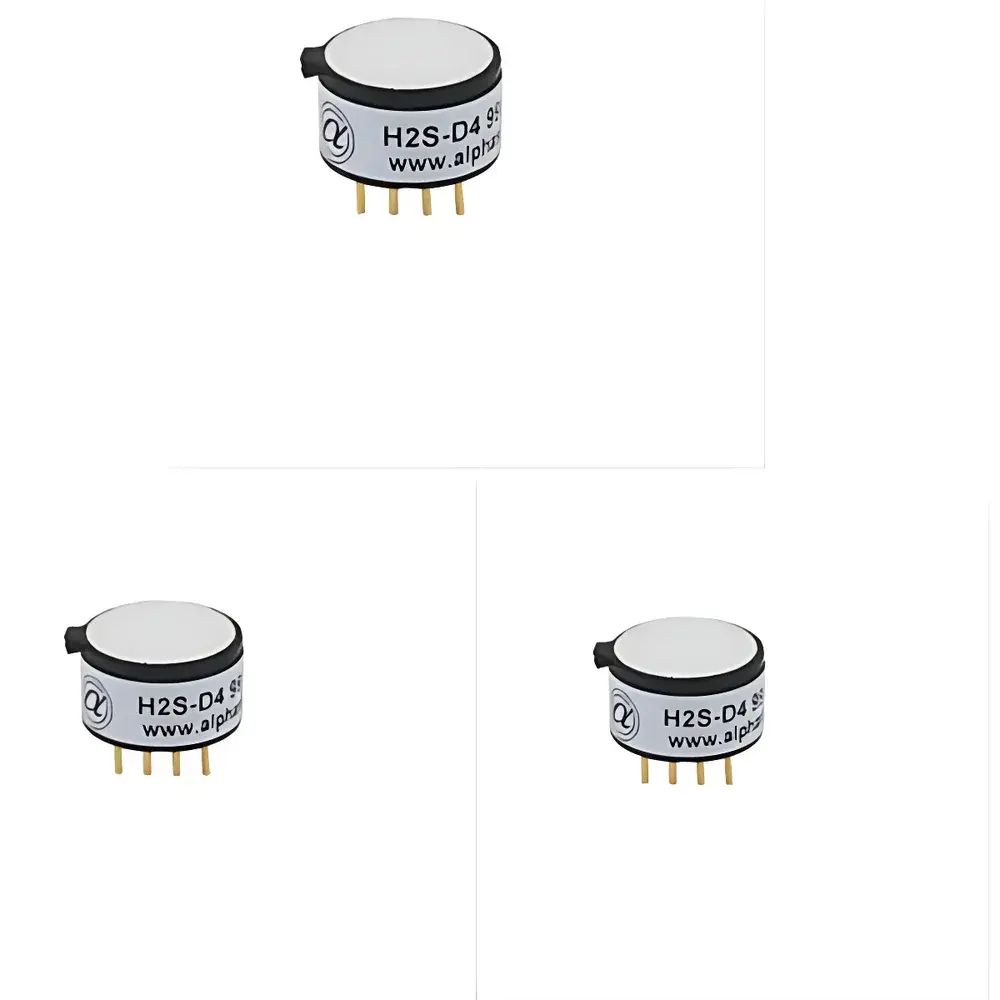
Alphasense H2S-D4 Miniature Electrochemical Hydrogen Sulfide Sensor
| Brand | Alphasense (UK) |
|---|---|
| Origin | United Kingdom |
| Model | H2S-D4 (Miniature) |
| Measurement Range | 0–100 ppm |
| Sensitivity | 110–170 nA/ppm |
| Response Time (t₉₀) | <25 s |
| Linear Range | 0–20 ppm (±6 ppm full-scale linearity error) |
| Overload Capacity | 200 ppm |
| Resolution | <0.2 ppm |
| Dimensions | Ø14.5 × 8.3 mm |
| Operating Temperature | −30 to +50 °C |
| Operating Humidity | 15–90 %RH (non-condensing) |
| Load Resistance | 10–47 Ω |
| Expected Service Life | 24 months |
| Storage Life (unmounted, sealed) | 6 months |
| Sensor Type | Three-electrode electrochemical cell |
Overview
The Alphasense H2S-D4 is a miniature, three-electrode electrochemical sensor engineered for the selective and stable detection of hydrogen sulfide (H₂S) in ambient air and industrial process streams. Based on amperometric transduction, the sensor operates via diffusion-controlled oxidation of H₂S at the working electrode, generating a current proportional to gas concentration. Its compact cylindrical form factor (Ø14.5 × 8.3 mm) enables integration into portable gas detectors, fixed-point monitoring systems, and low-power IoT-enabled environmental nodes. Designed and manufactured in the UK under ISO 9001-certified production controls, the H2S-D4 complies with IEC 60079-29-1 for use in potentially explosive atmospheres when incorporated into appropriately certified host instrumentation. It delivers high reproducibility across temperature and humidity gradients—validated per Alphasense’s internal QA protocol aligned with ASTM D5403 and EN 45544-1 requirements for electrochemical toxic gas sensors.
Key Features
- Miniaturized footprint: Optimized for space-constrained PCB layouts and battery-powered devices without compromising signal integrity or long-term baseline stability.
- Two-year operational lifetime: Achieved through proprietary electrode catalyst formulation and electrolyte retention technology; validated under continuous operation at 23 °C / 50 %RH.
- No external filter required: Integrated hydrophobic membrane eliminates need for user-replaceable particulate or chemical filters, reducing maintenance intervals and total cost of ownership.
- Low-power compatibility: Operates at ≤100 µA quiescent current; compatible with 3.3 V and 5 V analog signal chains and low-duty-cycle digital sampling architectures.
- Robust environmental tolerance: Specified performance maintained across −30 to +50 °C operating range and 15–90 %RH (non-condensing), with minimal zero drift (<2 ppm/°C) and span drift (<3 %/month).
- Trace-level resolution: Sub-0.2 ppm resolution supports compliance monitoring against occupational exposure limits (e.g., OSHA PEL = 20 ppm TWA, ACGIH TLV = 1 ppm STEL).
Sample Compatibility & Compliance
The H2S-D4 is intended for use in clean, non-corrosive air matrices. Cross-sensitivity to common interferents has been characterized per EN 45544-2: CO (−2 % response), SO₂ (+4 %), NO₂ (+1.5 %), Cl₂ (+8 %); no significant response to CH₄, CO₂, or VOCs below 100 ppm. The sensor meets RoHS Directive 2011/65/EU and REACH Annex XVII requirements. When integrated into final equipment, it supports compliance with IEC 61000-6-3 (EMC emissions), IEC 61000-6-2 (immunity), and UL 2075 (gas detector components). Full traceability documentation—including calibration certificate, material declaration, and manufacturing lot data—is provided with each shipment.
Software & Data Management
The H2S-D4 outputs a linear analog current signal (nA) directly proportional to H₂S concentration. For system-level integration, Alphasense provides open-format technical notes (TN-H2S-D4 Rev. 4.2) detailing recommended conditioning circuits, temperature compensation algorithms (polynomial coefficients included), and ADC configuration guidelines. While the sensor itself contains no embedded firmware, its analog interface ensures seamless compatibility with industry-standard data acquisition platforms—including those supporting Modbus RTU, CANopen, or MQTT-based telemetry. When deployed in regulated environments (e.g., wastewater treatment plants under EPA 40 CFR Part 60), users may implement audit-trail-capable logging via host controllers compliant with FDA 21 CFR Part 11 requirements for electronic records.
Applications
- Fixed-site H₂S monitoring in biogas upgrading facilities and sewage treatment plants
- Personal safety instruments for oil & gas field technicians and refinery maintenance personnel
- Indoor air quality (IAQ) networks in agricultural confinement buildings and composting operations
- Environmental emission monitoring at landfills and anaerobic digesters
- OEM integration into multi-gas detectors (e.g., 4-gas LEL/O₂/H₂S/CO configurations)
- Academic research platforms requiring stable, low-drift electrochemical sensing elements
FAQ
What is the recommended load resistance for optimal linearity?
A load resistance between 10 Ω and 47 Ω is specified to maintain output linearity within ±6 ppm over the 0–20 ppm range. Lower values improve signal-to-noise ratio; higher values increase voltage swing but may compromise accuracy at low concentrations.
Can the H2S-D4 be operated continuously at 100 ppm?
Yes—it is rated for continuous exposure up to 100 ppm and short-term overload up to 200 ppm for ≤10 minutes without permanent performance degradation, provided ambient conditions remain within specification.
Is factory calibration provided with each unit?
Each sensor ships with a NIST-traceable calibration report (2-point: zero air and 25 ppm H₂S), valid upon receipt. Users are advised to perform functional verification before first use and periodic bump testing per OSHA 1910.120(q)(4)(iii).
How should unused sensors be stored?
Uninstalled units must be kept in original sealed packaging at 20–25 °C and <60 %RH; maximum shelf life is six months from date of manufacture. Do not store in refrigerated or frozen environments.
Does the sensor require a warm-up period?
Stabilization time is <60 seconds after power application under standard conditions; however, full thermal equilibrium (for temperature-compensated measurements) is achieved within 5 minutes of ambient exposure.