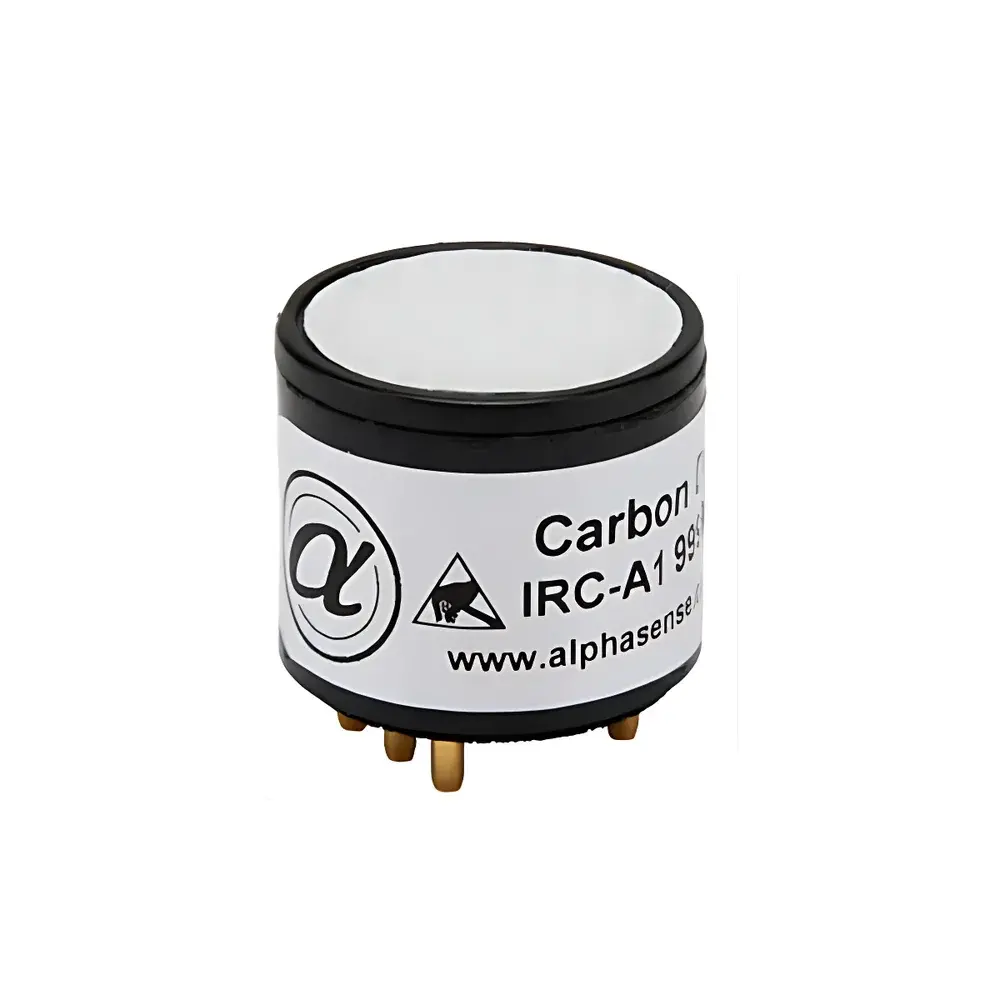
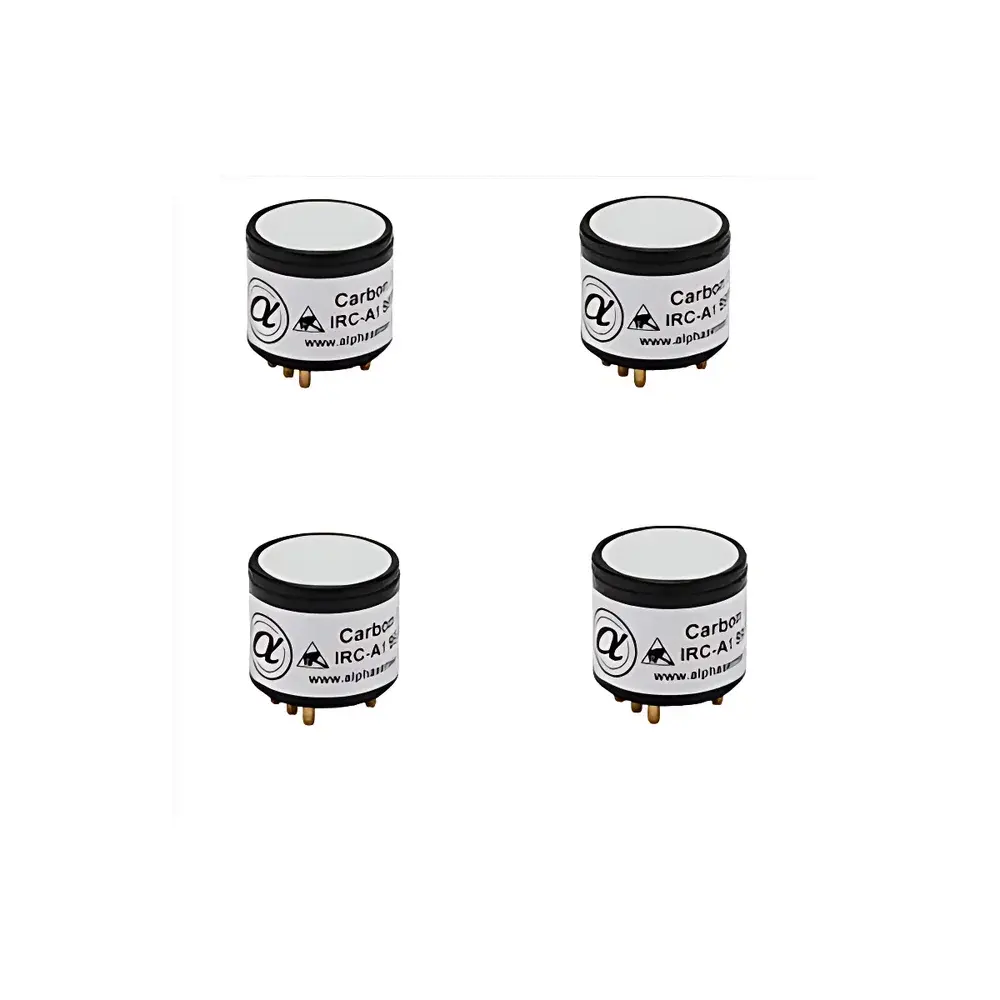
Alphasense IRC-A1 NDIR Carbon Dioxide (CO₂) Sensor
| Brand | Alphasense |
|---|---|
| Origin | UK |
| Model | IRC-A1 |
| Measurement Principle | Non-Dispersive Infrared (NDIR) |
| Range Options | 0–5000 ppm, 0–5% vol, 0–20% vol, 0–100% vol |
| Resolution | 15 ppm, 100 ppm, 500 ppm, or 0.5% vol (dependent on range) |
| Accuracy | ±1% FS, ±1.5% FS, ±2.5% FS, or ±4% FS (dependent on range) |
| Response Time (t₉₀) | <40 s |
| Operating Temperature | −20 °C to +55 °C |
| Expected Service Life | >5 years |
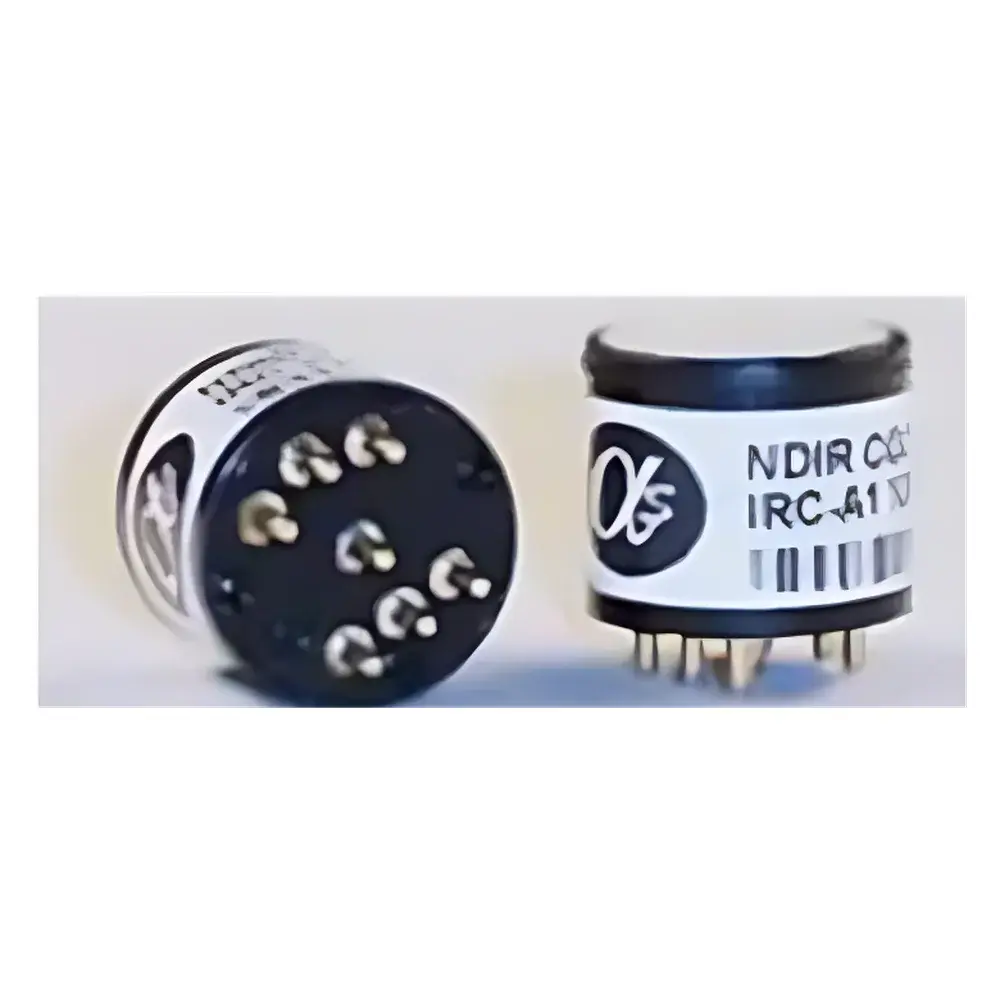
| Dimensions | Ø20.0 × 16.5 mm |
Overview
The Alphasense IRC-A1 is a compact, high-stability non-dispersive infrared (NDIR) carbon dioxide (CO₂) sensor engineered for continuous, low-power gas concentration monitoring in demanding industrial, environmental, and indoor air quality (IAQ) applications. Based on the fundamental absorption characteristics of CO₂ molecules at 4.26 µm wavelength, the IRC-A1 employs a dual-beam optical architecture with integrated reference and measurement channels. This design enables real-time compensation for optical drift, source aging, and minor contamination—key contributors to zero-point instability in conventional single-beam NDIR sensors. Unlike electrochemical or metal-oxide semiconductor (MOS) alternatives, the IRC-A1 exhibits no cross-sensitivity to humidity, temperature fluctuations (within specified operating range), or common interferents such as CO, CH₄, NO₂, or VOCs. Its solid-state construction—featuring a micro-machined IR source, thermopile detector, and hermetically sealed optical cavity—ensures mechanical robustness and long-term calibration stability without consumable components.
Key Features
- Dual-channel NDIR architecture with built-in reference path for active zero-drift suppression
- Multiple configurable measurement ranges: 0–5000 ppm (for IAQ and HVAC), 0–5% vol (fermentation & controlled atmosphere storage), 0–20% vol (combustion safety), and 0–100% vol (industrial process control)
- Typical resolution of 15 ppm at the 0–5000 ppm range; scalable resolution optimized per selected full-scale span
- Accuracy specified as ±1% FS (0–5000 ppm), ±1.5% FS (0–5% vol), ±2.5% FS (0–20% vol), and ±4% FS (0–100% vol), traceable to NIST-certified calibration standards
- t₉₀ response time <40 seconds across all ranges, validated per ISO 12039 and EN 14625 protocols
- Operating temperature range of −20 °C to +55 °C, with internal temperature compensation enabling consistent performance across ambient variations
- Compact cylindrical form factor (Ø20.0 × 16.5 mm) compatible with OEM integration into portable analyzers, fixed gas detection systems, and smart building controllers
- Design life exceeding 5 years under continuous operation, supported by Alphasense’s accelerated lifetime testing protocol (IEC 60068-2-64 compliant)
Sample Compatibility & Compliance
The IRC-A1 is intended for use with clean, dry, non-corrosive gas streams. While it tolerates typical indoor and industrial atmospheres, prolonged exposure to condensing humidity (>95% RH), aerosols, silicone vapors, or acidic gases (e.g., SO₂, HCl) may degrade optical window transmission and require protective filtration (e.g., hydrophobic PTFE membrane). The sensor complies with RoHS 2011/65/EU and REACH (EC) No. 1907/2006 directives. It is designed to support system-level conformity with IEC 61000-6-3 (EMC emission) and IEC 61000-6-2 (immunity), and its signal output (analog 0–2 V or digital UART/I²C variants) facilitates integration into safety-rated systems meeting SIL 2 (per IEC 61508) when deployed within certified host instrumentation. Calibration intervals are typically 6–12 months depending on application severity, aligning with ISO 4037-3 recommendations for field-deployed gas sensing modules.
Software & Data Management
The IRC-A1 operates as a smart analog/digital transducer and does not include embedded firmware or onboard data logging. However, its linear output (0–2 V proportional to CO₂ concentration) or optional digital interface (UART or I²C with ASCII or binary command set) allows seamless integration with host microcontrollers, PLCs, or data acquisition systems. Alphasense provides comprehensive technical documentation—including pinout schematics, calibration certificates, temperature compensation coefficients, and example Arduino/Python drivers—to accelerate system validation. When integrated into regulated environments (e.g., pharmaceutical cleanrooms or food processing lines), the sensor supports audit-ready calibration records and can be paired with host software implementing FDA 21 CFR Part 11-compliant electronic signatures and audit trails for calibration events and alarm logs.
Applications
- Indoor Air Quality (IAQ) monitoring in offices, schools, and hospitals per ASHRAE Standard 62.1 and EN 13779
- HVAC demand-controlled ventilation (DCV) systems for energy-efficient building management
- Fermentation and modified-atmosphere packaging (MAP) process control in beverage and food manufacturing
- Occupancy detection and breath analysis in smart home and healthcare wearables
- Leak detection and safety monitoring in laboratories, greenhouses, and biogas facilities
- OEM integration into portable multi-gas detectors (e.g., for confined space entry compliance with OSHA 1910.146)
FAQ
Does the IRC-A1 require periodic zero or span calibration?
Yes—though its dual-channel design significantly extends calibration intervals, initial factory calibration is traceable to NIST standards, and field recalibration using certified CO₂ gas (e.g., 1000 ppm in N₂) is recommended every 6–12 months depending on operational conditions.
Can the IRC-A1 operate in high-humidity environments?
It is rated for up to 95% RH non-condensing. For sustained high-humidity applications, integration with a sintered stainless-steel hydrophobic filter (e.g., Swagelok SS-4F-HP) is advised to prevent water film formation on the optical window.
Is the IRC-A1 suitable for use in explosion-hazardous areas?
No—the IRC-A1 itself is not intrinsically safe or ATEX/IECEx certified. It must be installed within an appropriately rated enclosure or used in conjunction with a safety barrier when deployed in Zone 1 or Zone 2 hazardous locations.
What is the recommended warm-up time before stable readings?
The sensor achieves thermal equilibrium and stable output within 60 seconds of power-on at room temperature; full specification performance is guaranteed after 2 minutes.
How is long-term drift characterized and verified?
Alphasense subjects production units to 1000-hour accelerated aging tests at 40 °C/85% RH, with drift measured against primary standard gas. Typical zero drift is <±20 ppm/year; span drift is <±2% of reading/year under normal operating conditions.